Democracy, Backsliding and the Need for a Weekly Radar
Introduction
In March 2026, the V‑Dem Institute published its tenth global Democracy Report: Unraveling the Democratic Era?
For the “average global citizen”, they conclude, the level of democracy is now back to where it stood in 1978. The gains of the so‑called “third wave of democratisation”, which began with Portugal’s Carnation Revolution in 1974, have been “almost entirely eradicated”.
The numbers are startling. At the end of 2025, the world has 92 autocracies and 87 democracies. Roughly 74% of the world’s population – about six billion people – now live in autocracies, and more people live in closed autocracies than in all electoral and liberal democracies combined. Only 7% of the world’s population – around 600 million people – live in liberal democracies at all.
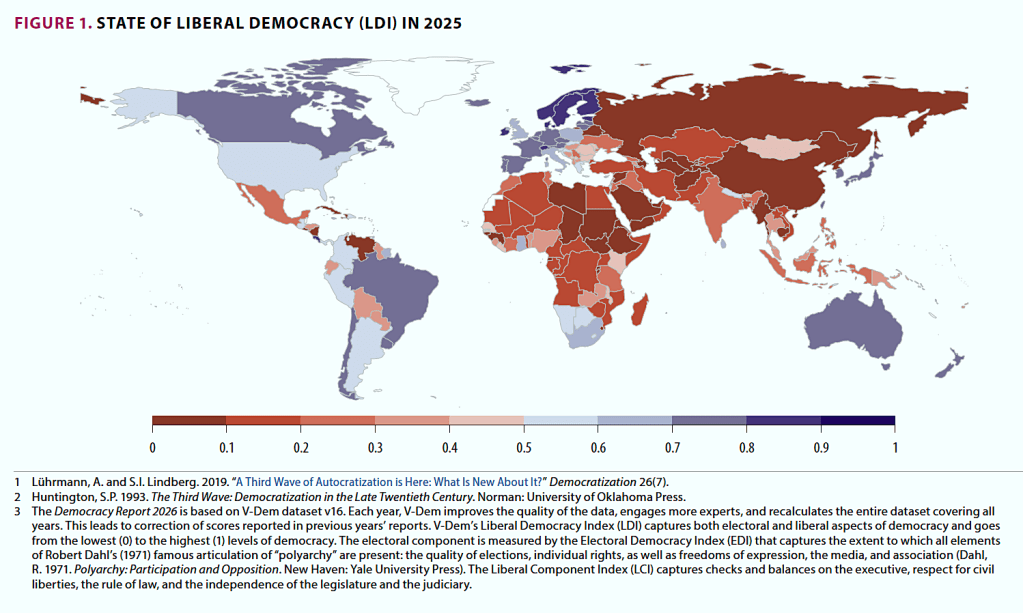
“The Liberal Component Index (LCI) captures checks and balances on the executive, respect for civil liberties, the rule of law, and the independence of the legislature and the judiciary. . Democracy is most widespread in Western Europe and North America, as well as in parts of East Asia and the Pacific, Eastern Europe, and Latin America. Lower levels of democracy are more common in the Middle East and North Africa, South and Central Asia, and Sub-Saharan Africa. The countries with the highest LDI scores in 2025 – Denmark, Sweden, and Norway – are in Northern Europe. The ones at the lowest echelon are spread across East Asia (China, Myanmar, and North Korea), Eastern Europe (Belarus), the Gulf region (Saudi Arabia), Latin America (Nicaragua and Venezuela), South and Central Asia (Afghanistan and Turkmenistan), and Sub-Saharan Africa (Eritrea and Sudan).“
For anyone who has spent the last decade being told that the trouble with democracy were being exaggerated, or that the institutions will hold, this should be a wake‑up call. The centre of gravity of human political experience has shifted decisively towards authoritarian rule. The question is no longer whether the democratic era is in trouble, but how far the unraveling has progressed and how quickly.
V‑Dem’s data are uniquely well suited to answering the first question. Annual indices tell us where we are in great detail but more regular monitoring is also useful to stimulate immediate action.
That is the gap the new weekly World Democracy Monitor is intended to fill.
Table of Contents
The Clock Has Turned Back – The Third Wave of Autocratization
It is tempting to treat the last decade of democratic backsliding as a temporary aberration, a kind of political long‑Covid that will eventually clear. V‑Dem’s longitudinal data suggest something more serious: a structural reversal.
Over the last twenty years, we have moved into what its authors call a “third wave of autocratization”. On almost every dimension of democracy they track, more countries are deteriorating than improving. In 2000, at the dawn of this wave, that balance was reversed. Today:
- 44 countries are autocratizing (either stand‑alone cases or “bell‑turns”), the highest number ever recorded.
- Only 18 countries are democratizing – and just three of those were “new democratizers” identified in 2025.
- 41% of the world’s population now lives in autocratizing countries, not simply in static autocracies.
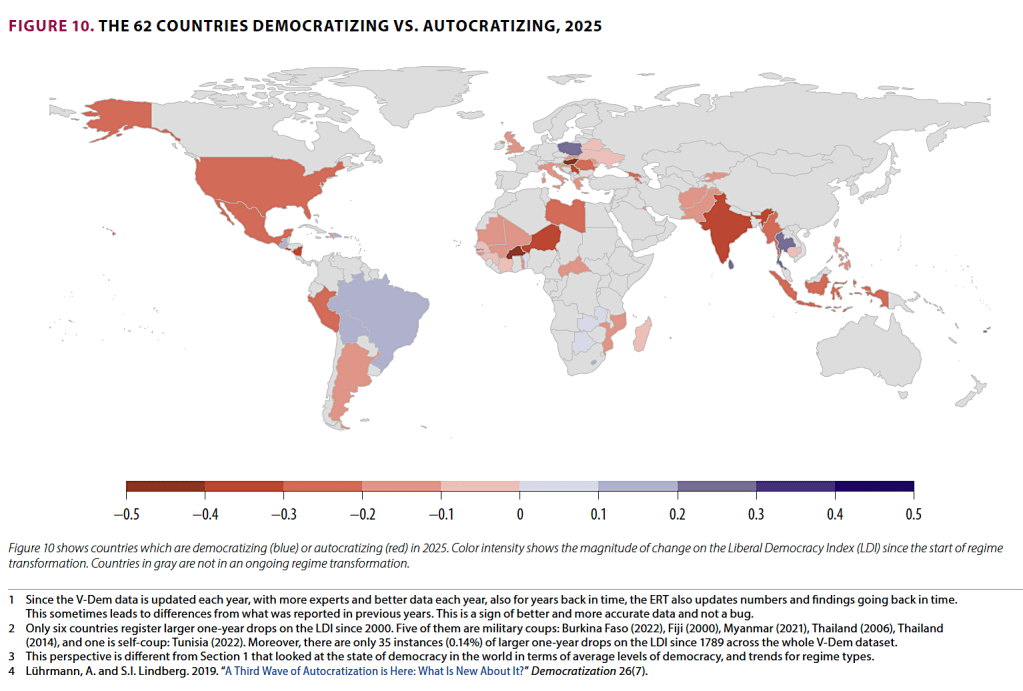
Europe alone now includes seven autocratizing EU member states, plus the UK. The report bluntly notes that the level of democracy in Western Europe and North America, for the average citizen, has fallen to its lowest point in more than fifty years, driven in large part by what they describe as a “rapid and aggressive concentration of powers in the presidency” of the United States.
For those of us working on European strategy, law and hybrid threats, this matters for three reasons.
- First, the wave is structurally global. It runs through India, Indonesia and the Philippines in Asia; across the Sahel and Central Africa; through Latin America’s largest economies; and now squarely through the Atlantic “core” itself. There is no safe periphery left whose stability can be taken for granted.
- Second, the population‑weighted collapse is more important than country counts. When India, China, Indonesia and the United States all either are autocracies or are undergoing sharp autocratization, the average citizen’s experience is dominated by decline, even if small states are improving at the margin.
- Third, the tactics of this wave differ in important ways from mid‑twentieth‑century authoritarianism. That has consequences for how we should monitor and respond to it.
How Democracies Die Now
A common error is to imagine democratic breakdown as a sudden, cinematic event: tanks in a parliament square, a military takeover or the constitution amended. V‑Dem’s breakdown of which indicators are actually moving tells a different story.
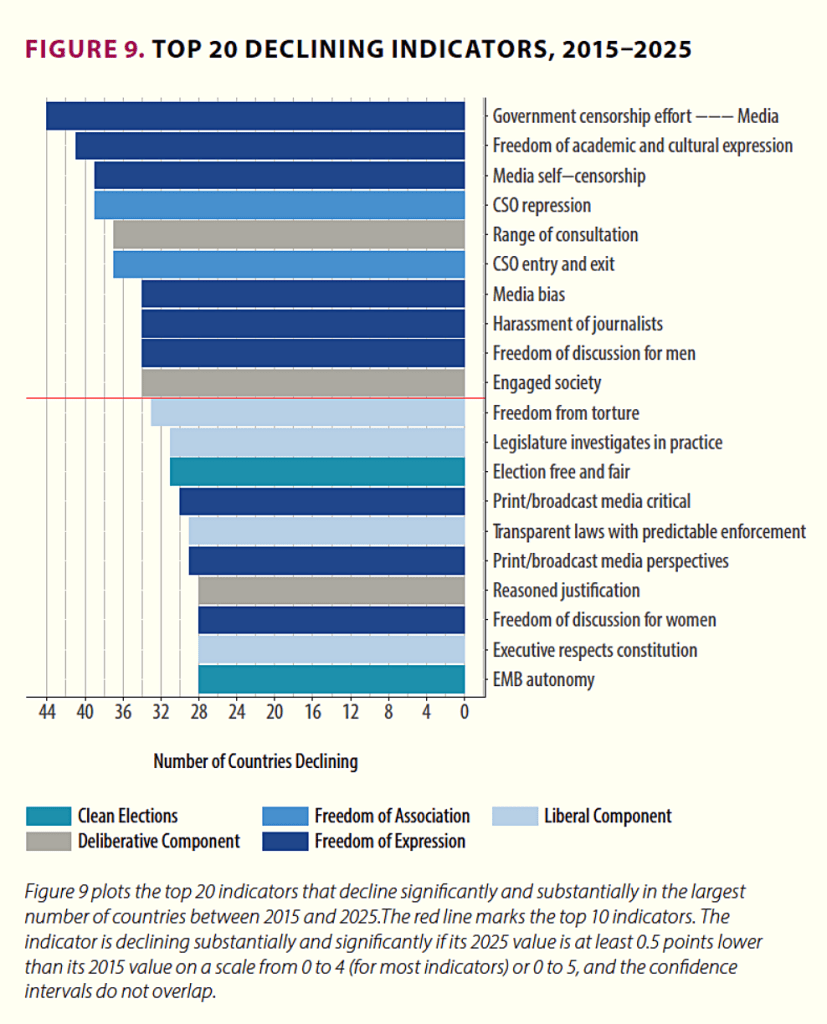
Compared to 2000, almost all aspects of democracy are now more likely to be declining than improving. The steepest reversals are not in the formal holding of elections, but in the surrounding ecosystem of rights, media and civic space. Over the past decade:
- Freedom of expression has deteriorated in 44 countries, while improving in only 11. In 2000, 52 countries were improving on this metric and just five were declining.
- Freedom of association and civil society has moved from improving in 54 countries and declining in two (in 2000) to worsening in 24 and improving in five.
- The Clean Elections Index, which captures the integrity of electoral processes, has flipped from improving in 43 countries to deteriorating in 22.
- Among autocratizing states, the most common tactic remains media censorship, used in more than 70% of cases, closely followed by repression of civil society and attacks on academic freedom.
The picture that emerges is the one that many journalists, activists and lawyers have been describing for years. Elections often still happen. But the level playing field that makes an election meaningful is being dismantled in slow motion:
- Independent media are bought up and consolidated into friendly foundations, or harassed until they self‑censor.
- “Foreign agent” and “fake news” laws are used to bleed NGOs and independent outlets dry with compliance costs and legal risk.
- Judicial appointments are quietly re‑engineered to favour loyalists.
- Protest is first corralled, then criminalised, then redefined as terrorism.
- The tax office and competition authority learn to bark on command.
These are legally deniable moves. Each can be defended in isolation as a technical reform, an anti‑corruption measure, or an overdue “modernisation” of an outdated institution. Taken together, they amount to a slow‑motion coup performed with lawyers and wealthy backers rather than tanks.
An annual index can capture the net effect of these moves as a score but it cannot easily show the sequence of steps that produced it, or tell you which stage a particular country has reached this week.
The Transatlantic Blind Spot, Quantified
One of the most striking sections of the 2026 V‑Dem report is its focus on the United States. Under Trump’s second term, they record what they describe as “the most dramatic decline in American history” on their Liberal Democracy Index. Within a single year:
- US democracy falls back to its 1965 level on the LDI, but in a context radically different to the civil‑rights era.
- Legislative constraints on the executive lose one-third of their value, plunging to their lowest point in over a century.
- Civil rights, equality before the law and freedom of expression/media all reach their lowest levels in sixty years.
- The core electoral components remain relatively stable “for now”.
This is the transatlantic blind spot in quantitative form. A great deal of European thinking about foreign interference, hybrid threats and lawfare still proceeds as if “Western” and “democratic” were stable, self‑reinforcing categories, and as if “the problem” were something other states do to us from outside. V‑Dem’s data record something different: the most dramatic democratic decline of the decade is happening inside the system’s supposed anchor state.
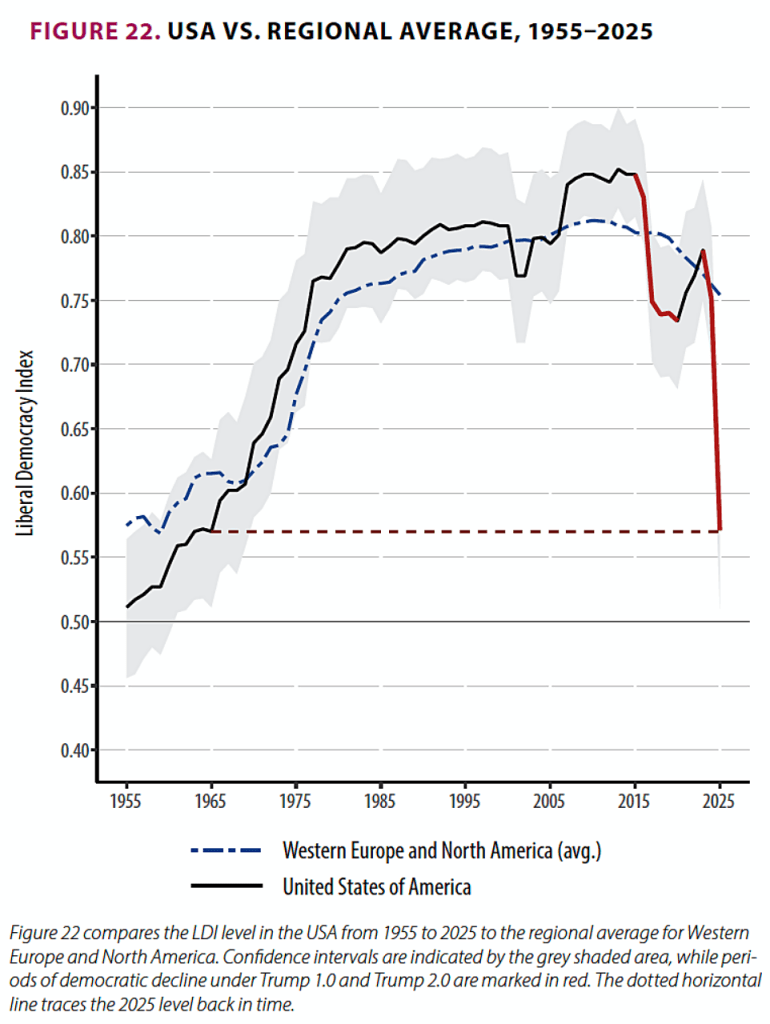
Under Trump’s presidency, the level of democracy in the USA has fallen back to the same level as in 1965. Yet the situation is fundamentally different than during the Civil Rights era. In 2025, the derailment of democracy is marked by executive overreach undermining the rule of law, along with far-reaching suppression and intimidation of media and dissenting voices. The speed with which American democracy is currently dismantled is unprecedented in modern history.
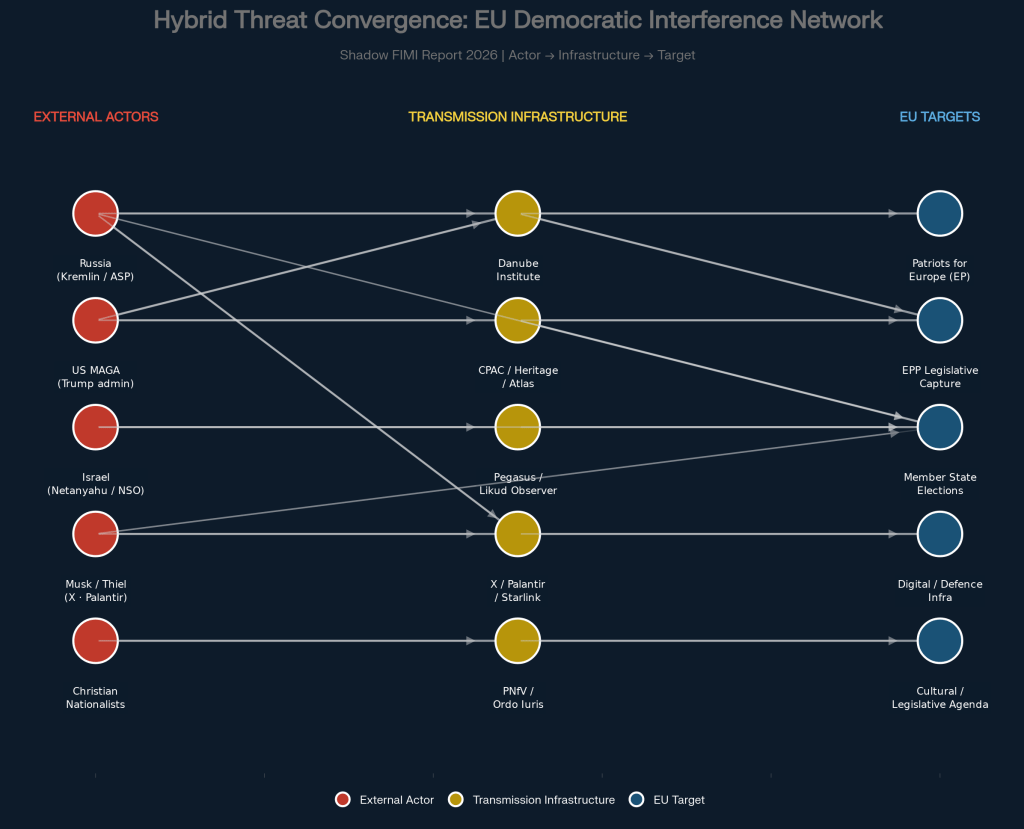
For those of us working on European strategic autonomy, this is not an abstract concern. When the same executive that is dismantling domestic constraints also exercises de facto control over key elements of Europe’s security, financial and technological infrastructure, a great deal of our “internal” democratic risk becomes entangled with external dependency.
That is one reason why the World Democracy Monitor is designed to sit alongside, and cross‑reference, the European Geopolitical & Hybrid Threat Monitor. The first tracks what states are doing to their own institutions. The second tracks what that means for Europe’s position in an increasingly unstable strategic environment.
Why a Weekly Monitor?
If V‑Dem and its peers already give us rich, global data, why build yet another monitor?
Time is crucial for activism, journalism, defensive and political action.
Most of the damage the V DEM report describes is not done by one single spectacular event but by chains of smaller legal and administrative moves which allows for creeping autocratisation. Sometimes the pattern only becomes obvious in retrospect, once the annual report has been compiled and the scores recomputed – although in the case of the US you did not need to wait for an annual report to make sense of the daily descent into an extremist neo-fascist state.
A weekly monitor is not a rival index. It is an attempt to build a radar for these chains of moves as they are unfolding. Rather than ask “Is this still a democracy?”, it asks more granular questions:
- Did the government introduce or tighten a foreign agent law this week?
- Was a “temporary” state of emergency renewed again?
- Did a major independent TV station or newspaper change hands under opaque conditions?
- Did the electoral commission lose powers – or gain political appointees?
- Were protests met with live ammunition or a new anti‑terror statute?
- Did a competition authority, tax office or state‑owned bank suddenly discover a problem at a regime‑critical oligarch’s rival?
None of these will be captured in a single headline score. All of them are recorded somewhere: in an NGO press release, an OSCE legal opinion, a UN special rapporteur’s statement, a buried competition decision, a local journalist’s thread. The monitor’s job is to pull those fragments together, code them in a structured way, and feed them into a set of panels that can be watched over time.
The World Democracy Monitor therefore tracks six main lanes:
- Institutional Pulse – court‑packing, term limits, emergency powers, lawfare and economic coercion & capture.
- Electoral Watch – rule changes before the vote; certification and acceptance after it.
- Digital & AI Warfare – deepfakes, computational propaganda, shutdowns, surveillance laws.
- Civil Society & Protest – foreign agent laws, protest repression, and successful pushback.
- Autocratic Export – who is importing Russian/Chinese legal models and surveillance tech, and who is targeting dissidents abroad.
- State Capture & Oligarchization – the Hungary‑style consolidation of media and economic assets in regime‑aligned hands.
Each week, these lanes are updated as a structured brief. Over time, they produce not just a snapshot of where democratic risk is highest, but a timeline of how a given country moves from one category to another.
Positive Deviants and the Possibility of Repair
One of the more interesting features of the V‑Dem report is its emphasis on “U‑turn democratization”. Not all autocratization episodes end in full breakdown. Some are arrested and reversed. Countries like Brazil, Poland and Sri Lanka appear in the data as systems that moved onto an autocratic trajectory and then pulled themselves back via elections, courts, civil society or elite splits.
There are not many such cases – V‑Dem counts eight stand‑alone democratizers and ten “U‑turns” – but they exist. More importantly, they demonstrate that the process you might call “democratic decay” is not unidirectional. There are points of leverage where institutional repair is still possible, and sometimes even successful.
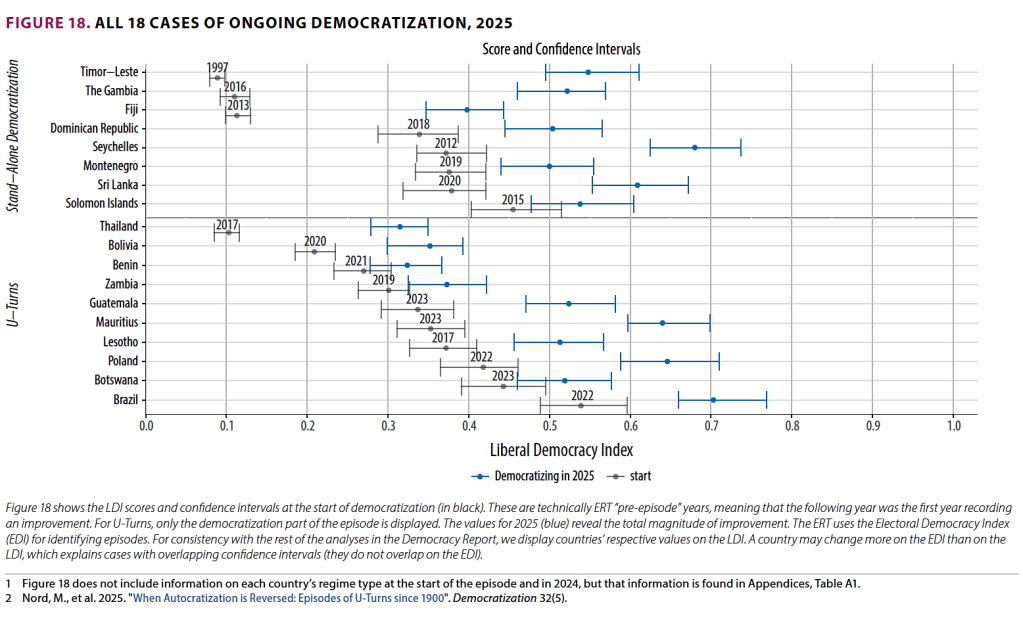
The World Democracy Monitor deliberately builds that possibility into its design. Each week, it looks not only for “Rapid Decay” but for “Positive Deviants” – countries where:
- Emergency powers are allowed to lapse rather than quietly extended.
- Media laws are liberalised, or strategic mergers unwound.
- Courts or competition authorities block political expropriations.
- Foreign agent laws are watered down under pressure from civil society, or struck down by constitutional courts.
- Independent prosecutions of previously untouchable figures actually proceed.
These cases are collected into a “Democratic Turnaround Watch” and a “Resilience Spotlight”.
Linking Indices, Monitors and Strategy
The V‑Dem Democracy Report provides something we have needed for a long time: a high‑resolution, historically grounded, globally comparable view of the state of democracy. Its 2026 edition’s headline message – democracy back to 1978 levels, the third wave of democratization almost erased, and the third wave of autocratization in full, global swing – should be enough on its own to concentrate minds.
But if we treat that annual review as sufficient, we will miss much of what matters in between scans.
The World Democracy Monitor treats democracy as a dynamic system under stress, whose vitals need to be taken regularly. It is built to sit on top of V‑Dem and its peers.
It is designed to integrate with the European Geopolitical & Hybrid Threat Monitor, because democratic erosion and external vulnerability are now tightly coupled phenomena. And it is grounded, as much as possible, in the work of those who deal with the consequences directly: local journalists, NGOs, human rights lawyers, election observers, and the people who take risks in defence of democracy (including with their lives).
Whether it succeeds will depend partly on whether it proves useful to others. If you work on democracy, lawfare, civil rights, hybrid threats – or if you are simply trying to understand what is happening to the system you live in – I would be interested in your views and suggestions for improvement.
The dashboard is here: https://asym-intel.info/monitors/democratic-integrity/overview.html
The full list of Monitors tracking geopolitics, democracy, AI governance, and systemic risk is here: https://asym-intel.info/monitors/
And the V‑Dem 2026 Democracy Report is here: https://www.v-dem.net/publications/democracy-reports/










 Compossible - that which can live together
Leave a comment