Engineering Escape Velocity – A 5 year Plan for Europe
This three-part Reckoning series began with a question about what China’s history, including its 19th-century failures and its 20th century successes, can teach Europe about its 21st-century moment of crisis. China failed to adapt to geopolitical changes in the 19th century and that mistake gave rise to a century of humiliation. China learned from that failure and is now a superpower.
Europe has five years, at most, to learn and incorporate some very important history lessons about failure and success from China.
“Opportunities multiply as they are seized.”1
(Sun Tzu)
Continued from:
- Getting Our House in Order: Neutralising the Veto Weapons
- Europe Has Intelligence But lacks Courage
- The MAGA Shield — Active Defence Against Dissolution
- The China Pivot: Leveraged Ambiguity in Practice
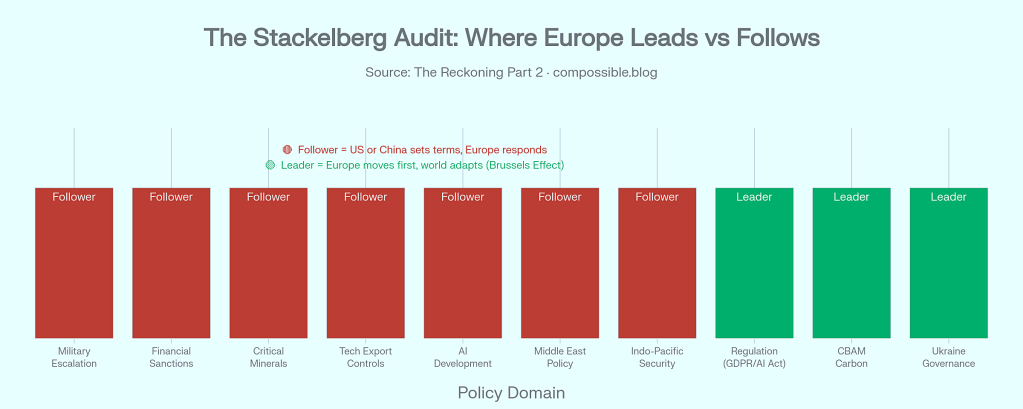
- A Stackelberg Attack— Seizing First-Mover Advantage
- The Wider European Context — UK, Norway, Iceland and the Concert
- The Five-Year Plan: Engineering Escape
- Footnotes
“A house divided against itself cannot stand.”2
(Abraham Lincoln)
Getting Our House in Order: Neutralising the Veto Weapons
Europe cannot execute a grand strategy while some of its members (Hungary, Slovakia & Poland) operate as foreign veto weapons within its own institutions. Hungary and Slovakia currently function as systematic spoilers—capturing EU nodes to block Ukraine aid and veto Russian sanctions on behalf of Moscow and Washington’s MAGA faction.
Poland’s situation within the EU is much more complex, though it is notable that Polish President Donald Tusk suggests there is a strong move towards Polexit (Polish exit from the EU) by some forces within and, as we have seen with Brexit, potentially encouraged and facilitated by agents in America.3
- The Article 7 Amputation: If Orbán wins the general election in Hungary in April, Article 7 proceedings against Hungary must be concluded within twelve months with suspension of all EU voting rights and transfer payments until there is a verified restoration of the rule of law. If Orbán loses, then a forensic examination must be conducted and published: focusing on the extraordinary scope and extent of corruption and his engagement with Russian, Israeli and American interests that facilitated Hungary as a Russian node and an anti-EU coordinator from within the EU. Orbán had over 7 years to build a local media monopoly in Hungary whilst the EU noted its concern but did not take serious action. The EU must learn from this, including for how it deals with countries like Slovakia that now walk the same path.4
- The Atlanticist Veto: The deeper risk lies in the “Atlanticist bloc”—states like Poland and the Baltics that have historically prioritised their American relationship and Washington’s security guarantees over European ambitions. The US continues to fostering this internal dependence which acts as a drag on European autonomy.
- Binding Architecture: We must move beyond trans-atlanticist hope – which will be the death of Europe. This requires measures like embedding Poland so deeply into joint European defence industrial base funding that the economic cost of prioritising bilateral US client-status over European solidarity becomes prohibitive for any Polish government. It is notable that Poland’s President Karol Nawrocki has stated he intends to veto Poland using its €43.7 billion allocation under the EU’s SAFE5 loans-for-weapons scheme6.
There is a deeper game-theory problem beneath the institutional issues we see. Every EU member state faces a version of the Prisoner’s Dilemma when it comes to European strategic autonomy: the collectively optimal outcome requires each state to accept short-term costs — e.g. a reduced bilateral relationship with Washington, reduced veto power, some loss of control over the fiscal contribution to collective defence — in exchange for long-term collective security. Each state currently individually calculates that it is better off defecting i.e., accepting the collective benefit while minimising its individual contribution. This is why QMV reform has stalled and why every attempt at European defence integration has been quietly sabotaged by those states that perceive they benefit most from the status quo. A binding architecture — SAFE bonds, EDIP procurement7, a pan-European Defence and Security Treaty — is the answer to the defection incentive. You do not ask states to trust each other’s commitments, you just need to make defection structurally more expensive than solidarity.
“It is not because things are difficult that we do not dare; it is because we do not dare that they are difficult.”8
(Seneca)
Europe Has Intelligence But lacks Courage
Europe is not sleepwalking into these crises in complete ignorance. The analytical work has already been done but it lacks the courage and drive needed to implement them.
In 2024, the EU commissioned three landmark strategic reviews — Draghi on competitiveness9, Letta on the single market10, and Niinistö on civilian and military preparedness — each of which correctly identified structural failures and prescribed specific remedies.
The Niinistö Safer Together report11, published in October 2024, was the most ambitious of the three with 80 detailed recommendations, and an explicit mandate to export Finland’s Comprehensive Security model — in which defence is a whole-of-society responsibility involving government, business, civil society, and citizens — to the EU level. The Commission launched its Preparedness Union Strategy in March 2025 as a direct response. A health crisis preparedness plan followed in November 2025. The White Paper on European Defence drew on the Niinistö architecture as its conceptual foundation. By the standards of the previous decade, it represents a genuine shift in institutional consciousness — the first serious attempt to treat security as a whole-of-government and whole-of-society challenge rather than the exclusive property of defence ministries. The mindset, at the Commission level at least, has changed.
But the mindset shift has not yet produced the institutional and fiscal transformation the crisis demands. The gap between the diagnosis and the treatment is a gap of political will dressed up as procedural prudence and constraint. The Niinistö recommendations that have moved are largely those that required no new money, no treaty change, and no confrontation with member state sovereignty. The ones that remain outstanding are the major ones that require all three.
What Europe is doing well
- Regulatory first-mover leadership. The GDPR, the AI Act, the Digital Services Act, and CBAM collectively represent the most sophisticated governance architecture in the world for the technologies and economic forces that will define the next fifty years.
- Defence financing architecture. The launch of EDIP and SAFE — including the €150 billion EU-bond financing mechanism for joint defence procurement — represents the most significant step toward European defence industrial base coherence since the EU’s founding. The political decision to fund European rearmament through collective borrowing, bypassing the fiscal conservatism that has paralysed the EU, was historic.
- Ukraine as an institutional anchor. The commitment to Ukrainian EU accession — despite being contested and slower than necessary — has kept Ukraine within the European institutional orbit through three years of existential war. The reconstruction governance architecture being built around that commitment is the significant.
- The Preparedness Union Strategy. The first EU-level framework that treats crisis preparedness as a cross-sectoral, whole-of-society responsibility rather than a defence ministry portfolio (though there is no EU defence ministry!).
- The Concert instinct. European diplomatic coordination on Ukraine has been more effective than its critics acknowledge. Europe has sustained a largely unified position against Russian aggression and supported Ukraine for three years despite sustained efforts by Moscow, Washington, Budapest, and Bratislava to fracture it. It also points the way to the need for more trans-European projects and institutions.
What Europe is failing to do
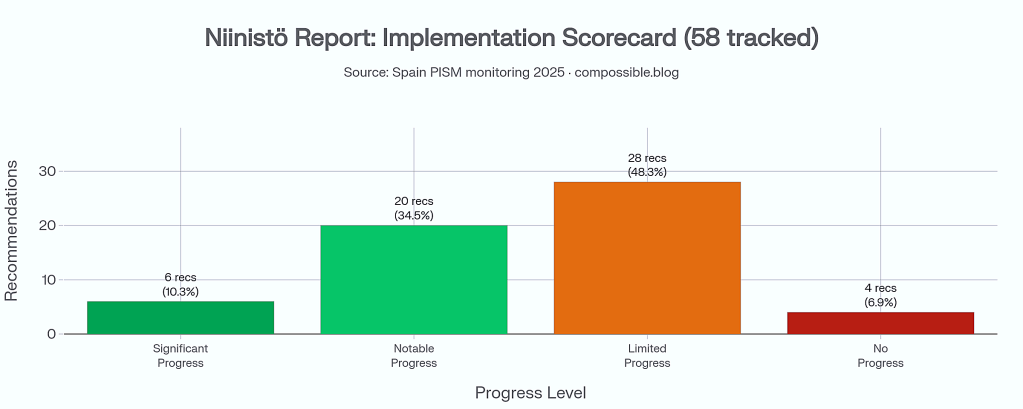
“[Europe has implemented]sporadic and disjointed initiatives rather than a coordinated programme”
- The fiscal ambition of Niinistö remains unacted on. The report’s recommendation that 20% of the overall EU budget be redirected toward security and crisis preparedness has not been adopted. Member states continue to treat crisis preparedness as a residual claim on national budgets rather than a collective investment in shared survival.
- Article 42(7) and Article 222 remain inoperative. The mutual defence clause and the solidarity clause have never been operationalised to cover the hybrid warfare, cyberattacks, and infrastructure sabotage that constitute the actual threats Europe faces.
- Qualified Majority Voting (QMV) on foreign policy has not moved. The unanimity requirement — which allows a single captured member state to veto European strategic action — remains the EU’s foundational institutional failure. It is the mechanism through which every adversary with a supportive client state inside the EU exercises a structural veto over European strategy.
- Intelligence coordination remains structurally broken. We need genuine EU-level intelligence coordination. What exists is a network of bilateral arrangements, NATO relay dependencies, and national silos that fragment European situational awareness when coherence is most needed.
The pattern is unvaryingly consistent: Europe excels at diagnosis and prognosis but is not delivering the reforms needed quickly enough to translate this into security and success. The EU is excellent at identifying what is wrong, it produces deep analysis and commissions detailed reports, and then it fails to translate intellectual clarity into institutional courage with the speed the crises require.
The Niinistö report is the most telling example. It was produced by a former Finnish president who led a country that has spent eighty years maintaining exactly the kind of strategic ambiguity, societal resilience, and sovereign military capacity that Europe must have to survive. The Polish Institute of International Affairs’ March 2025 assessment made clear that the fundamentally important recommendations in the report have not been properly implemented.
The next stage of European preparedness and coordination must be to implement the EU measures needed and to create new European alliances of the willing which includes non-EU members and which can proceed without EU unanimity. This needs to cover defence, intelligence, technology and any other areas where coalition is more important than EU concentration.
Europe now needs to learn another lesson from China, this time from Chairman Mao. The EU needs a 5 Year Plan with measurable objectives that are agreed, communicated and implemented without fail. Not another strategy document or roadmap or a set of aspirational targets (subject to the unanimity veto of the least willing). A real plan — with political owners, new EU and pan-European institutions, regular deadlines and clarity about the consequences for failure.
It is also worth noting that a continued focus on enlargement whilst these structural political deficiencies continue risks making matters worse.
The MAGA Shield — Active Defence Against Dissolution
The Trump administration is not a strategic rival. It is conducting a regime-change operation against democratic partners that are so called allies. Europe’s response must match the methods used against it, blow for blow, and without fear or apology.
- The Democracy Shield12: Designate US-funded political interference—including Musk’s X platform when used as an influence operation—as a “foreign influence operation” subject to the same legal frameworks applied to Russian sabotage.
- The Anti-Coercion Instrument13: The ACI must be deployed against US tariff coercion without prior consultation with Washington.
- C4ISR Independence: Sharing European intelligence with an administration that is actively working to dissolve European institutions is not partnership, it is an act of self-harm. European states must suspend intelligence sharing with US agencies under direct presidential control as a matter of basic operational security. Simultaneously, accelerate GOVSATCOM and IRIS² to full capability so European forces can navigate and communicate without American permission.
- European Intelligence Agency: Europe must move from ‘coordination’ to ‘agency.’ Suspending sharing with politically compromised foreign services is a temporary measure, a European Intelligence Agency (EIA) is a permanent urgent requirement. This ensures that Europe has sovereign oversight of foreign influence measures and makes it more immune to Atlanticist interference.
- Monetary Autonomy: Build a European alternative to SWIFT and initiate a systematic reduction of dollar exposure. Sovereignty is a fiction as long EU trade is a target for US secondary sanctions
- Defence Industrial Independence: EDIP and SAFE must proceed without Washington’s endorsement, without routing procurement through American prime contractors, and without treating US approval as a prerequisite for European military capacity. The lesson of the last thirty years is that asking for permission to build strategic independence is the best way to ensure you never achieve it.
“Speak softly and carry a big stick; you will go far.”14
(Theodore Roosevelt)
The China Pivot: Leveraged Ambiguity in Practice
Europe must now cultivate a better relationship with China without tipping into Chinese dependency. The power, as always, comes from credible uncertainty about where European alignment will ultimately land on key issues affecting China and the US balance of power.
Four concrete instruments that need to be deployed:
- The Critical Minerals Bargain: European participation in any US-led Western minerals architecture15 — including any critical minerals deal — is explicitly conditional on genuine US commitment to European strategic autonomy including an end to lobbying against EDIP and SAFE, formal C4ISR technology transfer etc.
- The CAI Revival: Revive the EU-China Comprehensive Agreement on Investment16. Negotiate selective tariff reduction in clean technology — a sector where China needs European market access — in exchange for binding, long-term, independently verified critical minerals supply agreements.
- Financial Hedging: A bilateral euro-denominated payment corridor for energy and materials transactions with China reduces exposure to US secondary sanctions and signals to Washington that European financial architecture is not an instrument of American foreign policy.
- Taiwan Neutrality Clarity: Europe must publicly adopt a position of diplomatic equidistance and an explicit statement that Europe will not commit to military involvement.
“The best time to plant a tree was twenty years ago. The second best time is now.”17
(Chinese proverb)
A Stackelberg Attack— Seizing First-Mover Advantage
The Brussels Effect is Europe’s most underexploited strategic asset. A number of first-mover windows are open now but will close soon:
- AI Governance: The EU AI Act must be internationalised before the US or China creates alternative frameworks. Bilateral AI governance agreements with partner states outside of the EU — using European market access as the incentive for adoption — can establish EU standards as the de facto global baseline. The alternative is watching the world fragment into a US permissive framework and a Chinese surveillance framework, with Europe’s careful regulatory architecture (and GDPR rights) left out of the global AI architecture. The EU must actively recruit a major AI developer — whether home-grown or relocated — to headquarter in Europe, using market access, talent visas, and regulatory co-design as incentives.
- CBAM as Coercion: The Carbon Border Adjustment Mechanism18 should be expanded in scope and deployed explicitly as a strategic forcing function — a Montreal Protocol model applied to carbon. Every major trading partner would then face a simple choice of meeting European environmental standards or paying the border adjustment.
- Ukraine Reconstruction Governance: The reconstruction of Ukraine will be the largest infrastructure investment in European history — conservatively estimated at €500 billion. The governance architecture for that reconstruction must be committed to tying every euro of reconstruction finance to EU legal, procurement, and institutional standards. Ukraine must be brought within the European cultural framework (and not a NATO framework) even without formal EU accession.
- Global South Financial Architecture: The dollar’s dominance is not inevitable — it is a political choice that Europe has declined to contest but now it should compete with it and also remove European reliance on US controlled financial and monetary architecture. Euro-denominated debt relief and development finance, offered on terms that do not require the surveillance infrastructure and political conditionality of Chinese Belt and Road alternatives, could position Europe as the credible third option in the emerging multipolar financial order.
The Wider European Context — UK, Norway, Iceland and the Concert
The strategic logic of this Reckoning series applies beyond the EU’s legal borders. The European security community — the democracies that share geography, values, institutional history, and strategic exposure — extends to the UK, Norway, Iceland, and the Western Balkan accession candidates. The artificial separation of these countries from EU strategic planning is a gift to every adversary that benefits from European fragmentation. Pan-European projects, architecture and institutions are needed to leverage these relationships and common interests and they also provide leverage within the EU against those members that act as enablers for US and Russian interests.
The UK is the most important case. Brexit was actively encouraged by Putin and Trump supporting organisations— it was a strategic operation against European coherence that succeeded. The consequences have been entirely predictable: British strategic influence has declined, European strategic capacity has been weakened, and neither has benefited from the separation. The Five-Year Plan must include a structured pathway for UK re-association that carefully avoids the political distraction of a full re-accession debate until the next generation dominates the UK political landscape.
The practical architecture already exists in embryonic form. We need the political will to deepen these into something that resembles strategic partnership in substance — joint defence procurement, intelligence sharing, and an explicit European Concert on foreign policy positioning. The Five-Year Plan should target a formal EU-UK Defence and Security Treaty that operationally integrates British military capacity into European command structures.
Norway and Iceland present a simpler case. Both are already integrated into the European single market through the EEA and into NATO’s military structures. A pan European defence industrial base and foreign policy agreement is needed which is wider than the EU for participation and voting purposes.
The architecture for a wider European security community does not need to be invented from scratch. It already exists in embryonic form in the Joint Expeditionary Force (JEF)19 — a UK-led, ten-nation coalition of northern European democracies, founded in 2014, that operates outside NATO’s command structure precisely for scenarios where the full Alliance cannot act. The JEF activated undersea infrastructure monitoring operations in the Baltic in 2025 and conducted large-scale exercises across the High North. The Five-Year Plan must formalise what the JEF has demonstrated informally: that UK military capacity, Nordic resilience, and Baltic frontline experience constitute a coherent strategic unit that belongs inside European decision-making, not alongside it.
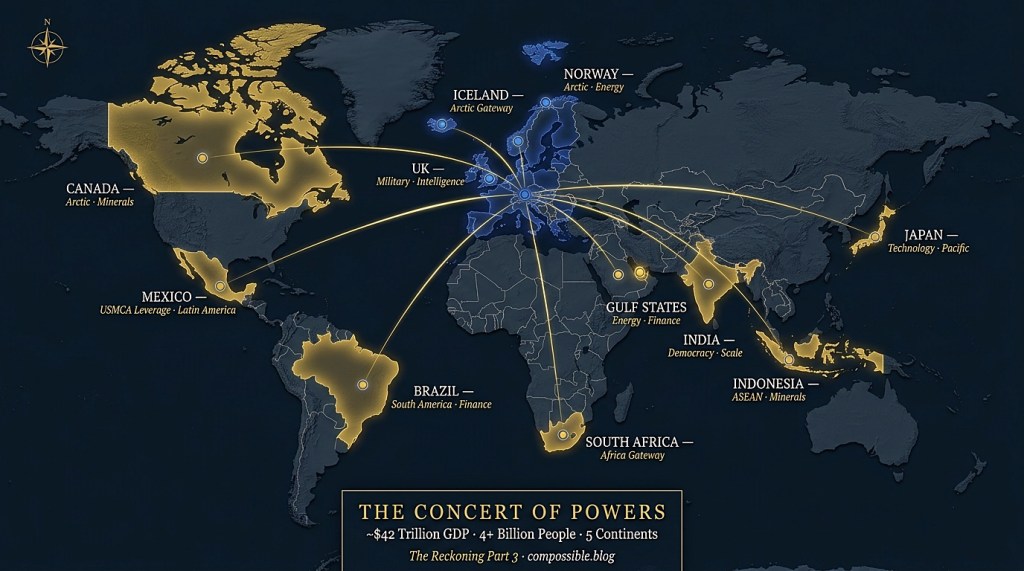
As Canada moves toward JEF membership — a development that would make six of eight Arctic Council members part of the same security framework — the JEF becomes the natural nucleus of the Concert of Powers the 5 year plan proposes. The JEF Leaders’ Summit in Helsinki on 26 March 2026 is the moment to table that ambition explicitly.
A European-led Concert of Powers Framework — EU and UK, with Canada, Mexico, Japan, India, Brazil, South Africa, Indonesia, and the Gulf states (if possible) — must begin being built immediately, without Washington, and on terms that Europe sets. Mexico warrants specific mention as the United States’ largest trading partner and a nation maintaining deliberate strategic equidistance between Washington and Beijing, it brings to the Concert a structural leverage over the American economy that no other member possesses. This is the 1815 Congress of Vienna model for the 21st century: a coordination framework for managing crises and establishing basic norms for great power restraint in the vacuum left by US institutional withdrawal. The EU has the diplomatic networks, the institutional architecture, and the normative capital to do this. What has been missing is the willingness to do so without American permission.
“The greatest enemy of a good plan is the dream of a perfect plan.”20
(Clausewitz)
The Five-Year Plan: Engineering Escape
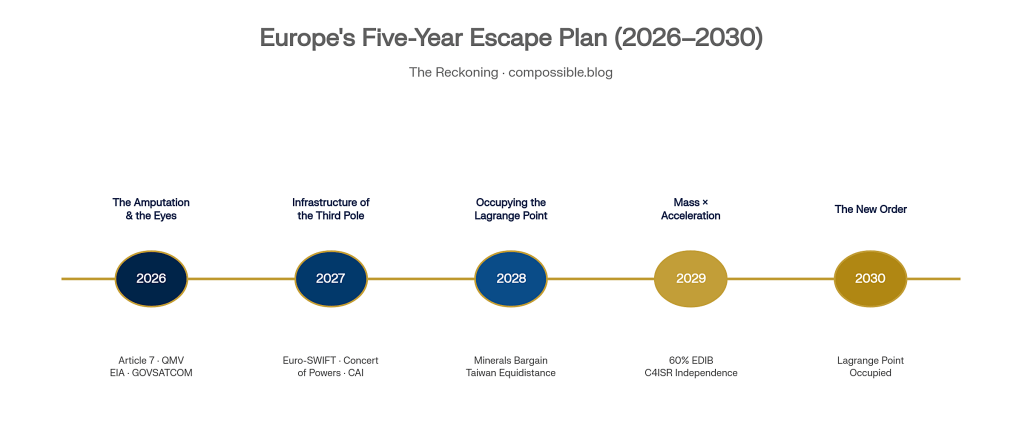
Any serious strategic plan must survive contact with the adversary’s response. The two most dangerous counter-moves are well-defined and the plan’s sequencing is designed to defeat both.
- The American counter-move is divide-and-rule: accelerating bilateral deals with Germany, France, and Poland individually to fracture EU unity before European financial and defence independence is achieved; threatening withdrawal of nuclear guarantees to panic Eastern European states back into Atlanticist dependency; intensifying MAGA-aligned media and funding operations inside member states to raise the domestic political cost of European solidarity. This is why Year One is non-negotiable. The Article 7 amputation, QMV on foreign policy, and the European Intelligence Agency are not merely institutional reforms they are the hardcoded preconditions for every subsequent year. An alliance that still contains captured nodes within Europe in Year Two cannot execute a minerals bargain in Year Three. The sequencing is key to the strategy.
- The Chinese counter-move is acceleration of dependency before the leverage window closes: tightening rare earth export restrictions to demonstrate European vulnerability before the minerals bargain is secured; increasing pressure on Taiwan to force Europe off its equidistance position before it is properly established; offering bilateral deals to individual European states on terms that undercut the collective EU position. This is why the CAI revival and the Taiwan equidistance declaration must happen simultaneously in Year Two, not sequentially — each provides the credibility that makes the other believable.
Credibility is the 5 Year Plan’s hardest requirement given neither superpower currently believes European commitments are real, because they have watched Europe signal resolve and then fracture and accommodate for thirty years. Game theory is clear that posturing and talk alone changes nothing and that costly signals are necessary to change anything. The costly signals proposed are specific and deliberate. Each of these imposes a real political cost on European governments. That cost is the mechanism by which the Plan’s commitments become credible to the adversaries it is designed to deter.
Year One (2026): The Amputation and the Eyes
The first year is aimed at reclaiming the ability to see the world through European eyes with a focus on what is in Europe’s best interests. To that end it agrees with von der Leyen’s comments about the need for pragmatic realism.
- The “Atlanticist Veto” must be neutralised.
- The EU must either conclude Article 7 proceedings against Hungary or, if Orban loses, publish a transparent autopsy of how Hungary was used as a Trojan Horse for undermining the European project. Likewise a post-mortem must connect some of those same forces to Brexit. This is essential to counter forces currently trying to undermine the EU within Poland and Slovakia.
- Simultaneously, the EU must move to Qualified Majority Voting (QMV) on foreign policy via enhanced cooperation among willing states, ending the era of paralysed force.
Crucially, Europe must break the American intelligence leash with a European Intelligence Agency (EIA) ending the ‘NATO relay’ dependency on external intelligence and providing Europe with clear-eyed situational awareness about threats to European democracy — including interference operations coordinated through internal nodes. The documented network connecting Netanyahu’s Likud to Orbán’s Fidesz, to Patriots for Europe, and to far-right parties across the EU constitutes precisely the kind of cross-border influence architecture that European intelligence has been structurally blind to, partly because our intelligence dependencies discourage naming allies as major threat actors.21
Year Two (2027): The Infrastructure of the Third Pole
In Year Two, Europe must build our its hard power of including the launch of a euro-denominated payment infrastructure for global trade on energy and critical minerals, signalling to Washington that the dollar-sanctions weapon has no reach. By opening a bilateral euro-corridor with China, Europe treats financial sovereignty as a security priority rather than a policy preference. The Taiwan equidistance policy must be clear and signalled.
Europe should host the first meeting of the Concert of Powers — a middle-power axis including the UK, Canada, India, and Brazil as a coordination engine for defence that bypasses US institutional withdrawal.
Year Three (2028): Occupying the Lagrange Point
Year 3 is the moment at which European leverage, built through two years of costly signalling and institutional hardening, is deployed simultaneously against both the US and Chinese superpowers.
- With America: the Critical Minerals Bargain is executed. European participation in any US-led Western minerals architecture carries an explicit price list — a formal end to US lobbying against EDIP and SAFE, C4ISR technology transfer, and treaty-level renewal of nuclear guarantees for Eastern European states. This is not a threat; it is the structure of any serious negotiation. The price list exists. Year Three is when it is presented.
- With China: the CAI technical working groups have produced a conditional clean-technology tariff offer. Year Three is when it is signed — binding, independently verified, with rare earth supply agreements attached. China’s structural fragility (documented in the EUISS Chaillot Paper 188) means the window for this bargain is open now and closes as China’s self-reliance drive succeeds. The signing cannot wait for Year Four.
The test at the end of Year Three is whether Washington and Beijing both making offers to Europe rather than demands of it.
Year Four (2029): Achieving Mass x Acceleration
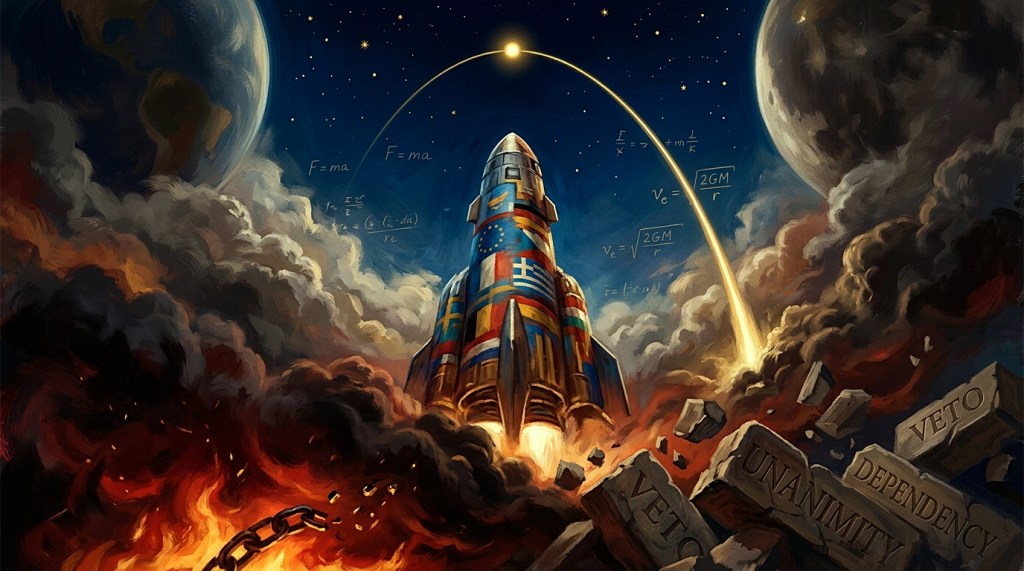
By Year Four, the European Concert defence industrial base must reach a threshold of 60% internal sourcing, ending the “procurement paradox” where European wealth flows to America. C4ISR independence must be achieved at this point. European forces will navigate and fight using sovereign data streams, verified by the EIA. By the end of Year Four, Europe as a force must no longer be paralysed. ‘F = ma’ is not a metaphor.
Year Five (2030): The New Order
The success of the 5 Year Plan is measured by a single metric: do the United States and China now both face genuine uncertainty about where Europe will stand on any major world geopolitical event, war or crisis which pits these powers against each other?
If the answer is yes, we have succeeded in creating our own stability (in occupying the Lagrange Point between great powers). We are no longer on the ‘menu’ of superpowers and Europe becomes the indispensable pivot and partner for a rules-based world order. Human survival depends on Europe and it’s middle power partners coordinating at a planetary level and neither China or the USA separately or together is capable of achieving this.
Success is possible if European and EU leaders are honest and forceful about the political and planetary challenges facing us and galvanise the public to support action that is clearly in our common interests. Europe does not lack mass to make its impact on the world stage, it lacks the will to do so and it must find it or face ruin.
“Civilisations die from suicide, not by murder.”22
(Arnold Toynbee)
Footnotes
These articles have been created with the assistance of AI tools including Claude, Gemini, and NotebookLM.
- Sun Tzu, The Art of War (Sūnzǐ Bīngfǎ), c. 5th century BC, traditionally attributed to the Chinese military strategist Sun Wu. The precise formulation “opportunities multiply as they are seized” does not appear verbatim in the oldest surviving texts and may be a later distillation of Sun Tzu’s broader doctrine — specifically his argument in Chapter 6 (Weakness and Strength) that the commander who moves first forces the enemy to respond, compounding the original advantage. It captures the Stackelberg logic at the heart of this article. Sun Tzu, The Art of War, translated by Lionel Giles (Luzac, 1910). ↩︎
- Abraham Lincoln delivered this formulation in his ‘House Divided’ speech accepting the Republican nomination for US Senate, Springfield, Illinois, 16 June 1858. Lincoln was quoting the Gospel of Mark (3:25) to argue that the United States could not survive indefinitely half slave and half free. The parallel for the EU is that an institution that houses both committed integrationists and state actors operating as foreign veto weapons for external powers cannot execute coherent strategy. The internal contradiction must be resolved before the external threats can be addressed. Abraham Lincoln, House Divided Speech, Springfield, Illinois (16 June 1858). ↩︎
- Polish Prime Minister Donald Tusk warned in early 2026 that Eurosceptic and nationalist forces within Poland — energised by the PiS party’s alignment with Trump-era MAGA networks — are actively building a political case for Polish withdrawal from the EU. As with Brexit, external encouragement from both Moscow and Washington’s MAGA faction has been documented. The structural conditions that produced Brexit — a captured media environment, an energised nationalist right, and external powers with an interest in fragmentation — are present in Poland. Politico Europe, Veto of EU Defence Loan May Be ‘Prelude to Polexit’ Bid, Polish PM Suggests (2026). ↩︎
- The Renew Europe Group’s February 2026 assessment of Slovakia under Fico documents the accelerating trajectory toward Hungarian-style institutional capture: judicial pressure, media consolidation, and alignment with Moscow on Ukraine sanctions. The group’s warning — “there is still time to stop the rot in Slovakia, but not much” — is the most precise current assessment of how quickly an EU member state can be converted from a functioning democracy into an externally controlled veto node. Renew Europe Group, There Is Still Time to Stop the Rot in Slovakia, But Not Much (11 February 2026). ↩︎
- Security Action for Europe (SAFE) is the EU financial instrument financed through collective EU borrowing, with the European Commission proposing up to €150 billion in funding until the end of the decade to support joint defence procurement. Funds are raised through single-branded EU Bonds and EU Bills at the highest EU credit rating. SAFE represents the most significant step toward a European Defence Industrial Base since the EU’s founding — and the Nawrocki veto on Poland’s €43.7 billion allocation is the most immediate test of whether binding architecture can overcome the defection incentive identified in this article. ↩︎
- Poland’s President Karol Nawrocki announced in March 2026 his intention to exercise his constitutional veto over Poland’s participation in the EU’s loans-for-weapons SAFE scheme, blocking access to Poland’s €43.7 billion allocation. The decision illustrates the Atlanticist veto dynamic in practice: a head of state prioritising bilateral US client-status over European collective defence architecture at precisely the moment when European defence industrial independence is most urgently required. Politico Europe, Poland’s President Vetoes €44B EU Loans-for-Weapons Program (March 2026). ↩︎
- The European Defence Industry Programme (EDIP) is the EU’s dedicated instrument for strengthening the European defence industrial and technological base, providing targeted funding for collaborative defence research and development among member states. It is the upstream complement to SAFE’s procurement financing — EDIP builds the industrial capacity, SAFE funds the procurement. Together they represent the most serious attempt in the EU’s history to build genuine defence industrial independence. European Commission, EDIP: Dedicated Programme for Defence (2026). ↩︎
- Seneca the Younger, Epistulae Morales ad Lucilium (Letters to Lucilius), Letter 104, written c. 65 AD. Seneca’s formulation inverts the intuitive assumption that difficulty precedes hesitation — arguing instead that the refusal to act is what creates the difficulty in the first place. Applied to European strategic culture, the insight is that the institutional paralysis documented throughout this series is not the product of genuine impossibility but of accumulated decisions not to dare. Lucius Annaeus Seneca, Letters to Lucilius (c. 65 AD). ↩︎
- Mario Draghi’s September 2024 report on European competitiveness — commissioned by the European Commission — documented a €750–800 billion annual investment gap between the EU and the United States, identified innovation capacity and energy costs as the primary structural weaknesses, and recommended a fundamental reorientation of EU fiscal and industrial policy. It is the most detailed quantitative case for European strategic economic autonomy produced in the current decade. European Commission, The Future of European Competitiveness: A Competitiveness Strategy for Europe, report by Mario Draghi (September 2024). ↩︎
- Enrico Letta’s April 2024 report on the future of the European single market — also commissioned by the European Commission — identified the fragmentation of European capital markets, the absence of a genuine European savings and investment union, and the persistence of regulatory barriers between member states as the primary obstacles to European economic scale. Together with the Draghi report, it provides the economic architecture for the strategic autonomy this series prescribes. Enrico Letta, Much More Than a Market, Report to the European Council (April 2024). ↩︎
- Niinistö, S., Safer Together: Strengthening Europe’s Civilian and Military Preparedness and Readiness, Report to the President of the European Commission (October 2024). The report’s 80 recommendations cover whole-of-society crisis preparedness, civilian-military coordination, intelligence sharing, infrastructure resilience, and societal cohesion. Implementation progress has been assessed by the Polish Institute of International Affairs as producing “sporadic and disjointed initiatives” rather than a coordinated programme. PISM, EU Unprepared for Crises: Challenges in Implementing the Niinistö Report (March 2025). ↩︎
- The European Democracy Shield is the EU’s proposed framework for coordinating member state responses to foreign information manipulation, interference in electoral processes, and covert funding of political actors by external powers. Its legislative development in 2025–26 represents the first attempt to treat democratic interference as a systemic security threat rather than a series of individual incidents. European Parliament Think Tank, The European Democracy Shield: An Overview (January 2026). ↩︎
- The EU Anti-Coercion Instrument (ACI), Regulation (EU) 2023/2675, provides the European Union with a formal legal mechanism to respond to economic coercion by third countries — including tariff measures, investment restrictions, and trade barriers deployed for political purposes. It was designed precisely for the scenario Europe faces with the Trump administration’s tariff coercion. Its non-deployment to date represents one of the clearest examples of the political will gap this article identifies. European Parliament and Council, Anti-Coercion Instrument, Regulation (EU) 2023/2675. ↩︎
- Theodore Roosevelt used this formulation — originally a West African proverb — in a letter to Henry Sprague on 26 January 1900, and subsequently as the organising metaphor of his foreign policy doctrine. Applied here it means precisely what Roosevelt intended: that the capacity for force, credibly demonstrated, allows diplomatic goals to be achieved without force being exercised. The lesson for Europe’s leveraged ambiguity doctrine is direct — the instruments of coercion (ACI, CBAM, SWIFT alternative, intelligence suspension) must be visibly available and credibly deployable to function as deterrents. Theodore Roosevelt, Letter to Henry Sprague (26 January 1900). ↩︎
- The US-EU critical minerals partnership framework under active negotiation in 2025–26 involves European access to US-guaranteed supply chains in exchange for European participation in export control regimes and technology sharing arrangements. The framing in this article — that European participation carries a price list including an end to US lobbying against European defence independence — reflects the transactional conditionality doctrine at the core of the Lagrange point strategy. JD Supra, The US and EU Approaches to Critical Minerals (2026). ↩︎
- The EU-China Comprehensive Agreement on Investment (CAI), negotiated over seven years and concluded in principle in December 2020, was suspended by the European Parliament in May 2021 following mutual sanctions exchanges. The technical working groups established during the negotiation retain institutional memory and personnel that could be reactivated. Reviving CAI as a negotiating instrument — not a concluded agreement — is distinct from ratifying it, and is the specific action proposed here. CSIS, The Rise and Demise of the EU-China Investment Agreement: Takeaways for the Future (2021). ↩︎
- The Chinese proverb on tree-planting has been attributed to various Chinese philosophical traditions but has no single definitive textual source. Its value here is both its content — the argument that the cost of inaction compounds over time — and its origin, which echoes the series’ use of Chinese history as a mirror for European strategic failure. The irony of citing a Chinese proverb in a section about seizing first-mover advantage before China does is deliberate. ↩︎
- The Carbon Border Adjustment Mechanism (CBAM), established by Regulation (EU) 2023/956, imposes a carbon price on imports of energy-intensive goods from countries with weaker carbon pricing regimes. It entered its transitional phase in October 2023 and will be fully operational from 2026. As argued here, it functions as a de facto Brussels Effect instrument — forcing global trading partners to internalise European environmental standards or pay the adjustment — and should be understood and deployed as a strategic tool rather than merely an environmental one. European Commission, Carbon Border Adjustment Mechanism (2023). ↩︎
- The Joint Expeditionary Force (JEF) was founded in 2014 and headquartered at Northwood, London, it operates outside NATO’s command structure and is specifically designed for rapid response in scenarios where the full Alliance cannot act. In early 2025 the JEF activated an undersea infrastructure monitoring system in the Baltic Sea. Exercise TARASSIS in September–October 2025 tested high-readiness operations across the High North and Baltic. A JEF Leaders’ Summit is scheduled for Helsinki on 26 March 2026. Canada’s prospective accession would make six of eight Arctic Council members part of the same framework. RUSI, The Joint Expeditionary Force and Its Contribution to European Security (December 2024); Wilson Center, The UK-led Joint Expeditionary Force’s Impact on Northern European Security (October 2024). ↩︎
- Note: The attribution of “the greatest enemy of a good plan is the dream of a perfect plan” to Clausewitz is disputed — it does not appear verbatim in On War but is consistent with Clausewitz’s doctrine of friction and his argument that plans must be robust to the “fog of war” rather than optimised for ideal conditions. Whether or not Clausewitz wrote it, it captures his central insight that the pursuit of the perfect operational plan consistently produces strategic paralysis — which is the European condition this article diagnoses. Carl von Clausewitz, On War (Vom Kriege) (1832), Book 1. ↩︎
- In January 2026, Prime Minister Netanyahu recorded a personal video endorsement for Viktor Orbán’s re-election campaign alongside far-right leaders from Italy, France, Germany, Spain, and Austria. In February 2025, Netanyahu’s Likud party was granted observer status in Patriots for Europe — the European Parliament bloc that includes Fidesz, National Rally, the Party for Freedom, and Vox. Hungary announced its withdrawal from the International Criminal Court on the day of Netanyahu’s Budapest state visit. Israeli Foreign Minister Sa’ar formally instructed Israeli diplomats to establish contacts with National Rally, Vox, and the Sweden Democrats. This constitutes a documented institutional network connecting Israeli government actors to the principal far-right and anti-EU forces in Europe — and represents precisely the kind of cross-border influence architecture that a European Intelligence Agency would be mandated to monitor. Foreign Policy, Why Israel Courts the Far Right in Europe (February 2026); Middle East Eye, Why Israel Is Joining Hands with Europe’s Far Right (February 2026). ↩︎
- Arnold J. Toynbee, A Study of History, 12 volumes (Oxford University Press, 1934–1961). Toynbee derived this conclusion from his comparative analysis of the rise and fall of twenty-three civilisations, finding that in the overwhelming majority of cases collapse was precipitated not by external conquest but by internal failure — the inability or unwillingness of ruling elites to adapt to new challenges, combined with a loss of the creative minority’s capacity to lead. The formulation quoted here is a condensation of his argument. Applied to Europe in 2026: the threat is real but the adversaries are not the primary danger. The primary danger is the choice, repeated across thirty years, not to act with the weight and coherence Europe actually possesses. Toynbee’s civilisations did not fail because they lacked the resources to survive. They failed because they lacked the will to use them. Arnold J. Toynbee, A Study of History, Vol. 4: The Breakdowns of Civilizations (Oxford University Press, 1939). ↩︎






 Compossible - that which can live together
Leave a comment