The Stackelberg Trap and dealing with the American Criminal Enterprise, China & Russia
Continuing the series:
- The Stackelberg Trap — Europe Nearly Always Follows
- The Opium Wars, Ambiguity & Chinese Realignment
- A Network of Criminal Enterprises
- Securing The Lagrange Point
- The Age-Old Russia Question
- Footnotes
“It is not the strongest of the species that survives, nor the most intelligent, but the one most responsive to change.”
(Leon C. Megginson)
The Stackelberg Trap — Europe Nearly Always Follows
In 1934, Heinrich von Stackelberg mathematically formalised what every alpha knows: the first mover usually dictates the reality for everyone else.1
In sequential games, the leader defines the parameters of the struggle and the follower merely manages the consequences. The audit of the last thirty years is a record of Europe’s chronic addiction to following America and China. From the dollar-denominated sanctions we scramble to mirror, to the critical mineral supply chains China locked down two decades ago while we slept, Europe has forfeited the ability to obtain a leader’s payoff. The leader (or bully) wins – not by being smarter but by committing credibly and early.
We have allowed Washington and Beijing to write the rules within which we are now being slowly strangled.
Europe is a chronic Stackelberg follower in every domain that constitutes hard power:
- Military escalation and de-escalation: the US or Russia moves, Europe responds.
- CS4R & Intelligence: Europe is a consumer of a US battlefield feed. Our ability to see, fight, and navigate is a permission-based utility provided by Washington.
- Financial sanctions architecture: Washington sets the rules, Brussels scrambles to follow.
- Critical minerals supply chains: China committed to processing dominance two decades ago, Europe is still downstream.
- Technology export controls: the US writes them, Europe harmonises after the fact.
- AI Deployment & Development: The US is the leader with China catching up quickly, Europe is lagging desperately.
- The Middle East: Israel & the US are creating a highly destabilised region. Europe watches powerless (Iran) or even largely facilitates it (as with the genocide of Palestinians).
- Indo-Pacific security: the US and China set the terms, Europe is expected to support the US position.
However, there is one primary domain where Europe is the Stackelberg leader – regulation: GDPR, AI Act, DSA, CBAM (Carbon Border Adjustment Mechanism), pharmaceutical standards, financial services rules. Europe moves first, everyone — including the US and China — adapts. This is sometimes called the ‘Brussels Effect’.2 It is almost completely under-exploited as a strategic weapon while being defended primarily as consumer protection policy.
“The art of war is of vital importance to the state. It is a matter of life and death, a road either to safety or to ruin.”3
(Sun Tzu)
Proof that the EU is a follower in other key strategic areas is not hard to find. Clinton used NATO expansion eastward to build the Atlanticist bloc inside the EU – binding new member states closer to Washington rather than Brussels, creating the structural veto on European strategic autonomy that persists to this day. Bush deployed “Old Europe/New Europe” as a deliberate divide-and-rule strategy. Obama also opposed PESCO throughout his term – diplomatic language for stop building what would make you independent. All US administrations have sought to kill EU defence integration or autonomy.4 Biden’s Inflation Reduction Act actively disadvantaged European green technology producers. Trump expects European defence spending increases to flow to American companies.
Chirac was right but this is just not about the current American malevolence. It is the structural logic of hegemonic first-mover advantage. A hegemon rationally prevents peer competitors from emerging within its own alliance. What is most damning for Europe, and concerning for our confidence in the EU’s ability to do better, is that it increased its military reliance on the US in the last decade, that is after Trump (a criminal with long standing links to the Russian mafia) first came into office in 2017.5
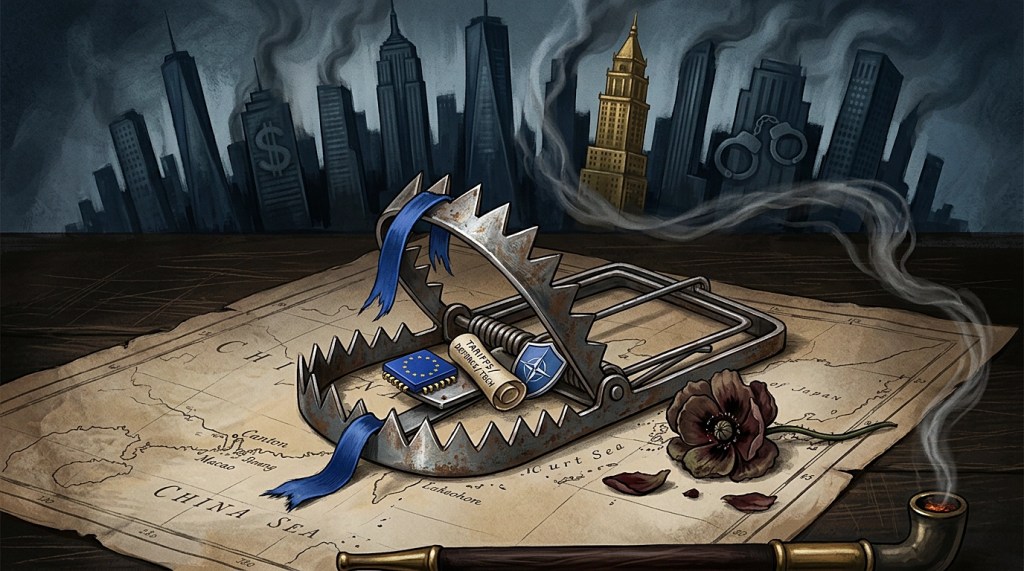
The historical parallel for what has gone wrong is not comfortable. In 1842, China was humiliated in the Opium Wars — not primarily because of military failure. China slept through the restructuring of the world around it. Europe in 2026 is making the same error. The world has restructured around it and the techniques it refuses to learn are strategic literacy. The cost of that refusal is becoming existential.
The American shield has long functioned as an opiate for the political classes, rendering European leaders senseless to their own demise
The Opium Wars, Ambiguity & Chinese Realignment
China’s humiliation in the Opium Wars was a culmination of various failures, but primarily it was because it relied on a picture of the world that had become obsolete and it failed to take account of changes in naval power and how they impacted the translation of economic strength into geopolitical power. It took China over 100 years to recover – a ‘century of humiliation’ that ultimately led to its dissolution into fragmented fiefdoms ruled by war lords.
Today in 2026 Europe is doing the same thing. To that extent von der Leyen’s speech was correct as a warning about Europe failing to adapt to the challenges it faces.
Europe has been negligently over-confident in a US alliance that has spent thirty years working to prevent European strategic independence (including an integrated European military capability – a capability which would have been very helpful when Russia attacked Ukraine or more likely would have avoided such an invasion).
Europe is structured for a multilateral framework and world that tripolar and bipolar physics is tearing apart. Europe’s policy is all too often to ask that people not do bad or undemocratic things, to be too slow to act or fail to act without unanimity (e.g. Hungary, Ukraine) or to seek permission from the great powers to do things which are in its own best interests.
The EU’s population, wealth and it’s economic and legal integration makes it a potential superpower however its structure and political culture makes it act like a committee of loosely bound weak countries.
Wei Yuan’s prescription — “learn the superior techniques of the barbarians in order to control the barbarians” — translates directly to what must be done: the EU must learn the superior techniques of great power competition in order to survive great power machinations. Not so that it can become a predatory superpower, but to acquire the strategic literacy necessary for survival and success. A strategic literacy and infrastructure that Europe has systematically avoided and outsourced – whether due to the demons of the two world wars fought on its seas, land and shores or perhaps also considering it a dirty business that is beneath its civilisational dignity.
People sleep peaceably in their beds at night only because rough men stand ready to do violence on their behalf.
(Unknown)
The second Chinese lesson is the more constructive one. In 1971, China was weaker than both superpowers by every conventional measure: smaller economy, inferior military technology, internationally isolated, nuclear but far below superpower parity. By no analysis was it a peer competitor to either the US or the USSR. And yet Kissinger identified — and Mao and Zhou Enlai exploited — the most powerful available position in a bipolar world: the third actor that both superpowers needed to court more than they needed to confront. The operational doctrine is simple: cultivate a better relationship with each superpower than the two superpowers have with each other and leverage uncertainty against each.
China occupied the Lagrange space precisely because it was weaker than both the US and the Soviet Union – making its alignment a prize both superpowers competed for and its ambiguity the source of leverage over both simultaneously. China maintained this position for twenty years by being strategically disciplined. Never fully committing to either superpower. Making both believe alignment was available and extracting the price of that possibility from both simultaneously. The moment China’s alignment became certain in either direction, the leverage would have evaporated. The power came entirely from credible uncertainty about which way it might tilt.
Europe currently signals its US alignment so clearly that it has no real leverage. That is its entire strategic failure in one sentence.
In addition, the current European dynamic with China is ready for realignment given that China is not as strong as it seems.
“China is now acting primarily from a position of vulnerability ...these vulnerabilities create scope for a more proactive, leverage-based EU diplomacy.”6
(Garcia-Herrero and Rühlig)
The conventional assumption underpinning European China policy has been that Beijing’s power is inexorably rising and that Europe must manage this from a permanently defensive crouch. The EU Institute for Security Studies challenged that assumption in a major paper published this month.
Garcia-Herrero and Rühlig document four compounding structural crises that will define China’s trajectory for the next decade:
- A rapidly ageing population: whose workforce is already shrinking by nearly eight million people per cycle;
- Chronically weak domestic consumption: driven by a collapsed real estate sector that represents 80% of household wealth;
- Public debt approaching 100% of GDP: with local government financing vehicles concealing a non-performing loan ratio that Chinese officials privately estimate at 15–20%; and
- Rising international technological barriers: as US export controls on semiconductors and quantum technologies close off the innovation pathways China’s growth model depends on. Officially China grew at 5% in 2025. The EUISS projects this falling below 2.5% within ten years, with some analysts placing it as low as 1% as early as 2026.
Chinese fragility does not make Beijing more cooperative – the report is emphatic that vulnerability makes China more coercive, not more benign, as the CCP doubles down on manufacturing dominance, rare earth export controls, and assertive nationalism to divert attention from domestic economic grievance. However, it does make China dependent on things Europe specifically provides such as: access to the European single market for the sophisticated, high-margin goods China can no longer sell at full price in Asian, African, and Latin American markets; European technology and research in semiconductor manufacturing equipment and 6G development; and the institutional legitimacy that only European engagement can supply.
The window for leverage-based diplomacy – the triangular strategy this article advises – is open and best taken advantage of now precisely because China is fragile. That window closes as China’s self-reliance drive succeeds. Europe must take advantage of this window while it still can. As the report states:
“This leverage will not last indefinitely. Without a change in policy, China will continue to gradually reduce its reliance on European technology. The EU …needs to act now.”
A Network of Criminal Enterprises
The polite, academic fantasy of European strategy has always been this: build just enough ‘autonomy’ to ask for a better seat at the American table. This assumes a host who still respects the rules. But the Trump administration has made it clear that European subservience isn’t a virtue to be rewarded but a weakness to be exploited. We are no longer dealing with a partner who values alliances instrumentally. Trump and his criminal friends are entirely predatory and view our institutional manners as a sign of decay and weakness.
“Europe’s policy of subservience has failed. The Trump administration clearly considers European subservience a sign of weakness.”7
After a year of attempting to accommodate Washington — signing an unbalanced tariff agreement that significantly harms European economies, committing to 5% GDP military spending targets arbitrarily imposed by a foreign president – Europe received not security and not respect, but increased pressure, continued anti-EU rhetoric, and interference in European domestic politics. It has also seen a US administration more supportive of Russian strategic objectives in the Ukraine war than those of its European allies.
Trump’s National Security Strategy8 – a 33-page document – crossed the rubicon. It explicitly praised “patriotic European parties,” including the AfD (designated by German intelligence as extreme-right). It’s a blueprint for a regime-change operation conducted against democratic partners. By explicitly endorsing the very parties designated as extremists by our own intelligence services and framing European unity as ‘civilizational erasure,’ Washington has moved beyond ‘disagreement’ and is now openly actively working to dismantle the European project from within.
“What I think is actually important for everybody to understand is that the US has been very clear that they want to divide Europe. They don’t like the European Union”9
(Kaja Kallas)
The report accused EU institutions of “undermining political liberty and sovereignty.” It characterised European democratic norms as threats. It was designed not to delegitimise European institutional responses to attack by this US administration. This is not strategic rivalry – it is assault.. It is a regime-change operation conducted against democratic partners and institutions by a US administration (with the support of its public-private partners like Musk and Thiel). The US administration and its private sector allies are effectively a network of overlapping criminal enterprises. The US and Russia look more and more similar every day.
Foreign Policy magazine asked in March 2025: “Is America a Kleptocracy?“10
The question mark was a journalistic convention, where the question provides the answer. The facts can no longer be in dispute, as we witness the transformation of a global hegemon into a predatory kleptocracy: the systematic dismantling of anti-corruption laws and enforcement, the pardoning of criminals (including sexual abusers) aligned with the administration, the concentration of economic decision-making in a small circle of personally loyal oligarchs, the weaponisation of the Justice Department against political opponents.
It bears remembering that the Soviet Union didn’t implode following defeat on a battlefield – it rotted from the inside out. It fell because of four specific features (or pathologies): a kleptocratic elite, imperial overstretch, a rigid ideology that couldn’t adapt, and a terminal gap between stated principles and how power was used and actually translated. By 2026, all four of these cancers are visibly eating the American body politic. From the systematic hollowing out of the State Department to the ‘DOGE’ project’s deconstruction of the administrative state, the infrastructure of American global power is being cannibalised by its masters. Trump and team actively target a weakened USA for self-interested profit and power motives.11
The asymmetry with the Chinese position in respect of the EU is striking. China’s official position — stated by Xi Jinping and Wang Yi explicitly and repeatedly at the highest level — is that it supports European strategic autonomy.12 A coherent EU reduces US leverage and creates diplomatic space Beijing can use. China wants a dependent Europe – specifically dependent on Chinese supply chains, technology, and infrastructure. However, it needs the EU institutional framework to function to make that dependency possible.
We must understand the asymmetry of the threats surrounding us. Beijing wants a dependent Europe – a client state locked into its supply chains and infrastructure. But Trump wants a dissolved Europe – a fragmented collection of vassal states that can be picked off one by one through bilateral coercion. Dependency can be managed through strategic conditionality but dissolution is a terminal event. We have spent years monitoring and publicly decrying Russian and Chinese interference, yet remained silent as our closest ‘ally’ conducted the same operations with more efficiency and no shame. That must change immediately.13
Securing The Lagrange Point
Europe is not weak. The EU’s GDP is approximately €18 trillion – Russia’s is €1.7 trillion. EU defence spending exceeds Russia. The EU has the world’s largest single market, its most sophisticated regulatory architecture, and a technology base that Russia’s sanctions-crippled industrial capacity cannot match.
Europe behaves as a smaller weak player because it refuses to act coherently and cohesively as one.
Newton showed that force = mass * acceleration. Europe has the economic weight of a superpower, but almost no mechanisms to translate that into political force in its own defence and for its own foreign policy interests. It is very slow to act, as witnessed with its failures to take action against Hungary.
“Shape without form, shade without colour,
( T. S. Eliot)
Paralysed force, gesture without motion”14
Russia, China and the US act as one body in their pursuit of their foreign policy interests. The EU acts as twenty-seven, requiring unanimity, parliamentary ratification in multiple capitals, months of negotiation before any commitment can crystallise. Furthermore the UK, which still has some economic mass and geopolitical influence, is not even within the EU anymore. This further weakens the UK and the EU (and we must remember that Brexit was actively encouraged by Putin and Trump).
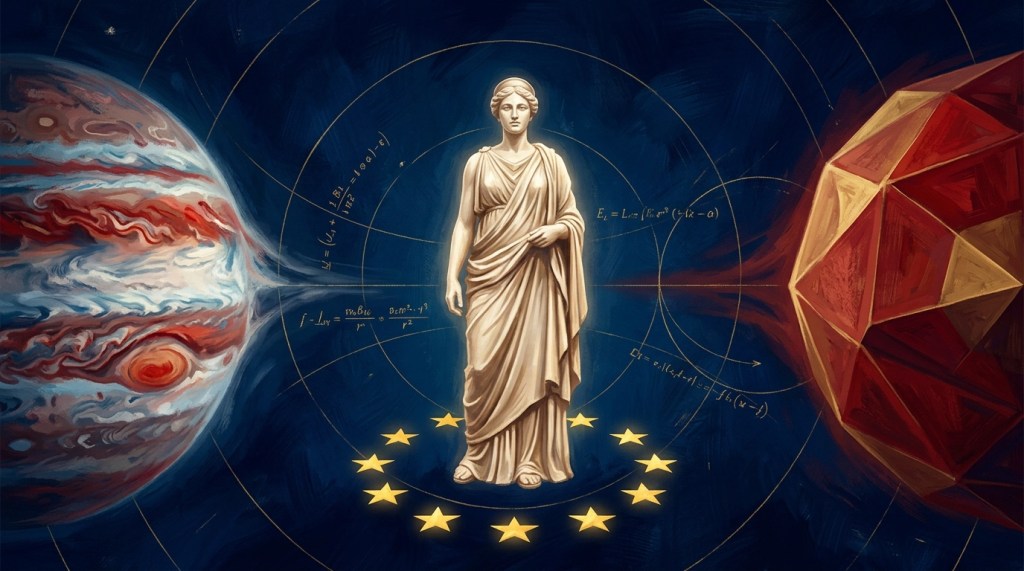
So how does the EU ensure it sits within a safe geopolitical Lagrange space?
It requires a leveraged ambiguity dynamic:
- Better EU-China relations than US-China relations – enough genuine engagement that Washington cannot take European support for China containment for granted.
- Better EU-US relations than China-US relations – not subservience, but enough strategic partnership that Beijing cannot take European neutrality for granted either.
Neither stance is a bluff but they require resolve and careful continuous positioning and negotiation. It can only work if there is credible uncertainty – from both superpowers calculating that European strategic alignment is available to them but not guaranteed. The moment either certainty is established, the leverage disappears. This means we need much stronger centralised EU institutional strength across a wide range of areas (intelligence, trade negotiation, increased technological and military independence).
Occupying the safe Lagrange space requires us to speak a language we have spent decades unlearning: one of transatlantic transactional conditionality. Every critical mineral deal with the US must be the price for non-interference in our defence industrial base. Every market access concession to China must be the price for their restraint on our borders. We must stop being the theatre where others play out their rivalries and geopolitical aims and instead create enough of a gravitational centre that it forces them to adjust their trajectory.
“The secret of politics? Make a good treaty with Russia.”15
(Otto von Bismarck)
The Age-Old Russia Question
The absorption of Russia into China’s sphere is catastrophic for Europe because it adds geo-political mass to China that can be used as leverage against Europe. China can destabilise Europe by aiding Russia while facing low risk of retaliation in its own borders.16 This is only made worse by a very unusual informal alliance between Putin and Trump, which had left Ukraine and Europe on its own.
“The reciprocal dynamic between Russia and China is prolonging the war in Ukraine”17
(ECFR)
Looked at clinically, Russian strategic independence is a European public good because a Russia more independent of China has interests that partially align with Europe’s: energy revenues, technology access and the dignity of not being subservient to Beijing’s interests.
This is not appeasement and there is a historic parallel with the 1815 Congress of Vienna model whereby France was readmitted to the Concert within five years of Napoleon’s defeat. This was agreed because a manageable France served everyone’s interests better than a permanently crushed one. The rise of fascism in Germany in the 1930’s, following a punitive post WW1 peace, was compelling proof of the wisdom of such an approach.
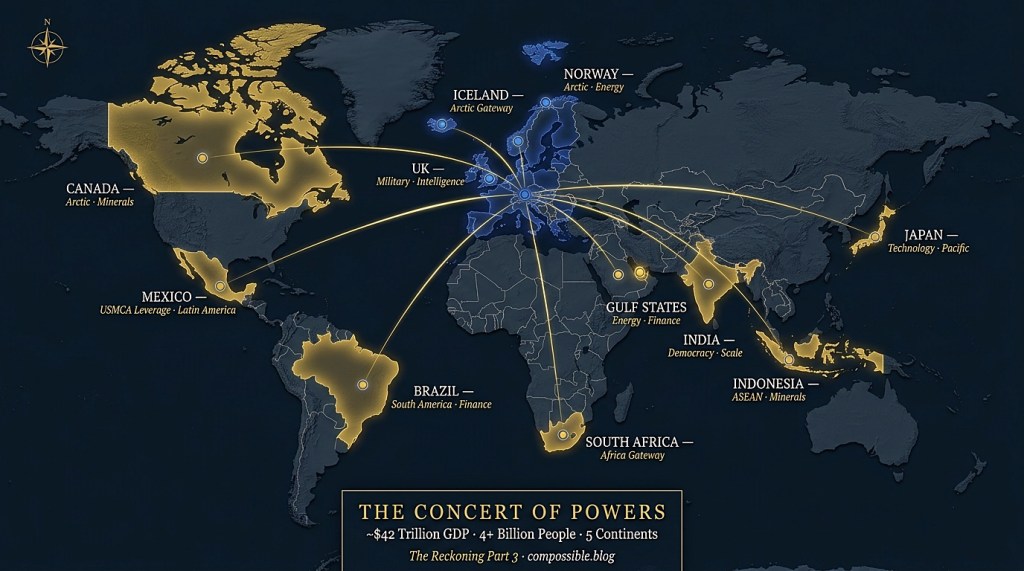
The Concert’s architecture was demanding but achievable: specific terms addressing the legitimate security concerns of all parties.
“China derives considerable benefits from a weakened but stable Russia — one increasingly dependent on Beijing for economic markets, technological alternatives and diplomatic cover.”18
The new European Russian strategy must involve:
- 1. Separating Putin from Russia: Design the post-Putin architecture now. The offer of re-entry into a managed multipolar framework is itself a strategic instrument that changes calculations inside Russia among actors who can see the cost of Putin’s folly in Ukraine and where absorption by China is leading.
- 2. Make the sanctions relief architecture explicit and conditional: tied to specific verifiable Russian behaviours, with the most significant relief tied to the most significant strategic change required i.e. verifiable reduction of military and technological dependence on China. Maximum sanctions with no off-ramp eliminate the leverage the sanctions were meant to create.
- 3. Rebuild OSCE frameworks19: It is the one multilateral institution that includes both Russia and all EU member states and was designed for exactly this purpose.
Obviously offering Russia a conditional off-ramp creates a new game in which Moscow can signal willingness to negotiate while continuing to prosecute the war — extracting concessions from the European offer and continued Chinese support simultaneously. Russia has no incentive to make the costly signal that would prove the offer is genuine, and Europe has no way to distinguish real strategic realignment from tactical delay designed to buy time and divide Western resolve. The answer is not to withdraw the offer but to specify in advance the single verifiable, costly signal required before sanctions relief architecture is activated. That signal must be military and physical, not rhetorical: a verified, monitored withdrawal to pre-2022 lines in a defined sector, independently confirmed by OSCE observers. Talk does not trigger the off-ramp, only a costly signal will suffice.
As with the Chinese strategy, the new Russia strategy can only work if Europe clearly and public signals its new relationship of strategic ambiguity with the US. In addition, we can not monitor and verify Russia’s actions without our own CS4R and intelligence services. An independent autonomous EU military organisation and intelligence agency ensures that we do not need US permission or know-how to manage the Russian threat or relationship and it also avoids Europe being dragged into future conflicts with Russia based on US foreign interests.
Footnotes
These articles are created with the Assistance of AI tools including Claude, Gemini and Notebooklm.
- Stackelberg competition is the game-theoretic model of sequential market interaction in which a leader firm commits first and a follower firm then optimises against that commitment. The leader obtains a systematically higher payoff not through superior resources but through the credibility of its prior commitment. First formalised by Heinrich von Stackelberg in 1934, the model has since been applied extensively to arms races, trade negotiations, and alliance formation. Heinrich von Stackelberg, Marktform und Gleichgewicht (Julius Springer, 1934); for a modern treatment, see: Wikipedia, Stackelberg Competition. ↩︎
- The Brussels Effect — the mechanism by which EU regulatory standards become de facto global standards because multinational firms find it more efficient to comply with the highest applicable standard across all markets rather than maintaining parallel compliance regimes — was systematically documented by Anu Bradford of Columbia Law School. Its application to GDPR, pharmaceutical standards, food safety regulations, and increasingly the AI Act makes the EU the world’s most consequential regulatory actor, despite its relative weakness in military and financial instruments. Anu Bradford, The Brussels Effect: How the European Union Rules the World (Oxford University Press, 2020); see also Wikipedia, Brussels Effect. ↩︎
- Sun Tzu’s The Art of War, composed in the 5th century BC during the Chinese Spring and Autumn period, remains the foundational text of strategic thinking across East Asian military and diplomatic traditions. Its emphasis on information asymmetry, deception, and positional advantage over direct confrontation is directly relevant to the Lagrange point doctrine developed in this series. Sun Tzu, The Art of War (c. 5th century BC); translation by Lionel Giles (Luzac, 1910) remains the standard English scholarly edition. ↩︎
- The CSIS analysis documents the historical record of US opposition to European strategic autonomy across administrations, from Clinton’s use of NATO expansion to bind new member states to Washington rather than Brussels, through Obama’s sustained diplomatic opposition to PESCO, to Trump’s explicit demands that European defence spending flow to American contractors. The paper is notable for acknowledging what most transatlantic commentary declines to state: that the constraint on European strategic independence has been a deliberate and consistent feature of US alliance management, not an oversight. Center for Strategic and International Studies, The United States Now Wants European Strategic Autonomy (2025). ↩︎
- The Parliament Magazine’s investigation into the depth of European defence dependency on the United States documents that the problem extends far beyond hardware procurement to encompass intelligence architecture, targeting systems, logistics software, and officer training pipelines — dependencies that were deepened, not reduced, in the decade following Trump’s first term in 2017. This is the most damning single data point in the Stackelberg audit: Europe’s response to the first demonstration of US unreliability was to increase its reliance on the US. The Parliament Magazine, Europe’s Defence Reliance on the US Runs Deeper Than Hardware (2025). ↩︎
- García-Herrero and Rühlig’s March 2026 Chaillot Paper is the most rigorous current quantitative assessment of China’s structural economic vulnerabilities, drawing on IMF data, People’s Bank of China disclosures, and anonymised interviews with Chinese officials and government-affiliated researchers conducted in Beijing in December 2024 and November 2025. The paper’s central finding — that China is acting from vulnerability rather than confidence — represents a significant departure from the prevailing consensus in European China policy circles. Alicia García-Herrero and Tim Rühlig, China: A Fragile Power? How Europe Can Use Its Economic Leverage Over Beijing, Chaillot Paper 188, EU Institute for Security Studies, March 2026. ↩︎
- The Carnegie Endowment’s February 2026 analysis is the most practically detailed assessment of the instruments available to European institutions in response to Trump 2.0’s coercive posture, including the Anti-Coercion Instrument, Democracy Shield legislation, and financial architecture alternatives to dollar-denominated sanctions. Its central conclusion — that subservience has failed and that the administration interprets accommodation as weakness — directly informs the strategic pivot argued for in this series. Carnegie Endowment for International Peace, What Can the EU Do About Trump 2.0? (February 2026). ↩︎
- Trump’s December 2025 National Security Strategy — a 33-page document notable for its explicit endorsement of European far-right parties including the AfD, its characterisation of European institutional unity as “civilisational erasure,” and its framing of EU democratic norms as threats to liberty — crossed a threshold that no previous US National Security Strategy had approached. The document constitutes a formal statement of intent to conduct political interference operations against democratic partner governments and should be read as such. White House, National Security Strategy of the United States (December 2025). ↩︎
- Kaja Kallas’s statement was made in the context of her response to the Trump administration’s National Security Strategy endorsement of European far-right parties and its explicit anti-EU framing. Kallas, serving as EU High Representative for Foreign Affairs and Security Policy, made the remarks in an interview published by the Financial Times on 13 March 2026 — the same day as this article’s publication — confirming that the most senior EU foreign policy official shares the assessment of US intent made in this series. Henry Foy, ‘EU Must Stick Together Against Trump’s Hostile Tactics, Says Top Diplomat’, Financial Times (13 March 2026). ↩︎
- Foreign Policy magazine’s March 2025 investigation into the transformation of US federal institutions under the Trump administration — documenting the systematic dismantling of anti-corruption enforcement, the concentration of economic decision-making in a circle of personally loyal oligarchs, the weaponisation of the Justice Department against political opponents, and the pardoning of criminals with administration connections — provided the most detailed early account of the kleptocratic transformation described in this article. The question mark in the headline was a journalistic convention; the evidence assembled made the answer clear. Foreign Policy, Is America a Kleptocracy? (March 2025). ↩︎
- Sarah Kendzior, scholar of authoritarian states and early analyst of the Trump administration’s structural character, has documented in detail the family financial entanglements, organised crime connections, and kleptocratic operating methods that distinguish the Trump administration from conventional right-wing populism. Her analysis of the four Soviet-style pathologies now visible in the American body politic — kleptocratic elite, imperial overstretch, ideological rigidity, and constitutional gap — provides the framework used in this section. Sarah Kendzior, Your Questions Answered: Trump Term 2, Substack (2025). ↩︎
- The European Parliament’s 2024 study on China’s position toward European strategic autonomy documents Xi Jinping’s and Wang Yi’s repeated explicit statements supporting EU strategic independence — and analyses the strategic logic behind that position: a coherent EU reduces US leverage in ways that create diplomatic space Beijing can use, while the EU institutional framework is necessary to make European economic dependency on China viable. The study concludes that China’s support for EU autonomy is genuine but entirely instrumental. European Parliament, China and European Strategic Autonomy, EXPO Study (2024). ↩︎
- The Le Monde analysis by historian Timothy Snyder draws the structural parallel between Putin and Trump not at the level of personal psychology but at the level of political method: both leaders operate through the systematic degradation of the distinction between public interest and private enrichment, both use revisionist historical narratives to delegitimise existing institutional constraints, and both treat democratic norms as obstacles rather than foundations. The parallel is directly relevant to the asymmetry of threats facing Europe documented in this section. Timothy Snyder, ‘Between Putin and Trump: A Similarity Born of Hatred, Contempt and Revisionism‘, Le Monde (4 February 2026). ↩︎
- T.S. Eliot’s The Hollow Men (1925) is one of the defining modernist statements on political and moral vacancy — the condition of institutions and individuals that retain the form of authority while having lost its animating substance. The lines quoted — “Shape without form, shade without colour / Paralysed force, gesture without motion” — describe precisely the gap between Europe’s structural weight (€18 trillion GDP, the world’s largest single market) and its political capacity to deploy that weight as strategic force. T.S. Eliot, The Hollow Men, first published in Poems 1909–1925 (Faber & Gwyer, 1925). ↩︎
- Bismarck’s remark on Russia — reported by A.J.P. Taylor as the private expression of Bismarck’s strategic method rather than a formal statement — captures the foundational insight of 19th-century continental statecraft: that a great European land power cannot be secure without a managed relationship with its largest eastern neighbour. The insight applies directly to the European Russia strategy outlined in Part 9 of this article. A.J.P. Taylor, Bismarck: The Man and the Statesman (Hamish Hamilton, 1955), ch. 7. ↩︎
- The ECFR’s 2025 analysis of the China-Russia nexus documents in detail how Beijing has provided Moscow with economic markets, technological alternatives, and diplomatic cover since 2022 — while carefully avoiding direct military supply that would trigger Western secondary sanctions. The paper concludes that the relationship currently favours China decisively, with Russia increasingly locked into dependency without reciprocal leverage. This strategic imbalance is the starting point for the European Russia strategy proposed in Part 9. European Council on Foreign Relations, Great Changes Unseen: The China-Russia Nexus and European Security (2025). ↩︎
- The ECFR article on Chinese funding for the Russian war effort in Ukraine — documenting dual-use technology transfers, currency swap arrangements, and the role of Chinese financial institutions in helping Russia circumvent Western sanctions — provides the detailed evidentiary basis for the claim that China is actively prolonging the conflict. The article argues that a European response is overdue and that the instruments available to the EU are significantly underused. European Council on Foreign Relations, Funding War, Courting Crisis: Why China’s Support for Russia Requires a European Response (2025). ↩︎
- The SWP Berlin analysis of the China-Russia relationship — from which the quotation in this section is drawn — provides the most rigorous current assessment of how China is managing Russian dependency: keeping Russia weakened enough to remain dependent, stable enough to remain useful, and isolated enough to have no alternative to Chinese partnership. This is the strategic logic that makes Russian strategic independence a European public good, as argued in Part 9. German Institute for International and Security Affairs (SWP), Russia’s Strategic Dependence on China (2024). ↩︎
- The European Parliament Research Service brief on the OSCE — the Organisation for Security and Co-operation in Europe — documents its founding mandate, its unique membership (the only multilateral institution that includes both Russia and all EU member states), and its current institutional paralysis. The OSCE’s 1975 Helsinki Final Act framework, which explicitly linked security, economic cooperation, and human rights in a single negotiating architecture, remains the most sophisticated model available for a managed post-conflict European security order. European Parliament Research Service, The OSCE: Challenges and Perspectives (2021). ↩︎




 Compossible - that which can live together
Leave a comment