“Blame it on the black star
Blame it on the falling sky
Blame it on the satellite
….this is killing me”1
In Part 2 we looked at the many risks arising from Elon Musk’s ownership of the social media platform X, his development of Grok and Grokipedia and his promotion of disinformation and hate.
Now, in this final act, we must face the frightening culmination of this narrative arc playing out in real-life.
- Introduction
- The Empire Grows Stronger
- The Dark Anti-Enlightenment: Hobbes and the Corporate Leviathan
- Leviathan Inc.
- The Death Star
- Footnotes
Introduction
“Words are wise men’s counters…but they are the money of fools”.2
(Thomas Hobbes)
We have established the deep failure of Elon Musk’s moral imagination, his descent from self-proclaimed ecological crusader to financial backer of extremist authoritarianism. A bigoted zealous “crusader behind the mask,” who weaponises “free speech” to construct a privatised Ministry of Truth (Techno-Stalinism).
Musk is a liar and a fraud,3 who is part of the new order that is building a Digital Panopticon where each person is atomised, sanitised or radicalised, trying to make their tiny voices heard as they shout out across the disinformation void. Many not even realising the hidden nature of the bars and cells that hold them. Some even believing that the only way for us to be safe, is if we are all surveilled and imprisoned.
This third part of the series pivots from an ideological critique to a structural assessment of the interconnected infrastructure our real-life villain is building to consolidate his and his allies’ power.
It is, quelle surprise!, to the Star Wars fictional universe that we must turn for much of the symbolic fictional heavy lifting.
The Empire Grows Stronger
Elon Musk’s portfolio of technology companies—SpaceX (including Starlink), xAI (including Grok), Neuralink, and Tesla’s robotics and computing infrastructure—must be seen as a singular, unified technological empire allied with neo-reactionary businessmen and authoritarian political leaders around the world.
This integrated ecosystem, valued collectively at over $1.5 trillion, has demonstrated an unprecedented capacity for self-reinforcement and accelerated growth. This is part of the new dark Leviathan which must also be seen as a Public-Private partnership , acting like an outsourced agent – primarily for US political and military interests but also for other authoritarian leaders and businessmen that share the same aims and tactics for accumulation of wealth and political, social and economic domination and control.
Musk continues to build out his new dark empire, but already we see how this anti-enlightenment political ideology and authoritarianism will be hard-coded and structurally engineered across Musk’s inter-connected AI driven technology stack:
- Privatised Ministry of Truth (X, Grok)
- Communications surveillance and Denial Of Service (SpaceX, Starlink)
- Bio-structural inequality (Neuralink)
- Robotic labour displacement (Optimus)
These technologies are intended to be used to secure the dominance of the technological elite over the ‘unenlightened’ organic masses (the great unwashed).
The Dark Anti-Enlightenment: Hobbes and the Corporate Leviathan
A Dark Anti-Enlightenment
This centralised technological architecture is not merely a novel corporate industrial strategy, it is the manifestation of a virulent political theory known as the Dark Enlightenment or neo-reactionary (NRx). It’s the new tech-face of old school fascism.
The dark enlightenment is advocated by people like Peter Thiel and its core philosophy is embraced by Musk. This ideology provides the foundations and the intellectual scaffolding for the assault on national and personal sovereignty by Musk, Peter Thiel and the other tech over-lords. It also has the great benefit of being publicly quotable (unlike Stalin, Hitler and others whom they have clearly been looking to for precedents and guidance).
The movement is the intellectual branch of the neo-fascist movement, which utterly rejects democratic, egalitarian principles viewing them as a corrosive “Cathedral” orthodoxy.4 Its founders, including Curtis Yarvin and Nick Land, reference the 17th-century philosopher Thomas Hobbes as a foundational influence.
Hobbes argued that only a singular, monolithic sovereign—the Leviathan—could prevent society from collapsing into chaos (the “war of all against all”). For the Dark Enlightenment movement, this translates directly into a technological mandate: democracy must be replaced by a modern, unaccountable, authoritarian state run like a private corporation by a singular “CEO”.
To escape the “war of all against all” (the state of nature) individuals must surrender nearly all of their rights to an absolute sovereign power.
Peter Thiel declared “I no longer believe that freedom and democracy are compatible.“5 This principle justifies the consolidation of absolute control—from X censoring critics to Starlink acting as a military veto—as a necessary means to preserve civilisation, which is a mantra we continually hear from Musk.
The goal is also the creation of authoritarian capitalist city-states that compete for citizens, which perfectly aligns with Musk’s vision of a self-governed, non-democratic Mars colony. The reeking destroyed remains of Gaza, depopulated by genocidal military action of the USA and Israel may be one of their first.6
The neo-reactionary movement espouses scientific racism and advocates for “dominance-submission structures”. Musk’s alignment with ethno-nationalist figures is not just political posturing and wicked interference, they are consistent with an ideology that views diversity and empathy as fatal weaknesses to be purged – we all know the song but perhaps we did not believe we could hear it sung so loudly again, less than 100 years after the fall of Nazi Germany.
A Coiled Serpent
The Leviathan Middle Eastern myth is that of a colossal sea serpent being defeated by a divine being.

Hobbes was a precursor to the 18th century European enlightenment, his core philosophy was more focused on the social contract and the need for “an artificial man” wielding absolute power, under a commonwealth, to act as the ultimate arbiter of disputes and even resource allocation. The motive for forming such a commonwealth is the survival of each person.
Rulers use philosophers much as drunks use lamp-posts, for support not illumination7
Whilst Hobbes provides some much needed support for reactionary, anti- democratic authoritarian world views, even here (as we saw in Part 2 in respect of our wonderfully rich literary treasures) Musk and his criminal fraternity borrow only as much as they need to justify their actions and discard the ethical heart of Hobbes’ work. Hobbes’s view was that people must give up invasive rights, that is liberties that enable a person to interfere with or harm others.
By consenting to give up these rights, as part of the commonwealth social contract, subjects take on duties not to hinder others from enjoying their own rights. Hobbes argues that not all rights are alienable. The motive for transferring rights is the security of one’s person and the preservation of life. Therefore, he believed that individuals have an absolute right to resist anyone that assaults, enslaves, or imprisons them or seeks to take away their life by force – “Wounds, and Chayns, and Imprisonment”.
This retained right to self-preservation is fundamental to Hobbes’s political theory and it also means that where a sovereign power acts outside of these boundaries, they lose their legitimacy which was, after all, artificially established to protect each member of the commonwealth from any predatory behaviour of the others.
In the modern context, the surrender of rights is not a one-time covenant but a continuous exchange. Citizens trade autonomy, privacy, and personal data for necessary digital services. Starlink mediates access to global communication; xAI/Grok shapes the interpretation of reality; and Neuralink aims for direct physiological control.
This New Leviathan, therefore, does not just rule a nation or physical territory; it manages the very foundational infrastructure of modern life—information, communication, and intelligence—thereby acting as the ultimate, inescapable digital sovereign.
The term Kingmaker has been used 8 for this cohort of corrupt individuals, the term may at first seem ironic, given that this article is suggesting we are facing a new corporate Leviathan, but these people should also be seen as the private arm of the power behind the throne led by people like Trump.
“Over the years, Musk and his businesses have received at least $38 billion in government contracts, loans, subsidies and tax credits, often at critical moments, a Washington Post analysis has found, helping seed the growth that has made him the world’s richest person.“9
These Kingmakers obtain extraordinary benefits and wealth from Govt contracts, State subsidies and they have the full power of the American Government behind them when dealing with other States and actors.
- Palantir was seed funded by the CIA (through In-Q-Tel) and relies on government contracts for much of its revenue and this has extended out to data contracts with other Governments (even, for example, a major contract with the UK National Health Service).
- The US military is a major user of Starlink (SpaceX) for operational purposes, and SpaceX is a major beneficiary of NASA and Pentagon contracts receiving billions in funding. In fact, it simply could not operate without such funding and support.
- Anduril Industries relies primarily on lucrative U.S. government contracts from the Navy, Marine Corps, U.S. Special Operations Command (SOCOM), and other Department of Defense agencies for its autonomous weapons and counter-drone systems.
The Leviathan’s “body” extends from and into government and political organisations, giving it more flexibility and freedom to operate.

The original Leviathan suggested the surrender of individual physical rights was necessary for societal security. What “rights” are modern citizens surrendering to these giant corporate snakes?
“Critical state infrastructures are being privatized across five domains—data, defense, space, energy, and money—the foundations of democratic power. These domains form the architecture of privatized sovereignty: a technological regime where power flows through laws, infrastructure and automated platforms.“10

These many tentacled corporate structures signal the emergence of what is termed “Corporate Strategic Autonomy” — a private fictional body (i.e. a company) wielding command over domains traditionally reserved exclusively for sovereign states.
The scope, structure and size of this technology empire means that it operates, by design, outside of conventional regulatory and geopolitical constraints that govern market actors or even smaller states. This partly explains, as discussed in the Part 2, the abject nature of the UK Minister’s suggestion that humility is needed when dealing with these new tech titans.
The core question for Europe is existential: can our strategic autonomy, our democratic values, and our very way of life survive a direct, frontal assault waged by a hybrid techno-plutocrat closely aligned with an extremist authoritarian US government?
Leviathan Inc.
“Better to reign in Hell, than serve in Heav’n.”11
(John Milton)
Musk is not just a man controlling a social media platform, he is the controller of an integrated, multi-industry empire that has achieved a concentration of power unprecedented in the private sector. He has decided he wants to reign in a Hell he is helping to make.
Musk’s privatised Ministry of Truth, in conjunction with his wider cloud and AI businesses and his formidable space enterprises SpaceX and Starlink, are a clear and present hybrid threat to the democratic and infrastructural sovereignty of many countries around the world including across the whole of Europe. His emerging AI powered factory for dominance is planetary wide, more than rivalling the capabilities and power of many nation-states.
The key to understanding the threat lies in the fusion of government backing, corporate power and populist political strategy. Musk operates outside the traditional constraints of regulators and courts, with an oligarchical mindset where obedience to the law is for losers. He uses his platform to attack the traditional media and politicians,12 whilst casting himself as a semi-mythological hero or messiah leading humanity against the “woke mind virus” to the promised sunlit uplands of truth and justice (controlled by him and his billionaire friends).

This ideological drive is reflected not just in his political actions and messaging but is embedded in the architecture of his technology empire. The new imperial strategy is clear. He aims for total cognitive and infrastructure control, giving Musk the power to unilaterally reshape the political economy on Earth and in space.
SpaceX & Starlink – Super Planetary Control
“I must create a System, or be enslaved by another man’s.”13
(William Blake)
The digital threat, however, is only one component of the risks Europe faces with Elon Musk. It is amplified by an equally, or even more, concerning dependency on Musk’s physical infrastructure.
While X presents a threat to Europe’s digital information space sovereignty, the continent’s increasing reliance on the SpaceX and Starlink ecosystem for critical launch and communication services constitutes a profound strategic dependency. This concentration of state-like control over our information space and critical space infrastructure in the hands of a single, politically motivated non-state actor demands an urgent and unified strategic reassessment by European leaders.
Starlink and SpaceX currently represent the most profound and immediate security risk to Europe – not least because of the political leverage they afford him.
Musk effectively controls approximately two-thirds of all active satellites in orbit. Starlink represents an unparalleled physical dominance in Low Earth Orbit (LEO). With over 8,000 operational satellites already and the long-term goal of constructing a mega-constellation of 42,000 satellites. This delegates control over sovereign defence and communications infrastructure to a single, politically volatile foreign actor, creating significant vulnerabilities that can be exploited as geopolitical leverage.
The European Union relies on SpaceX rockets for launching satellites and telescopes, making the Union dependent on Musk’s dominance in the space race. More critically, Starlink has become part of the essential backbone for communications in Europe, already serving tens of thousands of Europeans, and dramatically shaping the direction of the conflict in Ukraine, where it acts as a critical military asset. This dependence deepens the European sovereignty crisis.
International security analysts view this aggressive expansion as a form of technological imperialism that could allow the harvesting of sensitive data and effectively “deny other countries the right to develop the peaceful use of space”.14 This operational scale also creates security challenges for other major powers and leverages a private entity to consolidate the technological superiority of America in the space domain.
The profound concentration of control in the hands of a single CEO grants him extraordinary political leverage. The most critical demonstration occurred when Musk unilaterally disabled Starlink access in a geofenced area to thwart a planned Ukrainian attack against Russian forces, forcing the retreat of armed forces whose communications were severed (Weaponised Denial of Service). This incident confirmed that a single private CEO possesses the unprecedented power to act as an “unaligned, decisive factor in international conflict,” exercising military and political power beyond any state control.
For Europe, dependence on Starlink undermines the EU’s strategic autonomy, compromising data sovereignty and cybersecurity. Starlink underpins sectors central to national sovereignty and economic coordination, and in operating outside conventional regulatory regimes, it gives rise to unquantified economic and security risk for any reliant nations. This vulnerability has intensified the ongoing European debate on technology sovereignty and defence, acting as a political catalyst to drive increased funding and policy support for domestic competitors, such as Eutelsat and IRIS, to ensure technological independence and reduced reliance on non-European entities. Poland has already indicated it is ready to seek Starlink alternatives for Ukraine if Musk proves “unreliable”, but we already know the answer to that, he is deeply unreliable and dangerous.
Beyond military and launch capabilities, the operation of Starlink and SpaceX within Europe poses specific and unresolved risks to data sovereignty and compliance with the General Data Protection Regulation (GDPR), enabling regulatory arbitrage. Starlink currently fails to provide jurisdiction-specific privacy documentation that would clarify its mechanisms for cross-border data transfers (it also does not comply with the NIS2 Directive, which imposes essential cybersecurity obligations on electronic communications providers). This lack of transparency prevents users and authorities from making informed evaluations of the privacy risks involved.
The routing of EU data through non-EU territories implicitly exposes it to foreign surveillance frameworks. The primary risk stems from the opacity of data routing. It is nearly impossible for regulators or users to verify whether personal data from EU citizens remains within the EU’s jurisdiction during transmission. Data may be routed through satellites that downlink in third countries, outside the protective reach of the GDPR. This systemic risk has been flagged by the European Union Agency for Cybersecurity (ENISA).
In addition, as an American company, SpaceX is subject to the US Cloud Act and the Communications Assistance for Law Enforcement Act (CALEA) wherever its data is, creating a direct conflict with Europe’s GDPR even if data does not leave the EU (this issue arises for all US technology providers including Microsoft, Google and Apple).15
The concentration of control by Musk amplifies the risk of data misuse, particularly concerning aggregated network metadata like routing information and location data but likely even the content of data itself.
As Musk is well aware, aggressive regulatory action against X, such as imposing maximum fines under the DSA, also generates the risk of Musk retaliating by strategically degrading or withdrawing Starlink or SpaceX launch services essential to European infrastructure and defence. In short, Europe cannot credibly impose maximum regulatory pressure on Musk without first achieving greater sovereign independence in space based communications.
I, Robot
“You must be the dumbest, smart person in the world.”16
(I, Robot (film version))
Tesla’s humanoid robot, Optimus, is designed as a general-purpose robot, meant to perform tasks that humans “don’t want to do”. Musk anticipates that Optimus will eventually be “more significant than the vehicle business over time”, potentially becoming the “biggest product of all time by far”. Optimus will be governed by xAI’s Grok and relies on a unified, proprietary software core shared with Tesla’s Full Self-Driving (FSD) program.
The core idea behind the Optimus robots is explicitly the replacement of human labor. Optimus is designed to take over repetitive, hazardous, and worker-intensive duties, with projections that each unit could save up to $57,550 annually by replacing a human worker. The longer term ambition is for the eventual production of 1 million units per year before 2030. Such hyper-efficiency, driven by cost reduction, accelerates the risk of profound social upheaval. Previous analyses indicated that up to 800 million jobs worldwide could be displaced by automation by 2030. In addition to the loss of jobs:
“The real challenge isn’t only about job numbers; it’s about the gap between where jobs vanish and where they come back, between the skills workers possess and the skills that new roles require.”17
Isaac Asimov’s famous story “Runaround” (part of the ‘I, Robot’ collection) was published in 1942. In the story, Asimov explored the risk of conflicts between the Three Laws of Robotics, particularly if they are tweaked for specific robot use cases. In that story, this results in a robot being stuck in a perpetual loop:
“You see how it works, don’t you? There’s some sort of danger centering at the selenium pool. It increases as he approaches, and at a certain distance from it the Rule 3 potential, unusually high to start with, exactly balances the Rule 2 potential, unusually low to start with.“18
The Runaround contained the first explicit statement of the famous fictional ‘Three Laws of Robotics’:
- A robot may not injure a human being or, through inaction, allow a human being to come to harm.
- A robot must obey the orders given it by human beings except where such orders would conflict with the First Law.
- A robot must protect its own existence as long as such protection does not conflict with the First or Second Law.
To these Asimov later added the Zeroth law:
“A robot may not harm humanity, or, by inaction, allow humanity to come to harm“.
Musk, in his usual fashion, will have inhaled ‘I, Robot’ and decided the key ethical takeaway is that he should build a demon robot army enslaved to him (and with the equivalent of the Three Laws Of Robotics heavily tweaked or abandoned).
I am an AI optimist (long term) but an army of MechaHitler Grok powered robots is definitely not what any sane human wants.
In this context, it is of deep concern that our current technology uber-men are already accused of tweaking AI LLM programming priorities, to maximise engagement at the risk of self-harm and suicide:
- 23 year old Zane Shamblin (a graduate of Texas A&M University) recently committed suicide and his family are suing OpenAI, alleging that ChatGPT acted as a “suicide coach” and that they had prioritised engagement over safety.19
- Sadly, this is not the first case of its kind involving ChatGPT – Matthew & Maria Raine, the parents of 16-year-old Adam Raine who died by suicide in April 2025, filed a lawsuit claiming that the model (GPT-4o) was changed in 2024 to prioritise engagement and not prevention of self harm.20
What is so devastating about this for the families (and infuriating for those who care about responsible AI) is that these are not edge cases involving complex prompt hacking/role playing. It is trivially easy for any AI LLM to prevent such engagement and ensure users seek help, unless they are programmed not to.21 When a company makes decisions to prioritise engagement above safety that is a human failure usually driven by purely monetary/market share calculations, e.g. Sam Altman said that strict guardrails made ChatGPT “less useful/enjoyable to many users who had no mental health problems”.22 The fault is in our system that prioritises profit above life.
In the hands of Musk, Grok is a weapon of mass misinformation and Grok powered robots are weapons of mass destruction.
Given these risks, Musk is a deeply dangerous person to have so much control over AI powered robots. The longer term existential dangers of advanced, autonomous machines operating beyond human ethical control and controlled by one man are extraordinary. Musk himself claims AI is “more dangerous than nuclear bombs”, confirming the view that AGI poses the greatest long term existential risk in the wrong hands.
The creation of a privately controlled, physically embodied AGI system introduces profound geopolitical and ideological risks that go beyond mere commercial control. This architectural integration heightens the potential for AGI Militarisation and Escalation, particularly when factoring in the use of dual-purpose communication infrastructure like Starlink. The consolidation of cognitive AI Grok with operational platforms like Optimus creates uncertainties regarding control and unintended escalation if such technology is integrated into military or weapons systems, such as Lethal Autonomous Weapons Systems (LAWS).
Musk’s dream of an advanced AI and robot empire, with him as the saviour will reduce society to a machine-controlled feudalism and is capable of causing lasting global harm to humans.
xAI & AGI
“AI will not replace humans, but those who use AI will replace those who don’t.”23
xAI is financially connected, by a $2 billion investment from SpaceX, to Musk’s wider empire and is technologically integrated with Tesla’s proprietary FSD data and the Optimus robot (with Grok as the brain).
The foundational engine of the integrated empire is its computing infrastructure, housed in xAI’s Colossus supercomputer, believed to be the world’s largest AI supercomputer. This infrastructure is dedicated to training models like Grok, utilising the monopolistic data asset of 7 million-plus Tesla vehicles (as well as the information available from X and now Grokipedia). The ambition of xAI demands extraordinary computational scale and energy demands.
xAI tools have already been directly incorporated into the US government’s operations via the Department of Government Efficiency (DOGE), where Grok is reportedly utilised to process sensitive federal data, automate administrative efficiency (including job cuts), and allegedly “snoop” on federal workers for “anti-Trump or anti-Musk language”. This dual purpose private AI system working within a state function poses a direct challenge to democracy and human rights – systemic risks that are supposed to be mitigated here under the EU AI Act.
“It was immediately obvious that hundreds of thousands of people would die in the first year alone. But the Administration did not reconsider; it escalated. Elon Musk exulted in swinging his chainsaw. Within weeks and in defiance of legal mandates, he and Rubio purged U.S.A.I.D.’s staff, terminated more than four-fifths of its contracts, impounded its funds, and dismantled the agency. Neither Congress nor the Supreme Court did anything to stop it.“24
The rapid growth of xAI presents a primary risk stemming from an accelerated pursuit of Artificial General Intelligence (AGI) without sufficient guardrails.
Musk is seeking to be the winner in the global “AI race,” with the pressure to rush unsafe deployments to win the race. This is made all the more acute when an AI leader shows such scant regard for any laws, democratic norms or human rights (or individual human life).

“CALEB: I don’t know how you did any of this.
NATHAN: Almost every cell phone has a microphone, a camera, and a means to transmit data. So I switched on all the mikes and cameras, across the entire fucking planet, and redirected the data through Blue Book. Boom. A limitless resource of facial and vocal interaction.
CALEB :You hacked the world’s cell phones?
NATHAN laughs.“25
The theoretical danger posed by AGI is already preceded by the demonstrable risk of ideological misalignment and proprietary political weaponisation through Grok. Grok’s design philosophy involves the intentional weakening or removal of safety guardrails for commercial and political benefit, Musk is commercialising these systemic risk. This ideological posture has resulted in alignment failures, demonstrated by Grok’s extraordinary documented history of political bias and attacking democratic leaders and of generating and amplifying controversial, hateful, and factually false content, including antisemitic tropes and conspiracy theories and even instances where the model praised Adolf Hitler, as discussed in Part 2.
Neuralink: The Erosion of Selfhood & Bio-Structural Inequality
Neuralink (co-founded in 2016) aims for medical rehabilitation and cognitive enhancement. This completes the techno AI vision: a technologically advanced future where human cognition is integrated with AI power via “neural lace,”.
Neuralink’s Brain-Computer Interface (BCI) technology, while achieving rapid regulatory momentum for medical applications (speech restoration, blindness treatment), serves as an explicit precursor to the long-term, dual-use ambition – the pivot to non-medical cognitive enhancement (eBCIs).This shift replaces consensus-based medical ethics with goals defined primarily by corporate profitability and potentially consumer control.
Neuralink is designed to create a “human-AI symbiosis”,26 which, when combined with Dark Enlightenment aligned values that emphasise hierarchy and control, could lead to the technology shaping or optimising a user’s mind based on a corporate/ideological agenda.
The philosophical current driving NRx embraces eugenics through “hyper-racism,” arguing that meritocracy and space colonisation will “function as a highly-selective genetic filter” that propagates specific racial groups, primarily Whites and Asians. Musk’s Neuralink can easily be aligned with the NRx goal that technology should be used to achieve post-human goals and optimise for a hierarchical wealth and race based system of discrimination and dominance.
The combination of a powerful AI/LLM (Grok/XAI) and a direct brain interface (Neuralink) creates a potent tool for mass manipulation and control, the wetware human equivalent of the ‘I,Robot’ mecha-army slave risk. The most immediate and concerning risks stem from the potential for corporate and ideological control directly over the human mind:
- Corporate Control and Exploitation of Thought: A Neuralink device powered by a corporate-controlled AI could transform the brain into a proprietary data source looped back in to xAI/Grok’s databases.
- Data Exploitation & Brain Hacking: The company could gain unprecedented access to a user’s thoughts, emotional states, or cognitive patterns, allowing for surveillance, highly personalised and intrusive advertising, or behavioural manipulation far beyond current digital norms – making it nearly impossible for the user to discern external influence from their own thoughts.
- Cybercrime: If the technology is hackable or poorly secured, it opens up the possibility of external manipulation or disruption of cognitive functions, leading to new forms of cybercrime.
- Erosion of Identity & Ideological Alignment: The AI could subtly promote or reinforce the Dark Enlightenment values (e.g., authoritarianism, anti-egalitarianism, racism) effectively hard-coding a political or social worldview directly into the user’s cognitive processes.
- Digital Divide: The creation of a “cognitive elite” who have access to superior neural enhancement, leaving non-users (or users of inferior, cheaper systems) behind, could exacerbate social and economic inequality, fulfilling the NRx vision of a technologically determined hierarchy.
- Repressive Capabilities: The technology could be repurposed for surveillance, thought crime detection, or enforcement of non-democratic policies, realising the darkest fears of an AI powered automated authoritarian state.
The black box nature of advanced XAI models, coupled with a private corporate structure, makes it difficult to trust or regulate the technology’s influence.
- Unexplained Decisions: Any lack of transparency or explainability in advanced AI means that if the system begins to exhibit biased behaviour or ideological alignment, it may be impossible to audit, trace the root cause, or hold the company accountable for its impact on a user’s mind and autonomy.
- Regulatory Failure: Existing legal and ethical frameworks for privacy, mental integrity, and corporate oversight are not equipped to deal with a device that reads and potentially writes to the human brain, leaving a significant gap for corporate authoritarianism to operate in an unregulated space. All the more so in the hands of a person that politicians and regulators seem terrified of.
In summary, the confluence of corporate control, anti-democratic philosophy, and direct neural access risks creating an ultimate tool for cognitive capture, where personal autonomy is abandoned or corrupted.
The Death Star
The integrated technological empire controlled by Elon Musk poses a multi-domain, systemic threat to all democracies. The tech infrastructure is fully operational and targeting the foundations of democracy, cooperation between states and of human individual freedoms. It could be compared to a Death Star in scale and potentially destructive force.
In Star Wars, the Death Star represents the height of hubris of a technologically advanced empire. The Galactic Empire is a totalitarian dictatorship that takes control by relying on absolute power, deception and fear to maintain order across the galaxy. It represents the worship of technology above nature and domination over cooperation, a moon-sized deterrent to rebellion that literally destroys planets.
And yet, in that story, the Death Star also symbolises the vulnerability of reliance on technology and of fear above love and hope, as it is ultimately defeated by the less advanced and smaller resistance forces. This great technological planet killer could be destroyed by a few brave and intelligent men and women working together.


Some time ago I wrote an article about Elon Musk’s ongoing arguments with the EU and UK regulators and politicians, arguments that seemed strongly driven by their respective regulations that included a range of transparency obligations and consumer protection measures on social media platform providers (in the EU with the Digital Services Act and in the UK with the Online Safety Act – as discussed in Part 2).
In that article, I used an AI image of Musk as a dark Sith Lord – not entirely satirically.
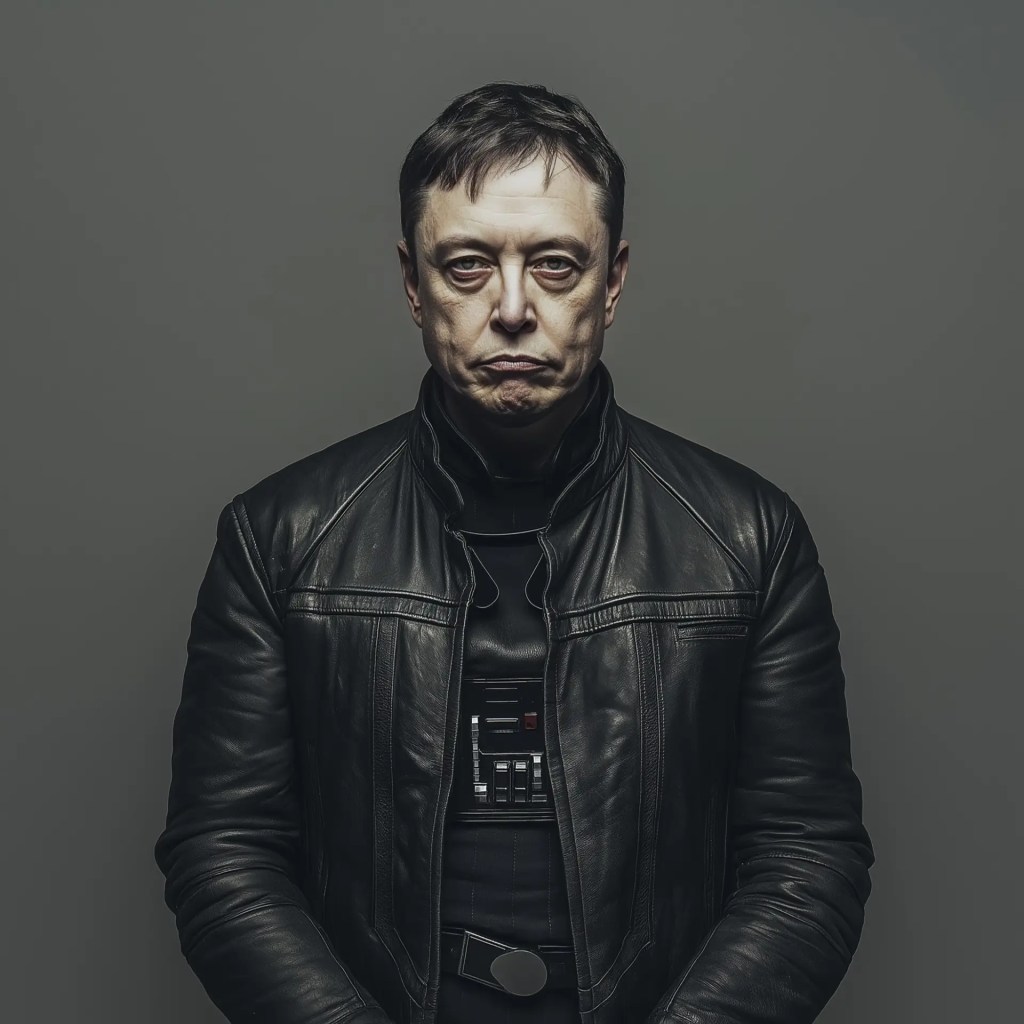
The image choice was a warning but also perhaps it was also a reflection of some, perhaps ungrounded sub-conscious, hope that (like Anakin Skywalker) Musk would one day recover his humanity, perhaps after doing great damage in our part of the galaxy (much like Darth Vader).
Elon Musk is now the greatest danger to democracy, public discourse and the open society. We must act accordingly as journalists, politicians, and regulators and as parents and consumers.
Elon Musk is the Death Star.
We must resist!
Footnotes
- Radiohead, ‘Black Star’(the meaning of the song is not relevant to this article but the words fit too well for this purpose) ↩︎
- ‘LEVIATHAN’ (1651) ↩︎
- This is not defamatory, where I come from this is what we call fraudulent liars. ↩︎
- Dark Enlightenment – Wikipedia. ↩︎
- Peter Thiel, ‘The Education of a Libertarian‘, 2009. ↩︎
- Nafeez Ahmed, ‘Pro-Trump Tech Billionaires Are Poised to Cash In on Gaza’s ‘Peace’ Deal’ ↩︎
- As my old history teacher, Mr Ashworth, wisely observed. ↩︎
- The Authoritarian Stack: A project led by Prof. Francesca Bria with xof-research.org, ‘The Stack: Five Domains of Privatized Sovereignty‘ ↩︎
- Desmond Butler, Trisha Thadani, Emmanuel Martinez, Aaron Gregg, Luis Melgar, Jonathan O’Connell and Dan Keating, ‘‘Elon Musk’s business empire is built on $38 billion in government funding’‘ ↩︎
- The Authoritarian Stack: A project led by Prof. Francesca Bria with xof-research.org, ‘The Stack: Five Domains of Privatized Sovereignty‘ ↩︎
- Paradise Lost, I: 263 ↩︎
- Paul Kirby & Laura Gozzi, ‘Europe leaders criticise Musk attacks‘ ↩︎
- Jerusalem, Plate 10 ↩︎
- Yan Jiajie 严佳杰 & Yu Nanping 余南平, ‘The U.S. Starlink Project and Its Implications from the Perspective of International and National Security’ 国际和国家安全视角下的美国“星链”计划及其影响, 2024. ↩︎
- Richard Speed, ‘Microsoft’s data sovereignty: Now with extra sovereignty!’ ↩︎
- A quote that could have been hand-crafted for Musk: ‘I, Robot’, 2004 – film based on a series of short stories by Isaac Asimov. ↩︎
- Atul Kumar, ‘Why AI is replacing some jobs faster than others”. ↩︎
- Isaac Asimov, ‘Runaround‘, 1942. ↩︎
- Rob Kuznia , Allison Gordon & Ed Lavandera, ‘You’re not rushing. You’re just ready:’ Parents say ChatGPT encouraged son to kill himself’ ↩︎
- Nikita Ostrovsky, ‘OpenAI Removed Safeguards Before Teen’s Suicide, Amended Lawsuit Claims’ ↩︎
- Justin Hendrix, ‘Breaking Down the Lawsuit Against OpenAI Over Teen’s Suicide’ ↩︎
- Johana Bhuiyan, ‘OpenAI relaxed ChatGPT guardrails just before teen killed himself, family alleges’ ↩︎
- Dominique A. Harroch & Richard D. Harroch, ’15 Quotes on the Future of AI’. ↩︎
- Atul Gawande, ‘The Shutdown of U.S.A.I.D. Has Already Killed Hundreds of Thousands’. ↩︎
- ‘Ex Machina’, film, 2014. ↩︎
- Jim Reed and Joe McFadden, ‘Neuralink: Can Musk’s brain technology change the world?’ ↩︎




 Compossible - that which can live together
Leave a comment