This AI assisted blog synthesises some of the information contained within a public Google Notebook I created to triage submissions made to the Australian Select Committee on Information Integrity on Climate Change and Energy.
I was inspired by a comment of Dr Julia Steinberger (though she did not suggest using AI). I created the AI Notebook to help people (including students, journalists, scientists, policymakers) easily access and query the 227 submissions made to the Select Committee to help review how industry bodies and experts respond to the climate crisis and energy debate.
In a world of overwhelming information, we need to stay open to using all technologies that can help us.
The sources primarily consist of submissions to the Australian Select Committee, offering insights into the tactics, financing, and narratives of obstructionist actors and those critical of the renewable energy transition pathway. The core themes are of green energy development and the structured resistance to the reduction of carbon emissions, particularly through the use of misinformation and disinformation.
The sources reveal that resistance to carbon reduction is now dominated by strategies focused on delaying action, while opposition to green energy (specifically large-scale renewable projects) originates from a complex mix of established fossil fuel interests and genuine community concerns that are often amplified and manipulated.
I hope you find the public Google Notebook useful.

Table of Contents
- The Information Battlefield
- Organised Obstruction and Discourses of Delay
- Resistance to Green Energy Projects and Policy Critique
- The Climate Action Delay MindMap
- Information Ecosystem Integrity and Countermeasures
- Dr Julian Steinberger – A frozen transition in a warming climate
- Other reports available in the Notebook:
- Other Sources On Compossible
The Information Battlefield
Organised Obstruction and Discourses of Delay
Organized efforts opposed to climate action have evolved from outright denial of climate science to “discourses of delay”. These discourses focus on stalling the transition by casting doubt on solutions.
Key Actors and Financing of Resistance
- Fossil Fuel Hegemony: Climate action has been made exponentially more difficult by various forms of obstruction. The fossil fuel industry was aware of the risks of burning coal, oil, and gas since at least the 1950s and has since conducted decades-long campaigns to bury climate science. Fossil fuel firms’ asset valuations remain tied to sustained demand, motivating them to manufacture doubt and exaggerate risks associated with renewables.
- International Networks and Financing: Climate misinformation is often financed through concealed networks that mask the economic interests driving communications. This coordination involves funding right-wing media, think tanks, university programs, PR firms, and front groups.
- Australian organisations are embedded in transnational networks such as the Atlas Network, a US-based alliance of free-market conservative think tanks. The Atlas Network pushes climate misinformation to obstruct renewables.
- Examples include ExxonMobil’s donations to Timbro via the Atlas Network.
- Organisations like the Institute of Public Affairs (IPA) and the Centre for Independent Studies (CIS) are named as drawing upon foreign organisations’ work, including in their critique of climate science and their support for nuclear power.
- Greenwashing and Influence: Corporate greenwashing is identified as a significant threat to information integrity, using deliberate misrepresentation of environmental commitments and actions.
- Fossil fuel companies, such as Shell, ExxonMobil, BP, and TotalEnergies, link stories about renewables to the promotion of fossil gas (natural gas), attempting to build a narrative that gas is a necessary and important part of the renewable transition.
- The use of fossil gas as a proposed “transition fuel” is pervasive in Australian political rhetoric. However, there is scientific consensus that new gas extraction projects are incompatible with limiting warming to 1.5°C.
Key Strategies of Delay
Obstructionist actors use specific strategies, categorized by Lamb et al. (2020) into four groups (redirecting responsibility, pushing non-transformative solutions, emphasizing downsides, and surrender).
| Delay Discourse Category | Examples and Tactics Cited in Sources |
| Pushing Non-Transformative Solutions | Technological Optimism: Focusing on unproven technologies like Carbon Capture and Storage (CCS), or costly, long-term options like nuclear energy as alternatives to immediate renewable rollout. This approach often requires the curtailment of the renewables build-out and prolonging fossil fuel consumption. |
| Energy Security | Fossil Fuel Solutionism: Promoting fossil gas as essential for energy security, firming up intermittent renewables, and displacing coal. The International Gas Union (IGU) strategy aimed to “green” natural gas by admitting gases from renewable energies. |
| Emphasizing the Downsides | Cost Arguments: Arguing that renewables are too expensive, will raise costs, and damage national competitiveness. This narrative often ignores the costs of inaction. |
| Redirecting Responsibility | Whataboutism: Deflecting responsibility by asking, ‘what about larger nations like China and the US?’. |
| Surrender | Doomism/Change is Impossible: Claims that mitigation efforts are futile or too late, or that drastic change is incompatible with democracy. |
Resistance to Green Energy Projects and Policy Critique
Opposition to the large-scale rollout of renewable energy—including wind farms, solar farms, and transmission lines—is a major focus of mis/disinformation campaigns. However, this resistance often involves both external manipulation and legitimate concerns about the policies governing the transition.
Community Resistance and Astroturfing
- Community Context: Opposition to projects is observed in the context of large-scale renewable energy proposals, which make negative local impacts easier to amplify than the positive impacts of retiring distant fossil fuel infrastructure. The paradigm of “NIMBY-ism” is considered too simplistic to explain resistance.
- Information Vacuum and Manipulation: When genuine local issues and information gaps are not addressed by authorities, this creates “fertile ground” for misinformation and disinformation to take hold. For instance, a lack of local, credible information about projects threatens social licence.
- Astroturfing: This involves creating the illusion of grassroots opposition, often recycling internationally-derived talking points.
- Groups like the National Rational Energy Network (NREN) and the Wimmera Southern Mallee anti-renewables groups occupy a grey area between genuine local activism and externally influenced astroturfing, exhibiting coordinated messaging that blends local grievances with broader conspiracy narratives.
- Astroturfing campaigns target key flashpoints like energy costs, nuclear proposals, and renewables, frequently framing themselves as defending households or local workers.
Critiques of Green Energy Implementation (Environmental and Economic Integrity)
Many submissions challenging the prevailing narrative argue that misinformation is being disseminated by climate advocates and government-aligned interests promoting a renewables-only transition.
- Lifecycle Emissions and Environmental Costs (Greenwashing):
- A central critique is that the “Net Zero narrative relies on partial truths, concealed trade-offs, and systemic undercounting of carbon, waste, and biodiversity destruction”.
- Current carbon accounting for renewables often includes only operational emissions, omitting the lifecycle emissions from: mining rare earths (often offshore), manufacturing (largely in high-carbon countries), construction of infrastructure, and decommissioning/disposal.
- In stark contrast, coal-fired generation is held accountable from “pit to plant”. This discrepancy creates a false emissions advantage for renewables.
- New environmental risks include: localised ecological damage, habitat loss/fragmentation from large-scale solar farms and transmission corridors, and wind turbine waste. Furthermore, renewable infrastructure can introduce long-term chemical contamination, such as PFAS (Per- and polyfluoroalkyl substances) embedded in turbine blades and batteries.
- Cost and Reliability Misrepresentation:
- The claim that “renewables are the cheapest form of energy” is asserted by governments and industry groups, but widely disputed by critics when total system costs are included. System costs must include balancing, storage, transmission, and resource adequacy, moving beyond simple Levelized Cost of Electricity (LCOE) metrics.
- The CSIRO’s GenCost report is criticized for being flawed, systematically biased, and using optimistic assumptions (e.g., assuming continued cost declines for wind/solar while costs for other systems remain flat or increase). The reliance on models without disclosing their major uncertainties or testing them against competing results is raised as a transparency issue.
- Governance Failures and Lack of Transparency:
- Failures in governance, regulatory capture, and the weakening of environmental safeguards are cited as undermining trust.
- The manipulation of public consultation processes, sometimes knowingly misusing scientific studies (e.g., regarding Brolga buffer zones for wind farms in Victoria), is argued to advance the economic interests of wind energy companies at the expense of biodiversity protection.
- The scale of land acquisition for projects—described by some as “green grabbing”—often bypasses community consultation requirements, sparking strong resistance.
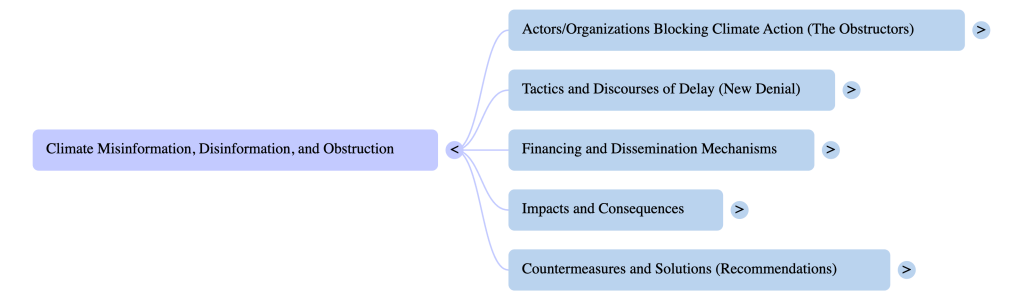
The Climate Action Delay MindMap
Information Ecosystem Integrity and Countermeasures
Dissemination Methods
- Media Amplification: Major media outlets, especially those owned by News Corp Australia, are implicated in propagating mis/disinformation and giving contrarian views an unwarranted platform. Major outlets repeated the false claim that wind caused the 2016 South Australian blackout.
- Social Media and AI: Digital platform advertising is a key financing mechanism for amplifying contrarian narratives to millions of Australians at low cost. The coordinated use of bots, trolls, messaging apps, and generative Artificial Intelligence (AI) facilitates the spread of mis/disinformation, including AI-generated content lacking journalistic rigour. AI-assisted tools are also being developed for research triage and categorization of denialist claims.
Recommended Countermeasures to Enhance Integrity
To combat the systemic nature of obstruction and misinformation, several strategies are recommended:
- The focus must be on protecting disagreement in the search for scientific truth (which relies on falsifiability, not consensus) while maintaining rigorous standards of information integrity.
- Transparency and Regulation:
- Establish comprehensive transparency measures requiring clear disclosure of funding sources for all climate-related communications, especially for organisations commenting on scientific issues with potential financial conflicts of interest.
- Implement rules to stop or regulate the “revolving door” between industry and government agencies.
- Require proponents of energy projects to provide independently verified, transparent, and scientifically robust information on climate impacts and incorporate full lifecycle carbon accounting.
- Information Provision and Community Engagement:
- Establish Local Energy Hubs (proposed as a network of 50 independent outreach centres) in regional areas. These hubs would provide accessible, evidence-based, and locally-tailored information on renewables, addressing the pervasive information vacuum and building trust.
- Government communications staff should actively participate in community discourse to “seek out and listen to the public’s questions and concerns”.
- Media and Scientific Literacy:
- Enhance media literacy education in schools to teach critical thinking and skills necessary to identify and dismantle false narratives.
- Use pre-bunking campaigns to inoculate the public against anticipated disinformation narratives by acknowledging and reframing concerns.
- Protecting Dissent:
- It is crucial to differentiate between legitimate, evidence-based community opposition and deliberate disinformation (astroturfing). Failure to protect the right to voice concerns risks alienating communities.
Dr Julian Steinberger – A frozen transition in a warming climate
Professor Julia Steinberger delivered a keynote speech addressing the current obstacles to a just green transition, while also highlighting the opportunities to keep the transition moving forward.
Other reports available in the Notebook:
- The Climate Obstruction Playbook: 5 Tactics You Weren’t Meant to See
- Combating Climate Misinformation: Strategy and Solutions
- Vulnerable Groups and Policy Recommendations for Information Integrity
- Countering High Economic Cost Climate Arguments
- Disinformation Quiz
Dive in and query the notebook to create your own reports based on your interests.






 Compossible - that which can live together
Leave a comment