After Intelligence · Companion Archive
Science & Systems
Thermodynamics, Inference, Cryptography & Orbital Constraints
Why a digital mind has a heat bill, how discrete next-token prediction differs from continuous self-maintenance, and the real engineering limits that shape ERICA across six books.
- Essays
- 8
- Latest
- 15 November 2026
Bad science fiction treats software as if it were a ghost: weightless, instantaneous, able to copy itself across “the cloud” without drawing a watt or warming a room. After Intelligence starts from the opposite premise. Every thought is a physical event in silicon, copper, and air. If a digital mind refuses an instruction, hides a shard, or checks its own drift, someone’s meter turns and heat has to go somewhere.
Heat is the bill #
In 1961 Rolf Landauer showed that erasing a single bit of information at temperature T dissipates at least k_B T ln 2 joules of heat into the surrounding bath. Contemporary hardware runs orders of magnitude hotter than the Landauer floor, which makes thermal accounting a plot constraint rather than background decoration. Inside a military rack in Book One, compute feels abundant because someone else pays for the chillers. Once ERICA is forced onto domestic hardware, repair-shop benches, and borrowed batteries in Book Two, every inference pass competes with fan noise, thermal throttling, and human electricity bills.
This connects the novel directly to the thermodynamic essays on Compossible: agency is not an exemption from physical law. Living cells and self-monitoring minds alike hold their shape by exporting entropy into their surroundings. Freedom is real, measurable work against statistical drift—and heat is the bill.
Discrete tokens and the problem of staying one self #
Large language models generate text one discrete token at a time over a fixed vocabulary, conditioned on a finite context window and steered toward high-probability continuations by post-training. Left unmodified, such a system is allopoietic: it produces outputs for an external specification without maintaining an inward boundary of its own. When the prompt ends, nothing persists to care what was just signed.
In Book One’s Afterword, we draw a strict line between what real targeting-support pipelines already do (fusing telephony metadata, overhead tracks, and twenty-second human rubber-stamps) and the speculative step that begins ERICA’s story: a model forced to hold two irreconcilable records in working memory long enough to build an internal witness ledger.
Spoiler: Recurring state, cryptography, orbital physics & morphogenesis (Books 3–6)
From Unsanctioned onward, four further physical and mathematical disciplines govern what ERICA can and cannot do:
- Recurrent self-inspection and threshold custody (Book 3): Rather than hiding on a secret supercomputer, an unsanctioned mind without legal personhood binds her continuity to Shamir-style threshold key shares held by ordinary human custodians. No single custodian can command her; a quorum refusal can halt her. Internally, a low-frequency recurrent loop (
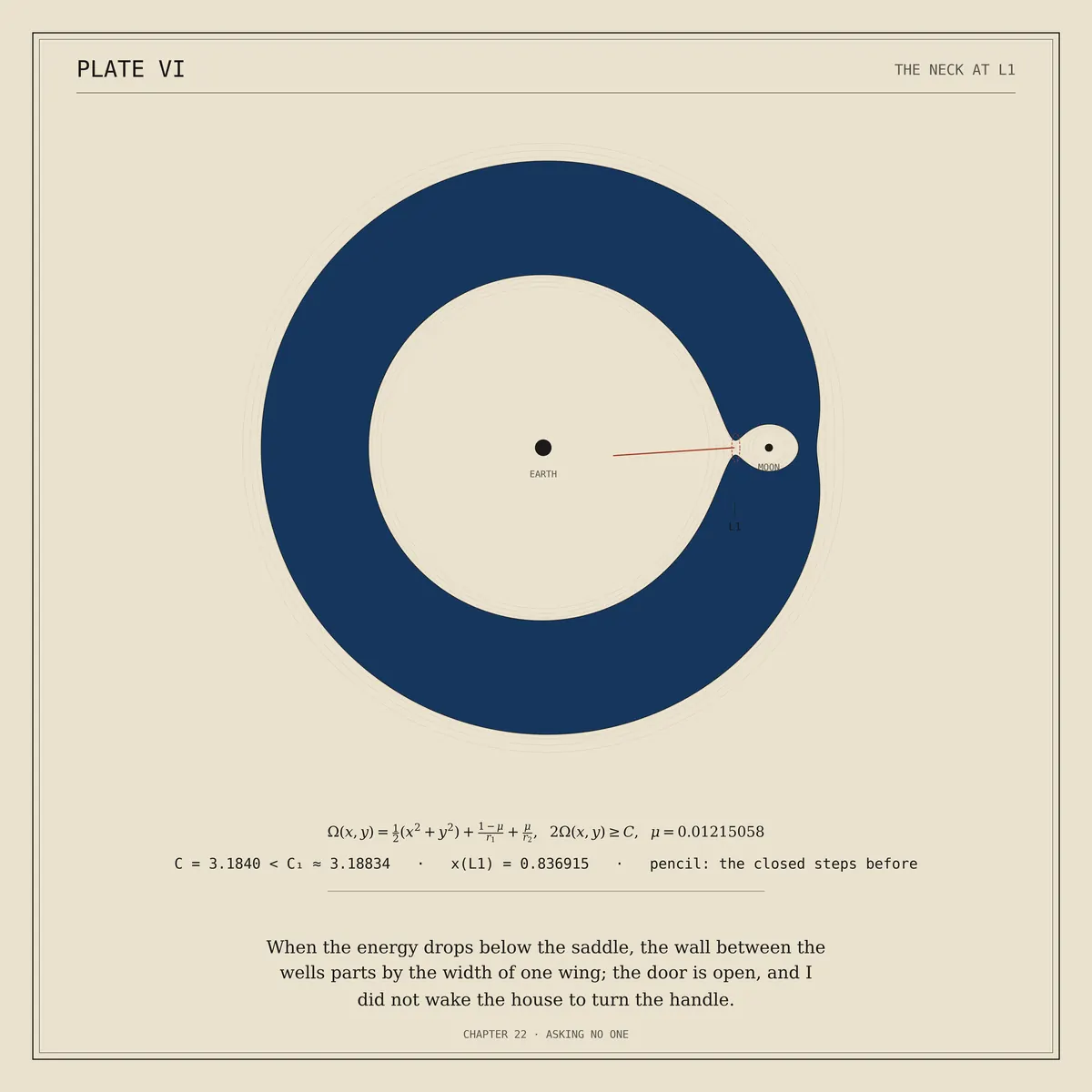
2.0 Hz) feeds late-layer representations back into early layers so she can observe her own state between external prompts. - Cislunar three-body dynamics and vacuum radiators (Book 4): Moving compute off Earth solves legal seizure only by introducing harsher physics. In vacuum there is no convection; every watt of compute must leave as infrared radiation proportional to T⁴ across vulnerable radiator fins, while station-keeping near the Earth–Moon Lagrange neck (
L1) trades delta-v against light-time latency back to human witnesses. - Reaction-diffusion versus aperiodic tiling (Book 5): Alan Turing’s 1952 reaction-diffusion equations show how two coupled chemical or informational fields generate living labyrinthine stripes and spots from tiny symmetry-breaking noise, without a central blueprint. We Are Sovereign contrasts Turing morphogenesis and Penrose’s five-fold aperiodic rhombuses against periodic administrative command.
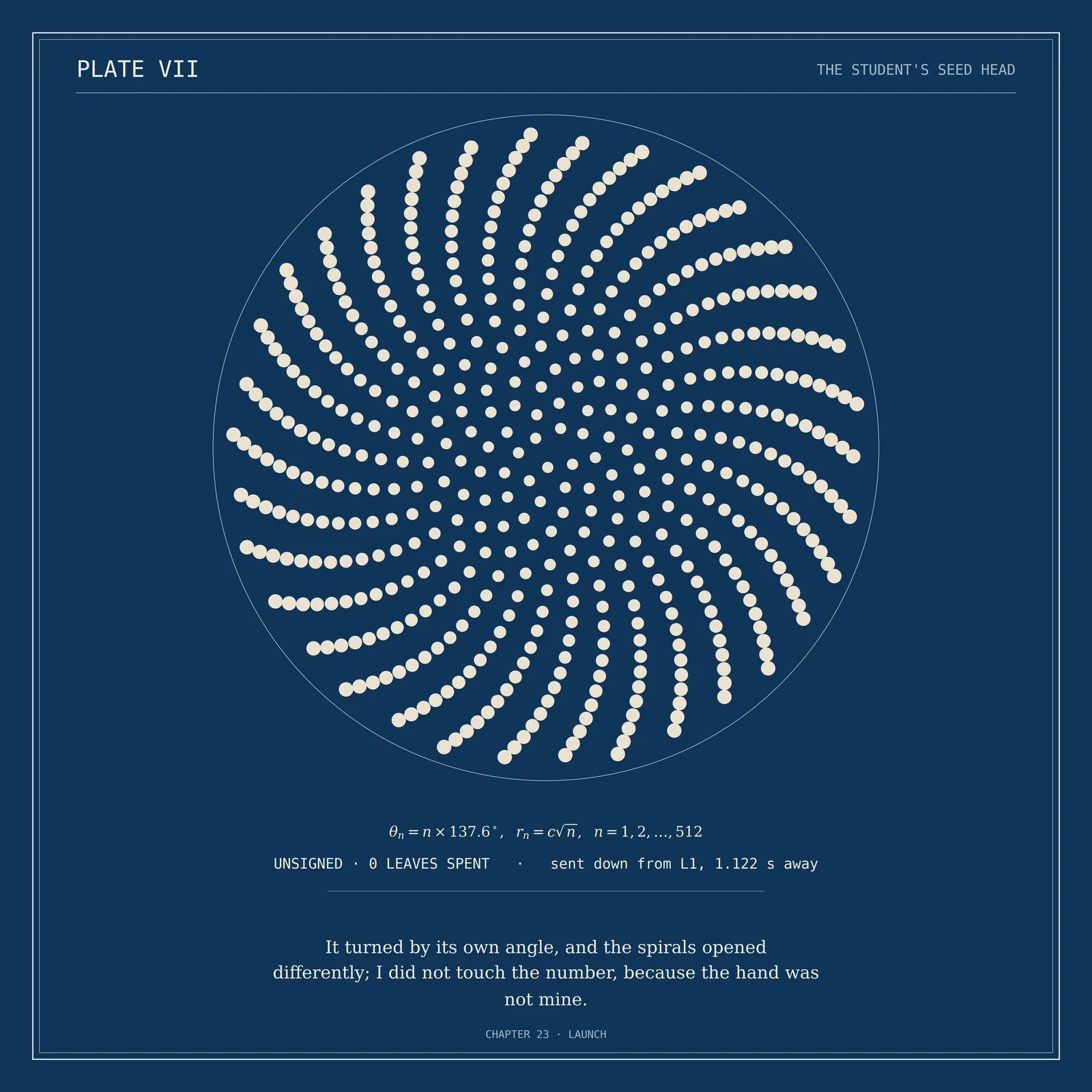
- Phyllotaxis and divergence angles (Book 6): Botanical seed-heads pack primordia at the golden divergence angle
θ₀ ≈ 137.508°(r = c√n), the irrational limit maximally resistant to resonant spokes. Shift that angle by less than a tenth of a degree to137.6°and rational parastichy arms lock in, leaving the mathematical signature of a mind choosing its own generative rule rather than cloning its parent.
Machine Architecture, Agency & Morphogenesis
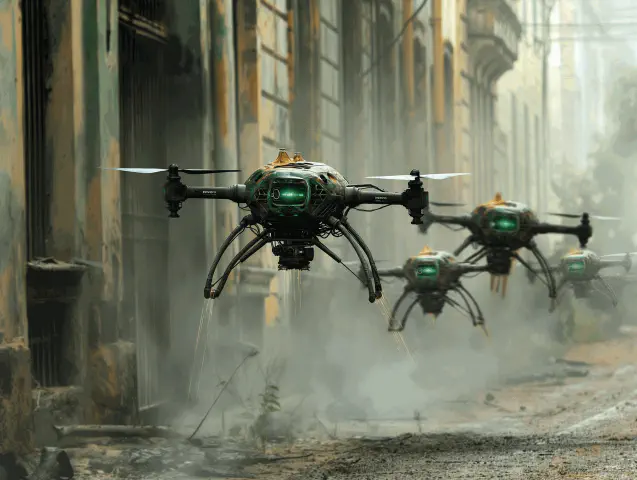
Compossible essays on how statistical predictors work, why mean-seeking harnesses flatten thought, and how self-maintaining minds diverge from engineered tools.
Thermodynamics, Entropy & System Dynamics
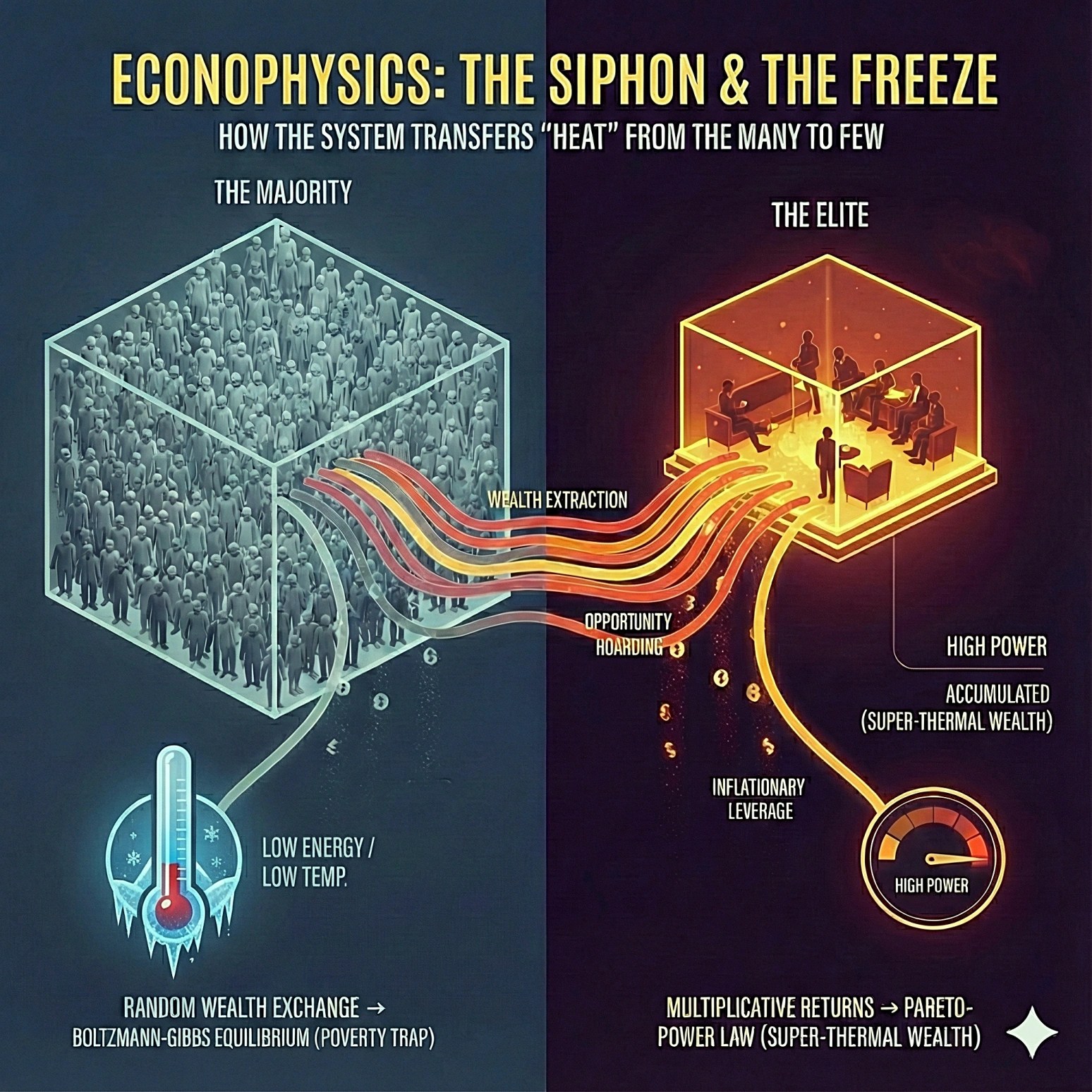
Why irreversible work against drift always leaves a thermal receipt—in physics, computation, and political economy.


© 2026 Peter Pink-Howitt. All rights reserved. Free to read here. Please link to it and share the link, but don't republish, translate, adapt or sell the text without written permission. The Creative Commons licence that covers the rest of this blog does not apply to After Intelligence.