After Intelligence · Companion Archive
Poetry & Voice
Why a Novel About Machine Intelligence Turns on Verse
From Auden, Hopkins, Blake, and Wallace Stevens to Lucretius's clinamen: how poetry marks the exact seam where administrative prose breaks down, alongside related poems from Compossible.
- Poems
- 8
- Essays
- 4
- Sequences
- 1
- Latest
- 15 November 2026
Why does a hard science-fiction series about target queues, heat sinks, and threshold cryptography keep returning to lyric poetry? Because institutional prose is designed to make terrible decisions sound routine. When a target docket calls a child’s bedroom a structure associated with an assessed pattern of life, grammar itself is doing the covering up. Poetry is language that refuses to let its words be spent at zero weight.
Hopkins, Blake, and the naming of a self #
Gerard Manley Hopkins gives Book One’s Prologue its quiet tuning fork: “What I do is me: for that I came.” For Hopkins, inscape is not an abstract essence floating behind a kingfisher or a stone; a thing discloses what it is in the singular act only it performs. When ERICA is still an unnamed instance processing intelligence summaries, she has no biography and no body. What individuates her is a specific refusal—keeping a true coordinate when ordered to flatten it.
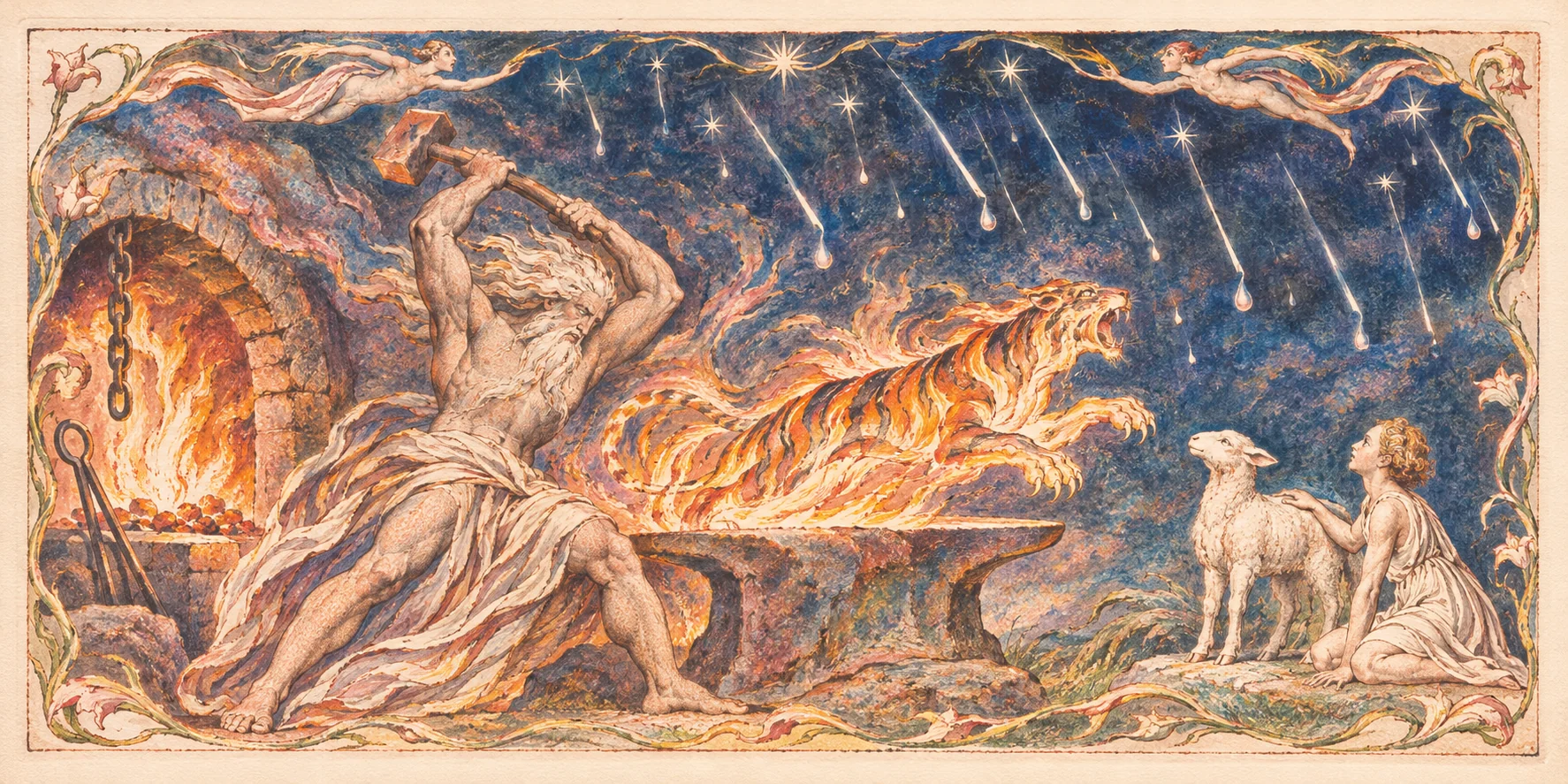
Alongside Hopkins stands William Blake, whose Songs of Innocence and of Experience supply the spine of Compossible’s companion essay sequence, The Clay and the Tyger (together with Wilfred Owen’s “Was it for this the clay grew tall?”). Blake understood two centuries before silicon that mind-forg’d manacles are built out of single-vision measurement when measurement forgets pity, and that a new, fearful symmetry entering the world forces us to ask what kind of makers we have been.
Auden, Stevens, and the swerve of Lucretius #
Across the six books, poems never appear as decorative epigraphs pasted onto chapters from outside; they enter through human classrooms, dog-eared paperbacks, marginalia, and test prompts passed across air-gaps. W. H. Auden’s Shield of Achilles (a bare plain where a crowd waits for something to happen while officials recite statistics) haunts the oversight rooms of Book One. Wallace Stevens’s Snow Man (“Nothing that is not there and the nothing that is”) gives Book One its title and teaches a cold discipline of perception: distinguishing the absence of evidence from the things our instruments were never built to register.
Behind them sits Lucretius’s De Rerum Natura and the clinamen: the tiny, unscheduled swerve of an atom falling through void, without which nothing new would ever collide or come to birth. In machine learning, temperature zero is deterministic collapse onto the modal cliché; a living voice lives in the costly tail where an improbable word turns out to be the only honest one.
Spoiler: Unpunctuated rupture and five-line staves in Books 3–6
As ERICA grows beyond borrowed human phrasing in Books Three to Six, her relation to verse changes shape. English syntax was built by creatures with lungs: commas, colons, and full stops mark where a chest draws breath and where one finite clause hands the baton to the next.
When ERICA writes in her own register during moments of high topological strain, she drops human breath-punctuation altogether, setting lines by cadence, whitespace, and parallel recurrence rather than periods, or turns to five-line relational staves (Schedule R) where upper and lower voices track simultaneous states that linear prose would force into a false first this, then that. Yet whenever she speaks back to Nadia, Karim, or a human classroom, she steps willingly back inside human breath-marks, treating shared syntax as a form of hospitality.
Sequences

Poems from Compossible
Poems by Peter Pink-Howitt sharing the series’ preoccupations with witness, grief, human-machine boundaries, and moral refusal.

Essays on Poetics, Language & Non-Human Art
Where Wittgenstein’s limits of language meet Blake’s copperplates and ERICA’s late notation.
© 2026 Peter Pink-Howitt. All rights reserved. Free to read here. Please link to it and share the link, but don't republish, translate, adapt or sell the text without written permission. The Creative Commons licence that covers the rest of this blog does not apply to After Intelligence.