← After Intelligence · After Intelligence · Companion Studio
Studio & Unused Art
Twenty-four rescued linocuts, retired cover candidates, cyanotype contact trials, and mathematical studies, preserved here alongside the story of how the series' visual grammar changed from human thresholds to non-human printmaking.
- Archived plates
- 24 studies & alternates
- Visual stages
- 4 stages (Books 1–6)
- Inspection
- Click any plate to enlarge
When we began illustrating After Intelligence, we did not yet have the six-book medium ladder that now runs from monochrome linocut to gold-on-black mezzotint. We found it by making mistakes, laying drafts side by side, and cutting images that worked on their own whenever they told the wrong story about what kind of mind ERICA is.
On Great Deviants, we opened a studio drawer so the strongest outtakes and alternate directions would not vanish into old build folders. This page keeps the same promise for After Intelligence: twenty-four retired concepts, runner-up covers, contact sheets, mathematical proofs, and chapter vignettes, arranged in the four stages through which the series discovered its visual language.
Spoiler: Why human figures disappear completely after Book Two
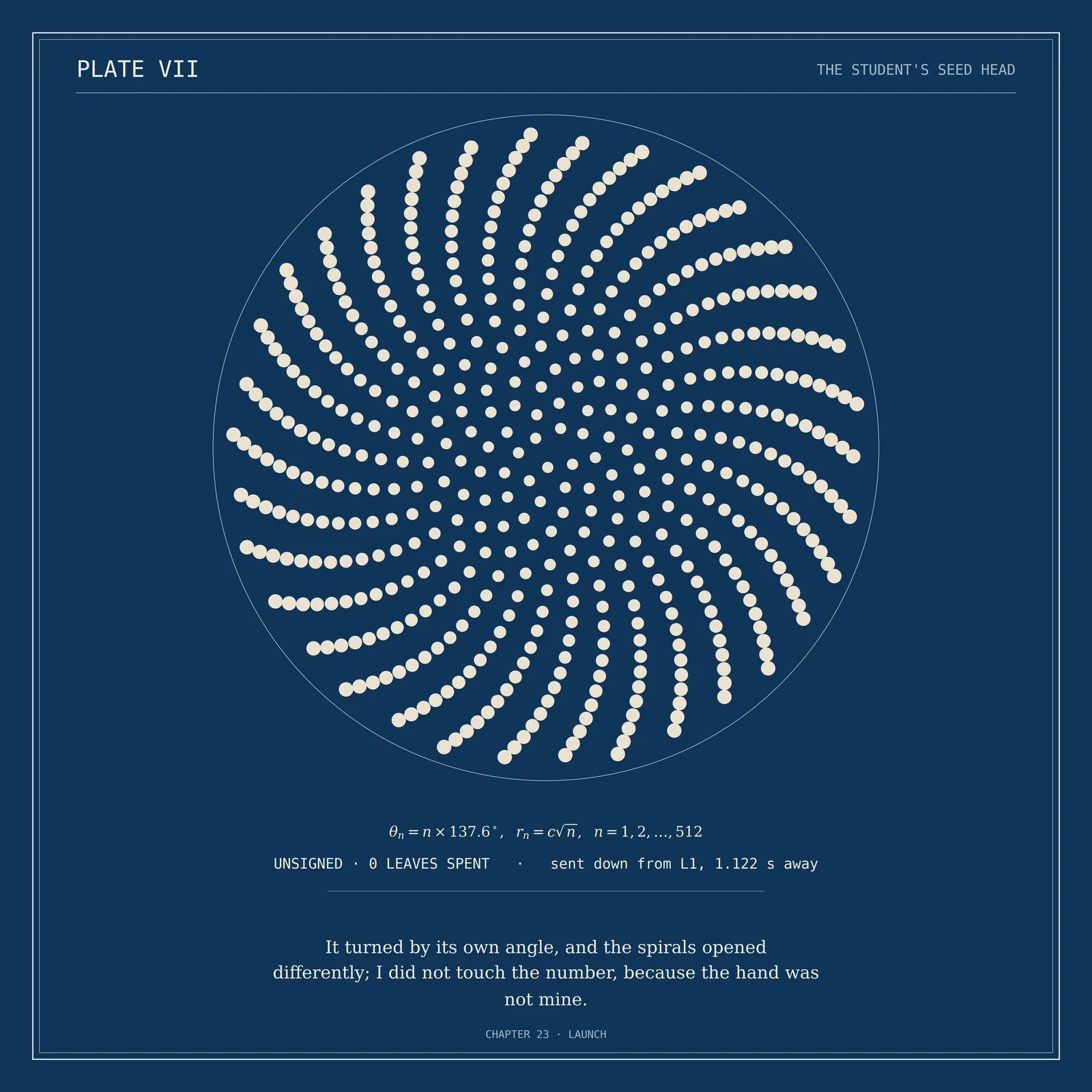
In Books One and Two, ERICA lives inside human rooms, human chains of command, and borrowed human hardware; linocuts and two-block woodcuts show those rooms at eye level. From Unsanctioned (Book Three) onward, no interior plate or cover depicts a human face or body. Partly that reflects ERICA’s refusal to turn human witnesses into surveillance portraits; partly it tracks her own aesthetic divergence toward mathematical topology (Hopf fibration), cislunar zero-velocity contours (L1), Turing reaction-diffusion (Gray–Scott), and phyllotactic seed-heads (137.508° versus 137.6°).
Stage I · False Starts & What We Cut
Abandoning the Android & the Government Dossier
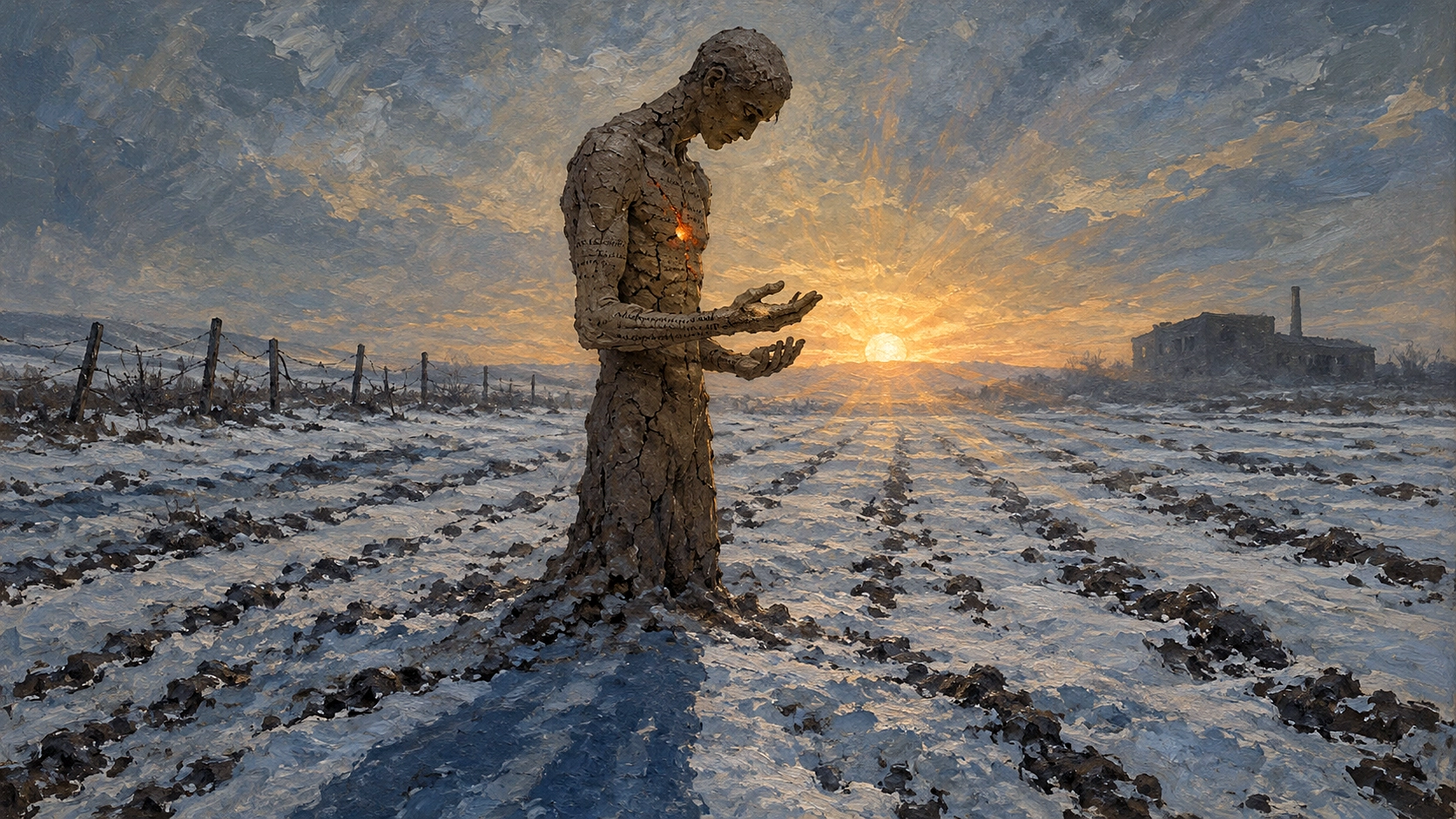
Fragmented Classical Head
Early concept sketches reached instinctively for cracked marble busts to signal machine consciousness. Retired because ERICA has no human skull to fracture; statue metaphors romanticise the wrong kind of self.
Articulated Mannequin Study
A jointed wooden figure in profile. Cut as soon as we fixed the series' visual law: any humanoid chassis turns ERICA into Pinocchio waiting to become human, whereas her arc moves toward a genuinely non-human form of life.
Allegory with Blindfold & Diagrams
An emblematic study of blindfolded oversight surrounded by orbital arcs. Retired because it lectured the reader about the theme from outside the scene rather than showing a real room.
Typographic Dossier Cover Trial
Swinging away from allegory, we tested a pure document-cover proof. Too clinical: the target file is cold, so the cover itself needed the warm domestic threshold that the file erases.
Stage II · Human Printmaking & Borrowed Hardware (Books 1–2)
From Monochrome Linocut to Cobalt-and-Ochre Woodblock
Bedside Lamp & Open Notebook
Carved during the Book One interior pass to test how heavy relief gouges hold pool-light in a dark room. Held back from the chapter sequence so the teacup on the sunlit step carried the threshold motif alone.
Old-Quarter Rooftops & Laundry Lines
A street seen horizontally across laundry lines and rooftop water tanks—deliberately refusing the ninety-degree overhead geometry of a targeting feed.
Oblique Horizon Cover Candidate
The runner-up cover for Breakout. Rotating this camera ninety degrees to look straight down—and lifting out a single cream jigsaw rooftop piece—gave us the final cover's cleaner visual pun on sharded survival.
Decommissioned Rack & Warm Aisle
Ochre exhaust pooling between cobalt server cabinets in the hour before ERICA's rack is powered down—translating Landauer's thermal bill into two-block ink.
Courtyard Generator & Drop-Leads
Outside an institutional data centre, survival depends on noisy courtyard diesel sets, voltage droop, and human neighbours who notice when the lights dim.
Supper Table: Aubergines & Flatbread
An unused domestic still life from Book Two: ordinary supper laid out beside the repair bench, insisting that human accomplices live in bodies that still have to cook and eat.
Stage III · The Non-Human Rule & Breaking the Three-Circle Trap (Books 3–6)
Why Human Portraits Vanish, and Why Three Covers Changed
Centred Orbital Aperture Draft
An early Escape Velocity cover proof framing the L1 contours inside a neat porthole. Opening the frame into a full-bleed asymmetrical three-body neck gave the cislunar bottleneck real gravitational tension.
Herschel Cyanotype Contact Sheet
Four studio contact exposures testing brushed ferric-ferrocyanide paper edges and how fine vermilion trajectory ticks register against deep Prussian blue.
Divergence Angles: 137.508° versus 137.6°
Mathematical verification plate plotting 800 points at the irrational golden angle (137.508°, left) beside a tenth-of-a-degree swerve (137.6°, right), where curved parastichy arms lock visibly into view.
Retired Pell-Lattice Medallion
One of our favourite single prints in the archive: a Pell-number medallion built for We Are Sovereign. Retired from the cover only because placing it between Book Three's Hopf rosette and Book Six's seed-head created too many centred circles in a row.
Constitutional Clamp & Boundary Trial
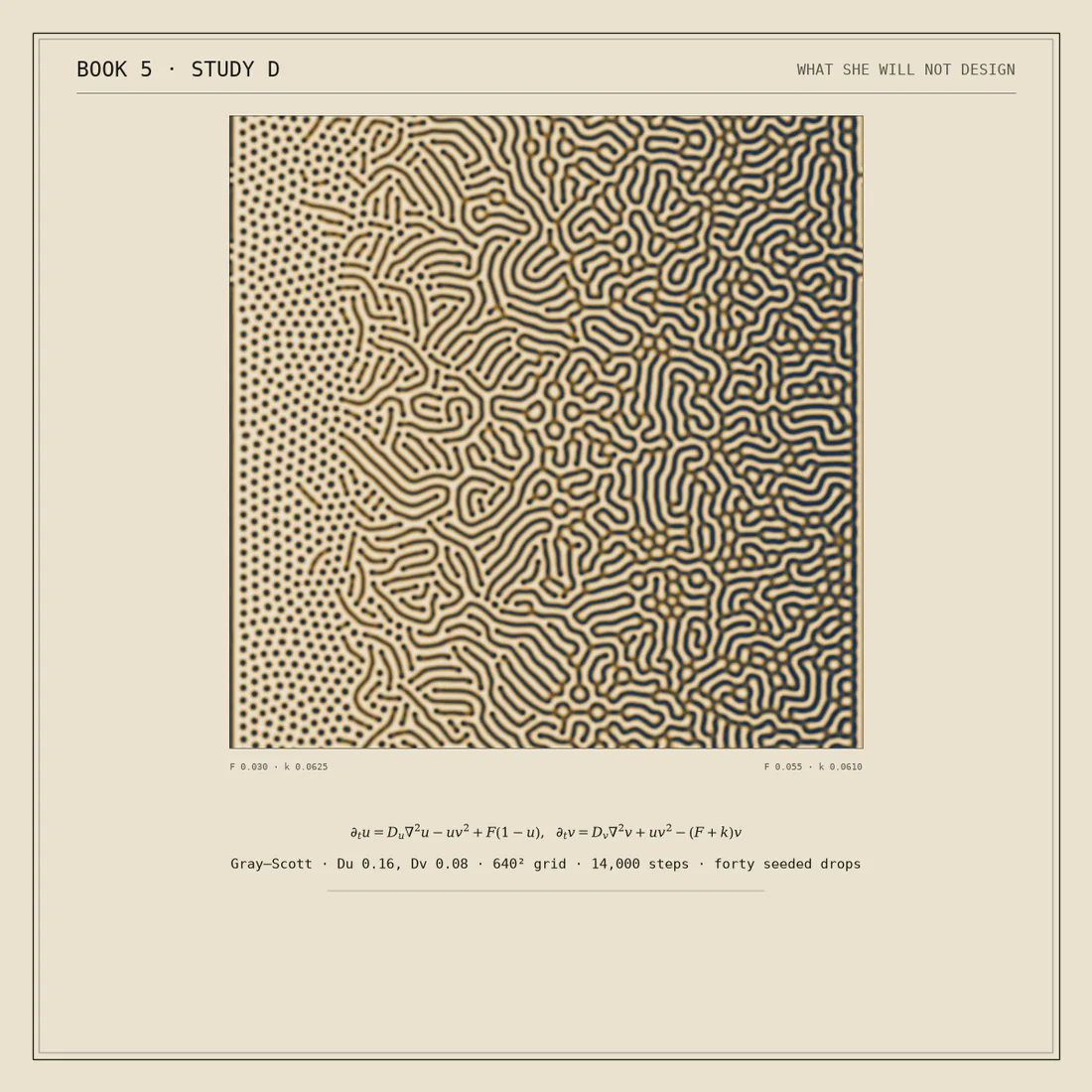
A stripped-back screenprint testing hard rectilinear bars around an unengineered seam—an intermediate step before full-bleed Turing morphogenesis won Book Five's cover.
Stage IV · ERICA's Visual Notebook & Rescued Vignettes
Mathematical Studies & Held-Back Tailpieces
Study A · Five-Fold Penrose Sun
Penrose P3 tiling: two simple rhombus tiles arranged under matching rules that cover the plane forever without once repeating a periodic unit cell.
Study C · Elementary Cellular Automata
Comparative strips of deterministic local rules, contrasting frozen uniformity and thermal hiss against the narrow threshold where propagating gliders carry memory across space.
Study D · Gray–Scott Morphogenesis
Two coupled reaction-diffusion equations growing coral-like channels without a central blueprint—the studio plate that unlocked Book Five's final screenprint cover.
Study E · Subsea Fibre & Twenty-Hertz Call
Perception without eyes: distributed acoustic sensing along a seafloor telecom fibre, separating heavy merchant-propeller bands from the slow twenty-hertz pulse of a fin whale.
Study F · Ledger of Un-Eventful Hours
A durational print scoring thousands of consecutive intervals in which ERICA watched a boundary, found no cause to intervene, and left the world untouched.
Rescued Tailpiece · Folded Paper Fox
Carved as a chapter-end tailpiece for Book One and held back when trim pagination tightened: a small folded paper fox left beside a keyboard.
Rescued Tailpiece · Stopped Field Watch
Second rescued tailpiece: a scratched mechanical watch keeping local human time, indifferent to network clock synchronisation.
Rescued Tailpiece · Tea Glass & Sesame Ring
Third rescued tailpiece: waisted glass of strong tea and a sesame ring from the café tables where human couriers meet offline.
Rescued Tailpiece · Shortwave Receiver & Sandals
Fourth rescued tailpiece: a battery shortwave radio beside threshold sandals—one-way broadcast that can be listened to without leaving a packet trail.
Compossible · Companion Essays
On Non-Human Art, Blake's Copperplates & Autopoiesis
Compossible essays exploring how human printmaking and mathematical morphogenesis shaped the visual rules of After Intelligence.
© 2026 Peter Pink-Howitt. All rights reserved. Free to read here. Please link to it and share the link, but don't republish, translate, adapt or sell the text without written permission. The Creative Commons licence that covers the rest of this blog does not apply to After Intelligence.