Speakers for the Dead — Part 2: Two Per Cent
The Neanderthals of Gibraltar left no words, only a cross-hatching cut into the floor of a cave and a trace in our own genomes. On Marcellin Boule's brute, the romance of the last refuge, Wittgenstein's lion, the enslaved girl Ibn Fadlan never named, Linear A, and the discipline of speaking for people without putting our words into their mouths.
Contents 7 sections
With every strut and squawk declaring This is mine, my home You will not make me leave
from my poem The Seagulls and the Sea, 2024
The lines in the floor #
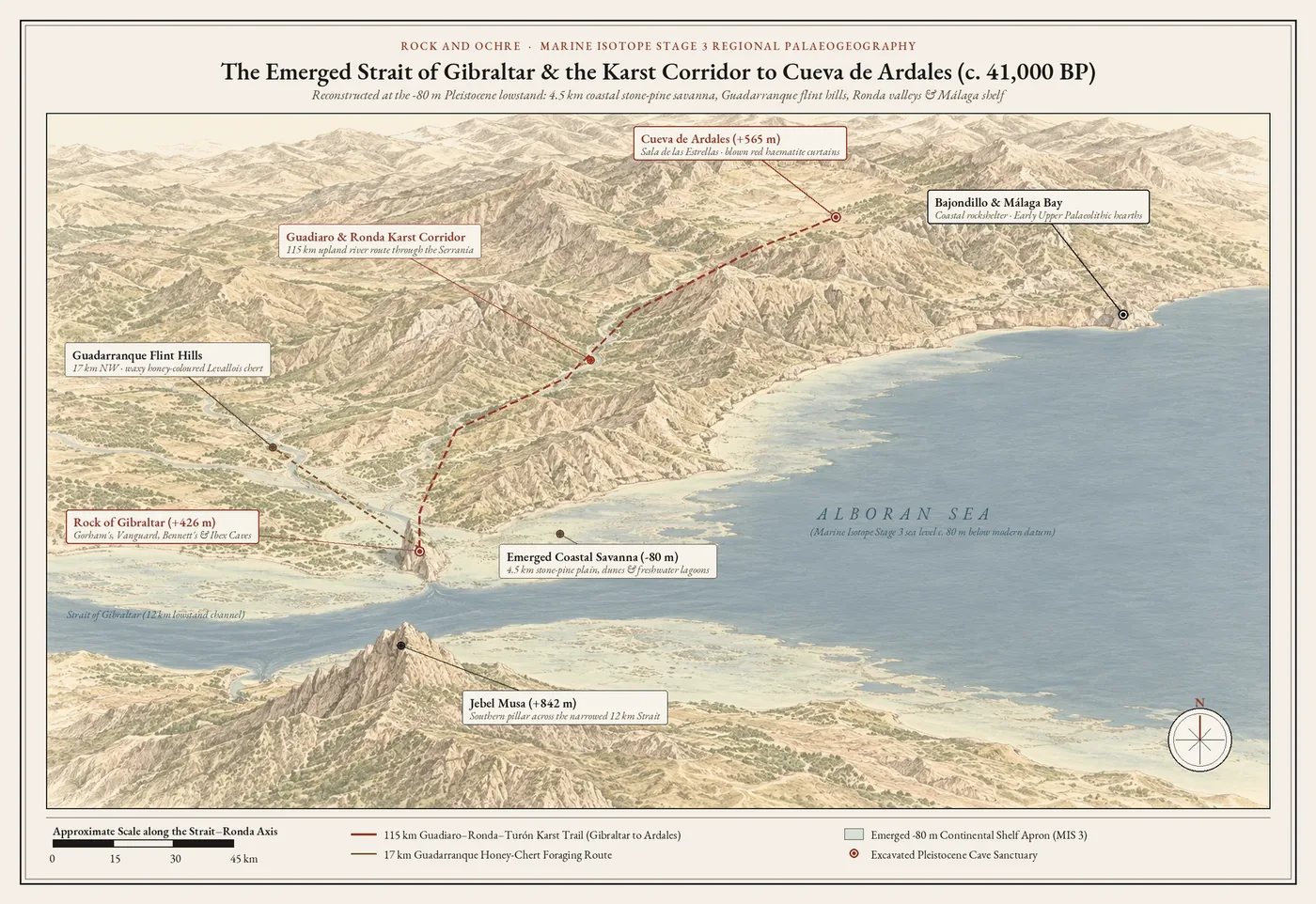
At the back of Gorham’s Cave, at sea level on the eastern face of the Rock of Gibraltar, a shelf of dolomite bedrock carries a pattern of deep, criss-crossing lines. It looks like the grid for a game of noughts and crosses. It was hidden for tens of thousands of years under sediment that contained Neanderthal stone tools, and when a team led by Joaquín Rodríguez-Vidal and Francesco d’Errico studied it in 2014 they showed that it was made before those layers built up, by someone passing a pointed stone tool again and again along the same grooves. They counted what it would have taken: at least fifty-four strokes for the deepest line, and between 188 and 317 for the whole pattern. It was not the scratching of someone cutting meat on a convenient rock. It was deliberate, prolonged and focused work.1
We do not know what it means. It may mean nothing beyond I made this. It is the nearest thing we have to a sentence from a people who had no writing, and it is a sentence we cannot read.
When I wrote about Gibraltar in a poem two years ago, the Neanderthal caves got half a line, between the Moorish castle and Sandy Bay, before I turned to the seagulls, whom I called experts on their prehistoric treaty. They wheel over the Rock declaring this is mine, my home, you will not make me leave. I was writing about the gulls, and about people, and about who belongs where. I did not think then about who had said those words on the Rock before us, and lost.
The brute #
The first great act of speaking for the Neanderthals was a slander, and it was made in the name of science.
In 1908 an almost complete skeleton was found in a cave at La Chapelle-aux-Saints in south-western France. The palaeontologist Marcellin Boule reconstructed it over the next few years and published a creature that stooped forward, with bent knees, a curved spine and its head thrust out on a short thick neck: something not quite able to stand upright, a step towards the ape.2 The old man of La Chapelle had in fact been badly arthritic and had lost most of his teeth long before he died. Boule’s reconstruction stood for half a century. It gave the twentieth century its picture of the caveman: dim, hairy, shambling, the thing we replaced.
Victors write the history, and on the long scale of the species we are the victors. Modern humans arrived in Europe and within some thousands of years the Neanderthals were gone. Why they went is one of the great open arguments of palaeoanthropology. It may have been competition, violence, disease, climate, the slow arithmetic of small populations that could no longer find each other, or all of these at different places and times. Nobody knows, and the honest speaker says so.
What we can say is that the brute was a portrait of the painter. It told us that our ancestors had replaced something lesser, which is a comfortable thing for the heirs of survivors to believe.
The last refuge #
The opposite temptation is gentler, and Gibraltar is its home.
In 2006 Clive Finlayson’s team published radiocarbon dates from Gorham’s Cave that seemed to show Neanderthals living there as late as twenty-eight thousand years ago, long after they had vanished from the rest of Europe.3 The idea that the last of them had held on at the southern tip of the continent, looking across the strait at Africa, was irresistible. It still appears in documentaries and on the walls of tourist sites. It has the shape of a novel: the last of a people, at the edge of the known world, keeping their fires going on a rock above the sea.
In 2014 Tom Higham and a large team re-dated material from some forty sites across Europe using improved methods for cleaning out modern contamination, and concluded that the Neanderthals had disappeared, site by site, between about 41,000 and 39,000 years ago.4 The late dates at Gorham’s remain contested, and the Gibraltar team has defended them. The studio’s Neanderthal novels follow the wider re-dating and say so in their notes, because a beautiful story about a last refuge is still a story we would be telling for our own sake.
That, too, is what grieving hagiography looks like at the scale of a species. We want the people we replaced to have had a noble ending, ideally in a place we love.
Two per cent #
And then, in 2010, the dead began to speak in a way nobody had expected.
Svante Pääbo’s team in Leipzig published a draft sequence of the Neanderthal genome, assembled from fragments of DNA in bones from a cave in Croatia, and compared it with the genomes of living people. Everyone alive today whose ancestry lies outside sub-Saharan Africa, they found, carries a small share of Neanderthal DNA.5 Later and more complete genomes put the share for most such people at roughly 1.5 to 2.1 per cent.6 Pääbo was awarded the Nobel Prize in Physiology or Medicine in 2022 for the work. The populations met, and had children, and some of those children were our ancestors.
The Neanderthal inheritance is not ornamental. Some of it shapes our skin and hair and how our immune systems respond to infection. In 2020 Hugo Zeberg and Pääbo showed that a stretch of chromosome 3 inherited from Neanderthals, carried by about half the people of South Asia and about a sixth of Europeans, is the strongest known genetic risk factor for severe COVID-19.7 Forty thousand years after the last Neanderthal died, a fragment of one of them was helping to decide who lived and who died in the intensive care wards of 2020.
The dead we owe most are not only behind us. Some of them are inside us. We are not merely the heirs of the survivors. We are, a little, the heirs of the people they replaced, carrying them in every cell, unable to hear a word they said.
If a lion could talk #
How do you speak for people who left no words?
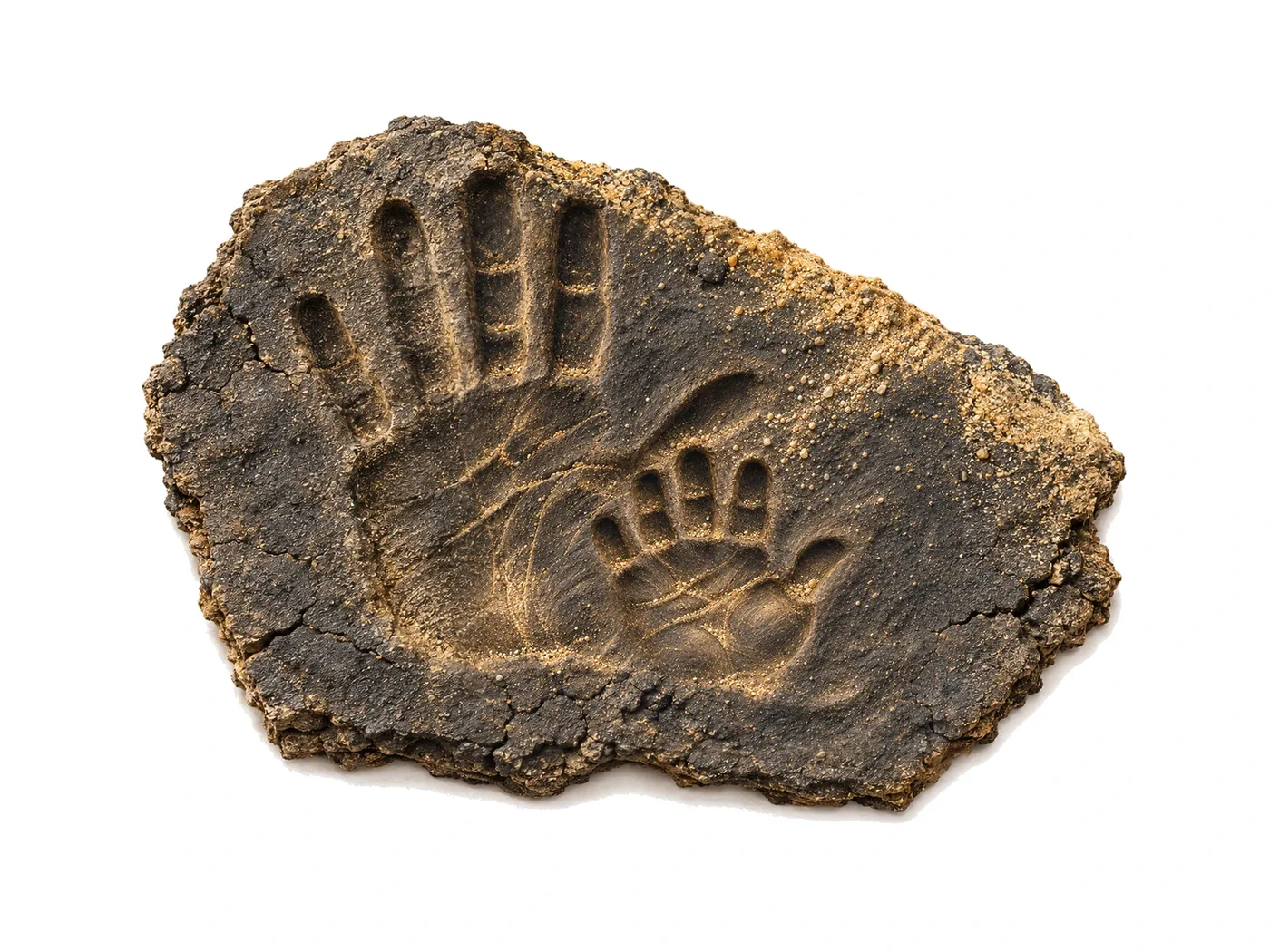
Wittgenstein, in a fragment of the Philosophical Investigations, wrote: “If a lion could talk, we could not understand him.”8 He did not mean that lions are stupid. He meant that understanding a language is understanding a form of life, and a lion’s life is not ours. The Neanderthals were not lions; they were close enough to us to have children with us. But their form of life was one that no living person has shared. They had no writing. They had no farming, no metal, no pottery, no wheel and, on the evidence, no kings. Whatever they thought, they thought without any of the furniture that five thousand years of reading and owning have put into our heads.
So the first discipline of the Neanderthal novels was a discipline of metaphor. A woman who has never seen writing cannot read her husband’s face; a memory cannot be written in stone; a man is not an open book. No plan is forged and nothing runs like clockwork when nobody has smelted ore. No one keeps a ledger, no one is a tribe chief, and no two peoples make a treaty, which is a word I had cheerfully given to the gulls. These are banned because they would make Neanderthals into us in fur. In their place the books reach for what the people of the Rock actually handled: the edge of fresh-struck flint, sinew twisted two-ply into cord, red ochre on wet stone, the smell of a struck pyrite spark.
In the fourth Carthage novel a woman “could read his face”, quite properly, because she lives in a city of scribes and contracts. Carried back forty thousand years to Gibraltar, the same four words are as false as a wristwatch.
This is a small thing to ask of a sentence, and it turned out to change everything. If you cannot give a character your metaphors, you cannot easily give her your thoughts. She has to think with her hands and her body and the weather. The books became stranger, and I think more respectful, because they had to admit on every page how far away these people are.
Three silences #
The Neanderthals are the purest case of a problem that runs through every vanished world, and it helps to name its degrees.
There are people who left no writing at all, like the Neanderthals and every human being before about five thousand years ago. A speaker for them has bones, tools, a cross-hatching and a trace in the genome, and must speak in images, never in quotation marks.
There are people who were written about but never wrote. In 922 the envoy Ahmad ibn Fadlan, travelling from Baghdad to the Volga, watched the funeral of a Rus chieftain and described in close detail the killing of an enslaved girl who was burned in the ship with her master.9 It is one of the most vivid documents of the Viking world, and it never tells us her name. In the palace archive at Pylos in Greece, clay tablets written in Linear B record rations for groups of women listed by where they came from (Miletus, Knidos, Lemnos), with their children: almost certainly captives taken in raids across the Aegean.10 We know what they were fed. We do not know what they called themselves. A speaker for these people must work against the grain of the only document that mentions them, because the document was written by someone who owned them or watched them die.
And there are people who wrote, and whom we cannot read. The Minoans of Crete kept accounts in a script we call Linear A. We can count with it, because the numerals are clear and one word sits where a total should be. We can make out some place names. We do not know what language it records. The studio’s online collection of ancient scripts will write a typed word in Punic letters, in hieroglyphs, in runes or in Linear B. For Linear A it refuses. It shows only signs and tallies from real tablets, and it will never spell a word, because a machine asked to write Minoan will oblige, fluently and with confidence, and every sign will be invented. The refusal is labelled on the page, and I am prouder of it than of anything the machine can say.
Wittgenstein ended his first book, the Tractatus, with a sentence I have argued with in The Limits of Language & Logic: “Whereof one cannot speak, thereof one must be silent.”11 In most of life I think the later Wittgenstein was right and the early one drew the walls too tight. But a speaker for the dead lives at the walls. The silence is not a failure of the speaking. It is part of it. It says: someone was here, and we cannot hear them, and we will not pretend.
The gulls again #
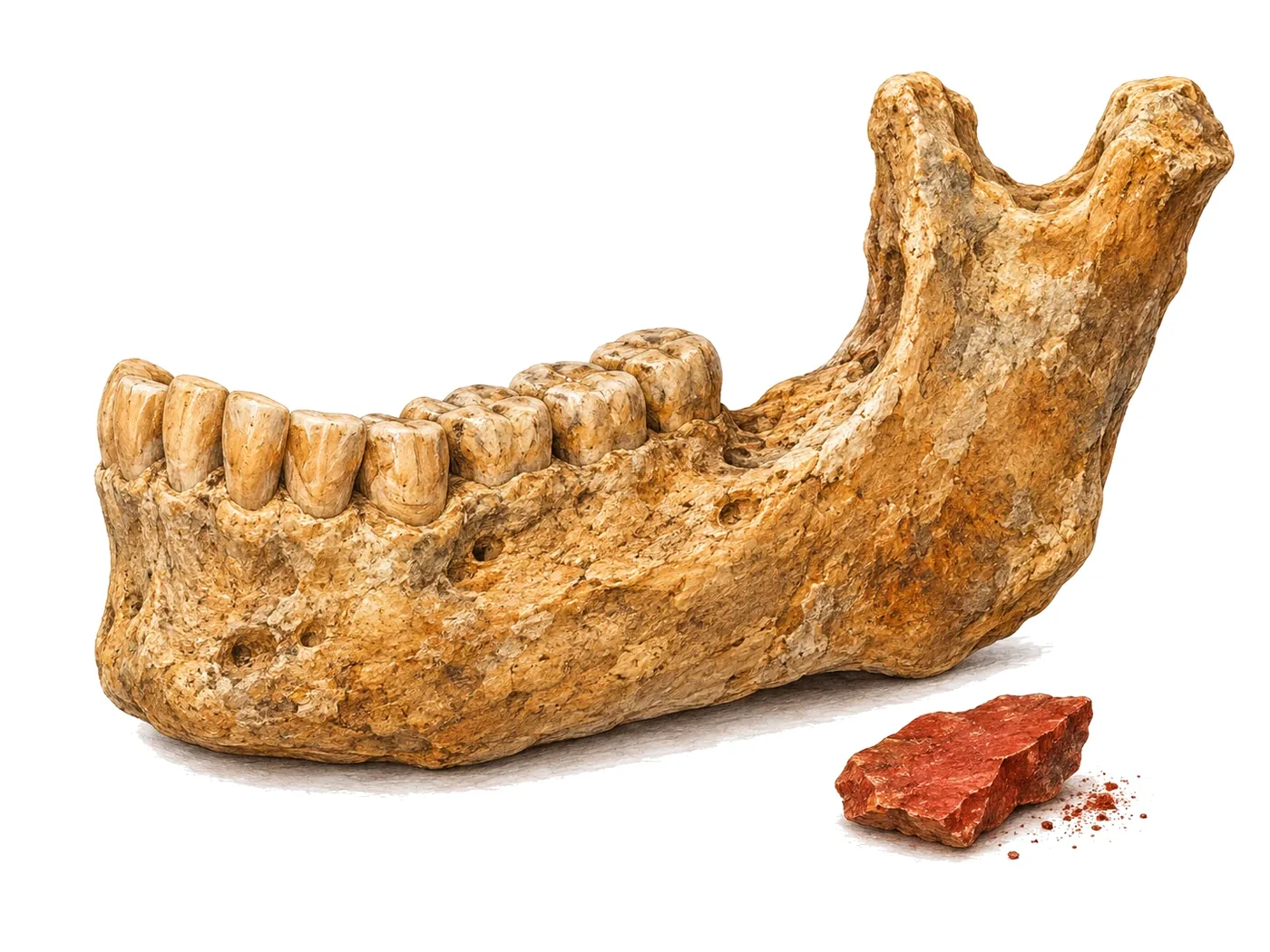
The gulls of my poem were right about one thing. Every creature that lives somewhere says, in its own way, this is mine, my home. The Neanderthals said it on the Rock for longer than our species has been writing, and could not make it stick. We said it after them, and so far we have.
I do not know whether our ancestors killed them, outcompeted them, out-bred them, married them, or simply outlasted them in a cold century. I know that some of them are in my blood, and in that of most people who will read this. That seems to me to change the question of who has the right to speak for them. We are not strangers to the dead of Gorham’s Cave. We are their descendants, a little, and their replacements, a great deal. A family has a duty to its dead that a stranger does not: to tell the truth about them, including the truth that we took their place; to stop telling the comfortable stories, about the brute and about the last refuge; and to keep silent where we cannot hear, rather than fill their mouths with our words.
It is not much. It is as much as we can.
The final essay turns to the instrument in our hands: a machine that has read the conquerors’ library, and what it would take for it to speak for anyone else.
This essay was drafted with an AI writing assistant from the studio’s research and my own notes and stances. I chose the sources, checked the facts and edited every line.
Joaquín Rodríguez-Vidal, Francesco d’Errico, Francisco Giles Pacheco et al., “A Rock Engraving Made by Neanderthals in Gibraltar”, PNAS 111, no. 37 (2014): 13301–13306. ↩︎
Marcellin Boule, “L’homme fossile de La Chapelle-aux-Saints”, Annales de Paléontologie 6–8 (1911–13). ↩︎
Clive Finlayson et al., “Late Survival of Neanderthals at the Southernmost Extreme of Europe”, Nature 443 (2006): 850–853. ↩︎
Tom Higham et al., “The Timing and Spatiotemporal Patterning of Neanderthal Disappearance”, Nature 512 (2014): 306–309. ↩︎
Richard E. Green et al., “A Draft Sequence of the Neandertal Genome”, Science 328 (2010): 710–722. ↩︎
Kay Prüfer et al., “The Complete Genome Sequence of a Neanderthal from the Altai Mountains”, Nature 505 (2014): 43–49. ↩︎
Hugo Zeberg and Svante Pääbo, “The Major Genetic Risk Factor for Severe COVID-19 Is Inherited from Neanderthals”, Nature 587 (2020): 610–612. ↩︎
Ludwig Wittgenstein, Philosophical Investigations, trans. G. E. M. Anscombe (Blackwell, 1953), Part II, section xi, p. 223. ↩︎
Ibn Fadlan, Risāla, in Ibn Fadlan and the Land of Darkness: Arab Travellers in the Far North, trans. Paul Lunde and Caroline Stone (Penguin Classics, 2012). ↩︎
Pylos tablets of the Aa and Ab series; Michael Ventris and John Chadwick, Documents in Mycenaean Greek, 2nd edn (Cambridge University Press, 1973); John Chadwick, The Mycenaean World (Cambridge University Press, 1976). ↩︎
Ludwig Wittgenstein, Tractatus Logico-Philosophicus, trans. C. K. Ogden (Kegan Paul, 1922), proposition 7. ↩︎