Speakers for the Dead — Part 3: The Hostage's Pen
Polybius wrote the fall of Carthage as a hostage in the house of the man who burned it. A machine trained on what survived is in the same position. On the conquerors' library, the Amarna blocks that were kept by being destroyed, what compression saves and erases, why more than one mind must read every page, and an objection to AI that this essay leaves standing.
Contents 7 sections
We are just one of the many flames of life. We are not the fire.
from my essay Towards a Universal Ethical Framework, 2024
The hostage #
In 167 BCE, after Rome had broken the kingdom of Macedon, a thousand leading men of the Achaean League were taken to Italy as hostages, to be held without trial until Rome decided otherwise.1 One of them was a cavalry commander in his thirties called Polybius. The others were scattered among the towns of Etruria. Polybius was allowed to stay in Rome, because the sons of the general who had won the war wanted his books and his company.
He tells us himself how it happened. The younger son, a shy boy of eighteen, caught him one day and asked, blushing, why Polybius always talked to his elder brother and never to him: did he think him idle, and un-Roman? Polybius promised to help him become worthy of his family.2 The boy was Publius Cornelius Scipio Aemilianus. Twenty years later, with Polybius at his side, he burned Carthage.
So the historian we trust most for the fall of Carthage, the man who scolded Phylarchus for turning history into a weeping-house in the first essay of this series, wrote as a hostage in the household of the man who did it. He was released with the surviving hostages in 150, and was soon back at his patron’s side. He was not a liar. He travelled, checked, interviewed veterans, walked the Alps to see Hannibal’s route. He was simply where he was.
And at one point he did something that should make every speaker for the dead take off their hat. When Carthage fell, he recorded what the Greeks were saying about it, and they did not agree. Some said Rome had acted wisely in removing a permanent danger. Others said that Rome had begun to behave like the empires it had replaced, and had used trickery and deceit with a people who had already surrendered.3 Polybius set the case against his patron down in his patron’s history. It is the best that a captured pen can do: not to escape the house, but to leave the door open.
The conquerors’ library #
When the city had burned, the Roman Senate gave the libraries of Carthage away to the kings of Africa. It kept one work. The twenty-eight books of Mago on farming were ordered to be translated into Latin, because they were useful.4
That is how the written record of the ancient world mostly survived: by being useful, or beautiful, or flattering to someone who could afford a copyist. Every one of the Punic books is lost. Almost all we know of Carthaginian thought comes from Greek and Latin writers, most of whom were on the other side. The Carthaginians survive as the Romans remembered them, and the Romans remembered them as liars.
Now consider the instrument in my hand. A large language model is trained on what has been written down and kept. It has read Polybius and Livy and Appian, and a great deal of Flaubert, and the scholarship of the last two centuries, which mostly read Polybius and Livy and Appian. It has read the Bible’s account of Moloch more often than it has read any bone report. It has never read a Punic book, because there are none to read. In AI – A Mean Machine I argued that these systems are pulled towards the average of what they have read. When what they have read is the conquerors’ library, the average is the conqueror’s view.
The machine in my hand is a Polybius. It is learned, fluent, often fair, and it grew up in the victors’ house.
What the chisel kept #
There is a strange consolation in Egypt.
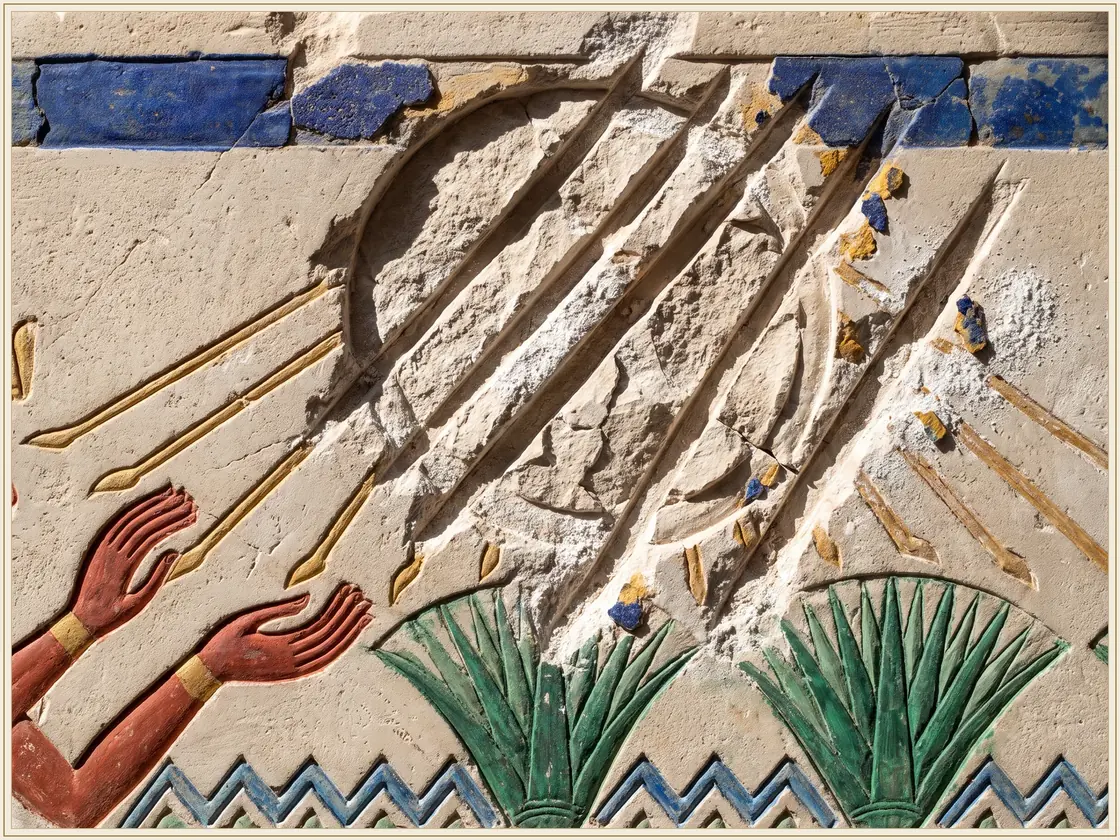
After the death of Akhenaten, the king who had tried to make Egypt worship a single sun disc with hands at the ends of its rays, his successors set out to unmake him. His city was abandoned. His temples to the Aten at Karnak were taken apart, and their small, standard-sized sandstone blocks, which Egyptologists call talatat, were used as rubble fill inside the great gateways that Horemheb raised there. Across the river at Hermopolis, blocks carried from his capital were packed into the foundations of a temple of Ramesses II. A generation later, an official called Mose recorded a lawsuit in his tomb, and referred to the years of Akhenaten’s reign only as the time of “the enemy of Akhetaten”.5 The king had become unspeakable.
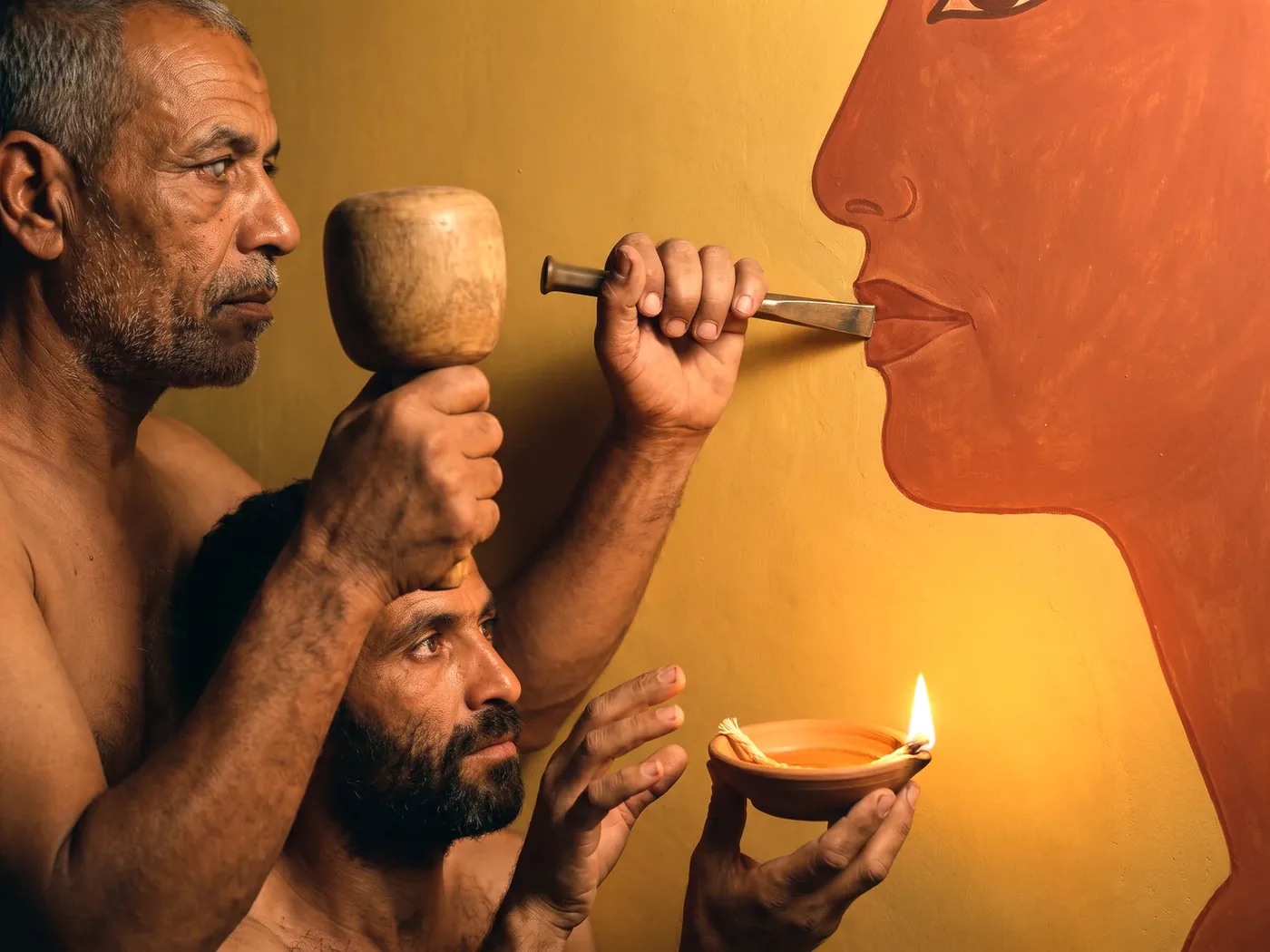
But the gateways stood for more than three thousand years, and when Egyptologists took them apart in the twentieth century, they found tens of thousands of the blocks inside, sealed from the sun and the rain, many of them still carrying their paint. The Akhenaten Temple Project spent years matching them up on paper and then by computer, like a jigsaw with most of the pieces missing.6 The blocks from Hermopolis gave up painted scenes of the royal family and the court.7 The act of silencing was also the act of keeping. Had the reliefs stayed on the temple walls, many of them would long since have weathered away.
I do not want to make too much of this. Most erasures are simply erasures. But it is a useful thing to know, when you work with a machine that compresses, because every compression is also a choice about what to keep.
What distillation saves #
The studio that makes these novels runs on a great deal of writing that nobody will ever publish: research notes, character files, guardrails, reports on what went wrong. Over time those files grow too long for anyone, human or machine, to hold in mind at once. So they are distilled. A year of notes about how a historian should work in a particular world becomes a single card of instructions. The long chronological logs are retired, and a short list of rules takes their place.
The card is easier to use, and it forgets why. Each rule is the scar of some particular failure, and the failure is gone.
The clearest lesson came in the first Carthage novel. The studio had built a set of checks to catch the faults of machine prose: the needless intensifiers, the tidy triplets, the reflexive not this but that. They worked. In eight chapters in the middle of the book they worked so well that the prose was squeezed into clipped, choppy lists, every sentence short, nothing allowed to unfold. The cure was another rule pointing the other way: every chapter must keep at least two long periodic sentences, of between thirty-five and fifty-five words, the kind that hold a thought open until the end. Every rule written to silence one fault silences something else. That is as true of a style guide as of a Senate decree, and it is why a distilled rule is never left to run alone.
Other minds #
The defence against a single learned voice is more than one mind.
The studio gives research, drafting, checking and criticism to separate roles with separate instructions, so that the voice that wrote a chapter is never the only one to judge it. Some faults are independent of each other. A painting can be correct in every buckle and still look like a computer game; it can be beautiful and show a Punic warship with the wrong number of oars. So every picture has to pass two separate checks, one for history and one for art, and passing one tells you nothing about the other. One reader is given a chapter cold, with no access to the plans, the research or the conversation that produced it, because a reader who knows what the writer meant will see it on the page whether or not it is there.
None of these minds is a speaker for the dead. Between them they can catch some of the places where one of them has spoken for the conquerors without noticing. They are a method for leaving the door open, as Polybius did.
And at both ends of the process there is a human being. Before anything is drafted, I sign off on the plot, the language and the art. After it is drafted, I read every page cold and edit it by hand. I could not do ten per cent of what we are attempting without AI, and I have explained elsewhere why I am an AI optimist. The human hand is there because someone has to answer for what is said in the names of the dead, and an answer is something only a person can give.
The objection that stands #
There are people who think that none of this should be done with a machine at all. They will not be persuaded by method, and I do not think they should be argued out of their position, because it is a position about principle and not about quality. I respect why they hold it.
Their strongest argument, as I understand it, goes like this. To speak for the dead is a form of mourning. Card’s Speaker could speak for the destroyed because he had destroyed them and grieved; the grief was what gave him the right. Polybius, for all his position, stood in the burning city and heard his friend quote Homer through tears. Whatever a machine does, it does not mourn. It has never lost anyone. It has never, to borrow from my own essay, shivered from the cold. If speaking for the dead requires grief, then what the machine has written is not speaking, however true each sentence may be. It is a very good arrangement of words about the dead by something to which the dead mean nothing.
I am going to leave that standing.
As much as we can #
What can be done is less than what is owed, and it has to be done anyway.
We can refuse the brute and the saint, the slander and the eulogy. We can label what is attested, what is disputed and what is invented, and keep the labels on the page. We can let the stones name the parents and leave the children unnamed, rather than give them names we chose. We can leave Linear A silent. We can remember that the library we learned from was the conqueror’s, and read it against the grain, as Polybius allowed his Greeks to do. We can remember that we are the heirs of the survivors, and carry the others in our blood. We can make the machine show its working to other minds, and then put a human hand to every page.
And we can remember that we are one of the many flames, and not the fire. The dead of Carthage and of Gorham’s Cave and of Amarna burned in their own time and are out. They cannot answer back. That is exactly why someone must try to speak for them, and why it must be done in a way they could correct, if they could. When I said I wanted us to be speakers for the dead as much as we can, I meant that.
How the novels are made
The historical novels behind these essays are drafted with AI under human direction, from a closed library of primary sources and excavation reports, with separate drafting, checking and criticism, and a four-tier ledger that marks every claim as attested, disputed, reconstructed or invented. The full method, including where unguarded AI fails on ancient scripts and on silence, is set out on the Historical Worlds method page.
This essay was drafted with an AI writing assistant from the studio’s research and my own notes and stances. I chose the sources, checked the facts and edited every line.
Pausanias 7.10.7–12, in Description of Greece, vol. III, trans. W. H. S. Jones, Loeb Classical Library 272 (Harvard University Press, 1933); see also Polybius 30.13 and 30.32. ↩︎
Polybius 31.23–25, in The Histories, vol. VI, trans. W. R. Paton, revised F. W. Walbank and Christian Habicht, Loeb Classical Library 161 (Harvard University Press, 2012). ↩︎
Polybius 36.9, in the same edition. ↩︎
Pliny the Elder, Natural History 18.22, in vol. V, trans. H. Rackham, Loeb Classical Library 371 (Harvard University Press, 1950). ↩︎
G. A. Gaballa, The Memphite Tomb-Chapel of Mose (Aris and Phillips, 1977). ↩︎
Ray Winfield Smith and Donald B. Redford, The Akhenaten Temple Project, vol. 1, Initial Discoveries (Aris and Phillips, 1976); Donald B. Redford, Akhenaten: The Heretic King (Princeton University Press, 1984). ↩︎
Günther Roeder, Amarna-Reliefs aus Hermopolis (Gerstenberg, 1969). ↩︎