Speakers for the Dead — Part 1: Because He Heard His Voice
Who has the right to speak for the dead? On the infant urns of Carthage, Orson Scott Card's Speaker, Polybius's quarrel with Phylarchus, Thucydides's honest confession, Scipio's tears, and what a novelist owes a people known to us only through the testimony of the city that burned them.
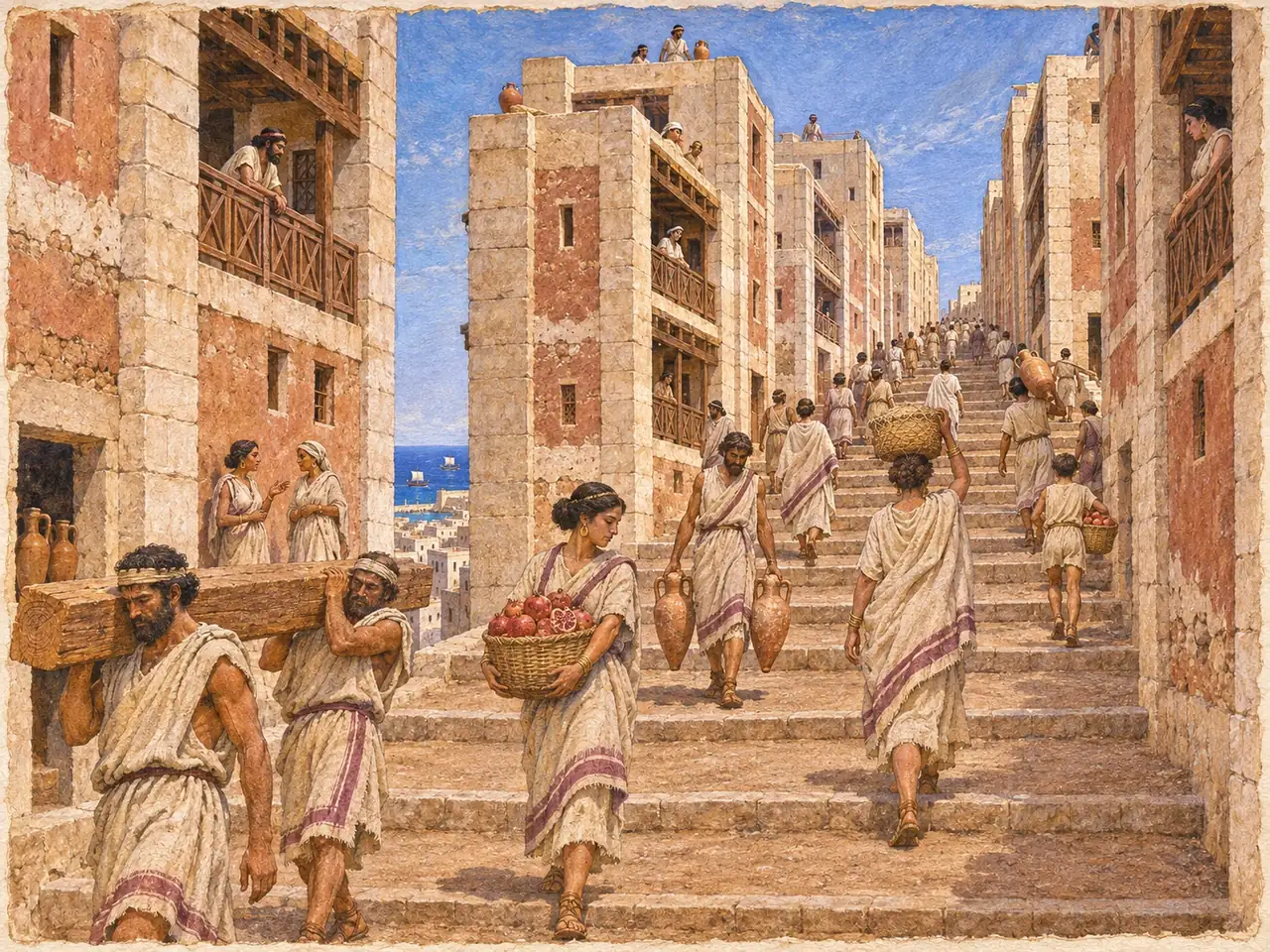
To the Lady Tanit, Face of Baal, and to the Lord Baal Hammon: what he vowed, son of his father, because he heard his voice. May he bless him.1
The common formula of the Carthage Tophet stelae
The stones and the urns #
On the edge of the Salammbô lagoon, south of the old harbours of Carthage, the ground is crowded with small limestone stelae. Many of them carry the same carved emblem: a triangle, a bar across its apex, a disc above. Archaeologists call it the sign of Tanit. The words cut beneath it are short and nearly identical across five or six centuries. They name the goddess and the god. They name the person who made the vow, and usually his father, and sometimes his grandfather. They give a reason, and the reason is almost always the same: because he heard his voice.
Beneath the stones are urns, thousands of them, holding the burnt bones of infants and of young lambs and kids.
Thousands of parents are named on the stones. The children are not.
The god heard the parent’s voice. Two thousand years later we are still trying to hear it, and we cannot agree on what it said. Greek and Roman writers were certain. Diodorus describes a bronze statue of Kronos with its hands held out and sloping, so that a child laid on them “rolled down and fell into a sort of gaping pit filled with fire”, and says that in a single crisis in 310 BCE the Carthaginians offered two hundred children of their noblest families.2 The bones are less certain. In 2010 Jeffrey Schwartz’s team examined the remains from 348 urns and found that many of the infants were prenatal or newborn, which is what a cemetery for babies who died naturally would look like.3 A year later Patricia Smith and Lawrence Stager’s team aged similar material by other methods, found the deaths clustered at one to two months, and argued that this is what sacrifice would look like.4 The word on the stones that the vow was made with, mlk, is read by most specialists as the name of an offering. The argument continues.
I have been on one side of it. In 2025, in the notes to a poem called Moloch for the Minotaur, I wrote that the practice of burning children to Moloch “spread to Carthage with the Phoenician founders from Tyre”. The poem was about Gaza, and about the tribute that Europe pays to other people’s gods of war, and I reached for Carthage the way the Romans did: as the name of the worst thing that people do to their children. I stand by the poem. Read beside the bone reports, the note needs the question mark that the evidence still carries.
That small correction is the subject of this series. It is about what we owe to people who can no longer answer back.
The Speaker #
In 1986 Orson Scott Card published a novel called Speaker for the Dead. Its hero, Ender Wiggin, had as a child destroyed an entire alien species, believing he was playing a training game. Afterwards he found the last surviving queen in her cocoon, listened to her, and wrote a short book in her voice that told her people’s history as they had lived it. He signed it with a new title: Speaker for the Dead. In the generations that followed, the title became a vocation. When someone died, a Speaker might be called to tell the truth of the life: neither the eulogy the family wanted nor the gossip the town preferred, but the life as the dead person had actually lived it, from the inside.5
The centre of the novel is one such speaking. On a colony world a man called Marcão has died: a drunk who beat his wife and was hated by his children. Ender speaks him. He tells the town what nobody knew. Marcão had been dying for years of an inherited disease; he had known that the children he raised were not his; he had stayed. The speaking excuses nothing. The bruises are still bruises. But for the first time the town can see the man whole, and grieve him as a person, which none of them had been able to do while he was either a monster or a saint.
Card’s two refusals are the two temptations of anyone who writes about the past. The first is the victor’s slander: the dead described by the people who defeated them, in the terms that justified the defeat. The second is the grieving hagiography: the dead described by people who loved them, or who love the idea of them, with the cruelty quietly removed. I have written before, in Was It For This The Clay Grew Tall?, about Susan Owen choosing her son’s epitaph and leaving off his question mark. Love edits as surely as conquest does.
And there is a third thing in the novel, which is easy to miss and which I think matters most. The first Speaker was the destroyer. The right to speak for the hive queens was not given to someone innocent of their death. It was taken up by the one person most implicated in it, and it was earned by the manner of the speaking.
I have asked the studio that writes my historical fiction to be speakers for the dead, as much as we can. Both halves of that sentence carry weight. The first is a vocation. The second is a confession.
Phylarchus and Polybius #
Historians have argued about this since there were historians. In the second century BCE Polybius, the Greek who knew Carthage’s destroyer better than anyone, attacked a rival called Phylarchus for the way he had written about the sack of the city of Mantinea. Phylarchus, he complains, “in his eagerness to arouse the pity and attention of his readers” brings on women clinging to each other, tearing their hair and baring their breasts, and the tears of men and children led away. That, says Polybius, is the business of tragedy. The tragic poet wants to thrill and charm an audience for a moment. The historian must instruct and persuade serious readers for all time, by the truth of what was actually done and said.6 A little earlier he had put the point more starkly: as a living creature deprived of its eyes is wholly disabled, “so if History is stripped of her Truth, all that is left is but an idle tale”.7
A novelist is Phylarchus by profession. The whole craft exists to make a reader feel what a person felt, in a room the reader has never entered. If Polybius is right, the historical novel is an idle tale with footnotes, and the phrase “speaker for the dead” is a flattering name for ventriloquism.
I think Polybius is half right, and the other half was supplied long before him by Thucydides. Near the start of his history of the Peloponnesian War, Thucydides makes an admission that every historical novelist should have framed above the desk. He could not remember the speeches exactly, he says, and neither could his informants; so he has made each speaker say what seemed to him called for by the situation, “keeping as closely as possible to the general sense of what was actually said”.8 The most influential historian of the ancient world put words into the mouths of the dead, and he told us he was doing it, and he told us how.
That is the licence and the condition together. A speaker may give the dead a voice only if he says, plainly and where the reader can find it, which words are evidence and which are his.
In the Carthage novels this became a rule with a dull name and a serious purpose. Every fact the books rely on is marked, in the research behind them, as attested in a primary source, disputed between sources, or invented for the story. Where the scholars disagree, nobody is allowed to split the difference and invent a comfortable middle. The story takes a stance, because a scene cannot be written in two minds at once, and the Historical Note at the back of the book names the evidence on both sides and says which way the fiction leaned and why. A vow at the Tophet is written from inside one family’s faith and dread. It has no torchlit statue and no tidy infant cemetery either. The question mark is kept, in the back of the book, where Thucydides would have put it.
The city before the fire #
There is a quieter slander than the one about the children, and it is harder to see because it is made of silence. Carthage is remembered almost entirely for two things: its accused infants and its death. Hannibal crosses the Alps, the Romans sow salt (they did not; the salt is a modern invention), and the city burns.9 Everything in between, which is to say almost everything, has gone.
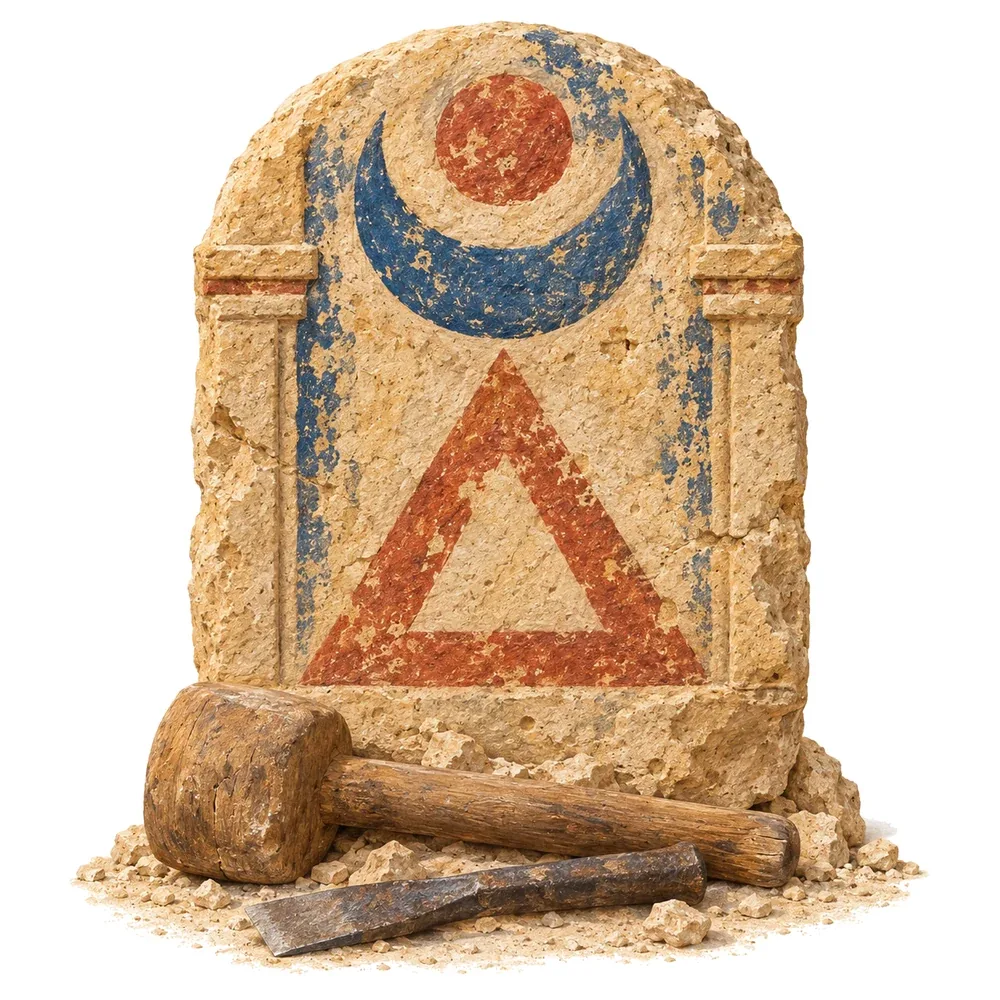
A speaker has to give that back. When Henry Hurst’s team excavated the circular war harbour of Carthage they found the ring of ship-sheds that had housed its fleet: well over a hundred slipways under flat roofs of mudbrick and mortar, and not a single terracotta tile.10 When Rome took the city’s libraries it gave them away to the kings of Africa, but kept one work, and had it translated into Latin by order of the Senate: the twenty-eight books of Mago on farming. Two centuries later Columella was still calling Mago the father of husbandry.11 The Carthaginians grafted vines and weighed silver and argued over contracts and climbed steep stepped streets with baskets on their heads. To speak for them is to speak those streets as well as the urns, and to resist the pull of the most dramatic thing that happened to them, which was only the last.
That pull is strong for a writer, and it is stronger still for a machine. The language models the studio writes with have read the whole library of what has been written about Carthage, in roughly the proportions in which it was written. Most of it was written by Romans, by Greeks who admired Romans, by Flaubert, whose Salammbô lit the bronze furnace for a Parisian audience in 1862, and by a century of schoolbooks. Ask such a machine for Carthage and it will give you the fire. That is the subject of the last essay in this series. For now it is enough to say that the speaker’s first duty is to notice whose voice is already in his mouth.
Scipio’s tears #
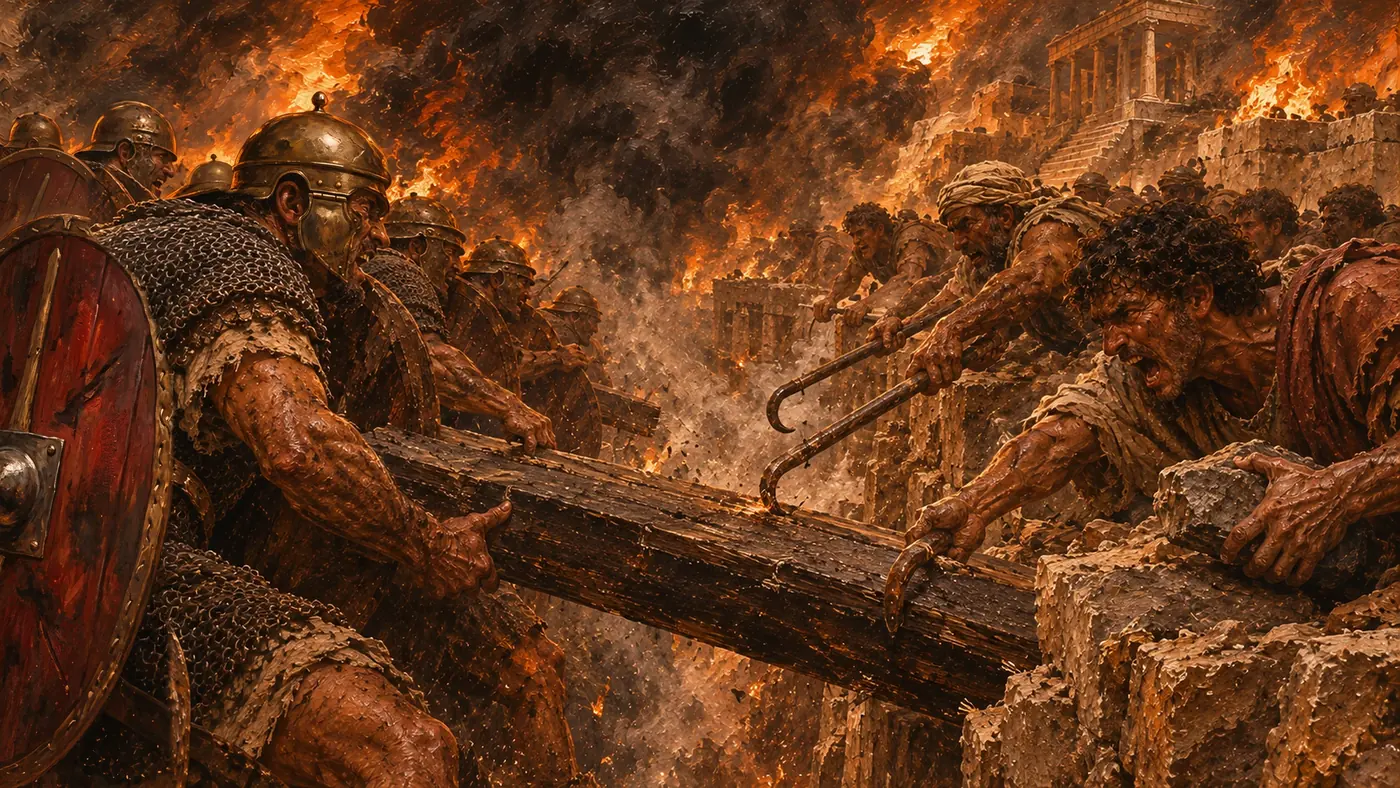
In the spring of 146 BCE Roman troops broke into Carthage beside the war harbour, and for six days fought their way up through the streets to the citadel on the Byrsa hill, setting fire to the houses as they went and clearing the burning streets for the cavalry. On the seventh day about fifty thousand survivors came down from the citadel under a promise of their lives and were sold.12
Polybius stood beside the Roman commander, Scipio Aemilianus, and watched the city burn. He records that Scipio wept, and quoted Homer: a day will come when sacred Troy shall perish, and Priam and the people of Priam. When Polybius asked what he meant, Scipio said that he feared the same fate would one day befall his own country.13
It is a famous scene, and it is often told as evidence of Scipio’s humanity. Perhaps it was. But look at what the tears are for. They are for Rome. The victor, watching a people die, weeps for himself. That is not nothing; a general who can imagine his own city burning is better than one who cannot. It is not speaking for the dead either.
What, then, do we owe them? I can only answer in the terms the Speaker taught me. We owe them the whole of their lives, which includes what we would rather not know and what they would rather we did not know. We owe them the admission of what we cannot know, set down where a reader can see it. We owe them their own terms: a Carthaginian father believed that his god heard his voice, and any speaking that treats that belief as stage scenery has stopped listening to him. And we owe them our tears for them, not for ourselves.
Who has the right? I do not think anyone is innocent enough to claim it by birth. The Romans who burned Carthage are among the ancestors of the culture I write in; the library I learned from is theirs; the language I am writing in now carries their words. If Card is right, innocence was never the qualification. The right is earned, or forfeited, by the manner of the speaking.
The stones say that the god heard his voice. We cannot promise to hear it. We can promise not to put another voice in its place without saying so.
The next essay goes further back, to a people who left no stones with words on them at all, and whose voices survive, if they survive anywhere, inside our own bodies.
This essay was drafted with an AI writing assistant from the studio’s research and my own notes and stances. I chose the sources, checked the facts and edited every line.
The standard dedication formula of the Carthage Tophet stelae, given here in a composite English rendering; see Corpus Inscriptionum Semiticarum, Pars I (Paris, 1881–), and H. Donner and W. Röllig, Kanaanäische und aramäische Inschriften (Harrassowitz, 1962–64), nos. 78–79. ↩︎
Diodorus Siculus 20.14.4–6, in Library of History, vol. X, trans. Russel M. Geer, Loeb Classical Library 390 (Harvard University Press, 1954). ↩︎
Jeffrey H. Schwartz, Frank Houghton, Roberto Macchiarelli and Luca Bondioli, “Skeletal Remains from Punic Carthage Do Not Support Systematic Sacrifice of Infants”, PLoS ONE 5, no. 2 (2010): e9177. ↩︎
Patricia Smith, Gal Avishai, Joseph A. Greene and Lawrence E. Stager, “Aging Cremated Infants: The Problem of Sacrifice at the Tophet of Carthage”, Antiquity 85 (2011): 859–874; see also Paolo Xella, Josephine Quinn, Valentina Melchiorri and Peter van Dommelen, “Phoenician Bones of Contention”, Antiquity 87 (2013): 1199–1207. ↩︎
Orson Scott Card, Speaker for the Dead (Tor Books, 1986). ↩︎
Polybius 2.56.7–12, in The Histories, vol. I, trans. W. R. Paton, revised F. W. Walbank and Christian Habicht, Loeb Classical Library 128 (Harvard University Press, 2010). ↩︎
Polybius 1.14.6, in the same edition. ↩︎
Thucydides 1.22.1, in History of the Peloponnesian War, vol. I, trans. C. F. Smith, Loeb Classical Library 108 (Harvard University Press, 1919). ↩︎
R. T. Ridley, “To Be Taken with a Pinch of Salt: The Destruction of Carthage”, Classical Philology 81, no. 2 (1986): 140–146. ↩︎
H. R. Hurst, Excavations at Carthage: The British Mission, vol. II.1, The Circular Harbour, North Side (Oxford University Press for the British Academy, 1994). ↩︎
Pliny the Elder, Natural History 18.22–23; Columella, De Re Rustica 1.1.13. ↩︎
Appian, Punica 127–130, in Roman History, vol. I, trans. Horace White, Loeb Classical Library 2 (Harvard University Press, 1912). ↩︎
Polybius 38.21–22, preserved via Appian, Punica 132; Homer, Iliad 6.448–449. ↩︎