Is/Ought Problems and Hume
Philosophers are like a dog with a bone
“Science is not only a disciple of reason, but also one of romance and passion.”1 (Stephen Hawking)
Philosophers, mathematicians and lovers of logic obsess about things most of us never think about. They are like dogs with bones: when something does not quite add up, it bothers them and they enjoy worrying it down. Sometimes their speculations have major real‑world consequences, and even then most people never notice.
I have written elsewhere about one such bone in computing, the halting problem, which is fundamental to computer science and to how code is written. Most of the world’s population uses a computer every day; I expect more than 99% of them have never thought about the halting problem. This has not affected the popularity of computers.
The is–ought problem is similar, and it has been running for nearly three hundred years. Every human makes innumerable decisions about what to do based on the facts as they see them. We are often wrong about the facts, and perhaps more often wrong about what to do given the facts. Nonetheless billions of us manage to cross streets, work, shop, eat, find partners and raise children, judging all the time what we ought to do from what is. Other life‑forms do the same. Many of these judgements happen so quickly, or so far below consciousness, that the life‑form is not aware it is making them.
This essay is a companion to Towards a Universal Ethical Framework. That framework claims that ethics can be grounded in reason and in an invariant property of the universe. Hume is the sceptic such a claim must answer, both because his argument is strong and because he remains the most influential voice on the question.2
Hume’s claim #
David Hume, the great Scottish philosopher and historian, is famous for A Treatise of Human Nature (1739), the Enquiry concerning the Principles of Morals (1751) and his Essays. His moral theory can be summarised as follows:
“(1) Reason alone cannot be a motive to the will … (2) Moral distinctions are not derived from reason … (3) Moral distinctions are derived from the moral sentiments: feelings of approval (esteem, praise) and disapproval (blame) felt by spectators who contemplate a character trait or action … (4) While some virtues and vices are natural … others, including justice, are artificial.”3
I focus on one aspect of what are loosely called the naturalistic fallacies,4 the is–ought gap:
“[The problem] arises when a writer makes claims about what ought to be that are based solely on statements about what is … there is a significant difference between positive statements (about what is) and prescriptive or normative statements (about what ought to be), and it is not obvious how one can coherently move from descriptive statements to prescriptive ones. Hume’s law … is the thesis that, if a reasoner only has access to … factual premises, the reasoner cannot logically infer the truth of moral statements.”5
In Hume’s own words:
“…the author proceeds for some time in the ordinary way of reasoning, and establishes the being of a God, or makes observations concerning human affairs; when of a sudden I am surpriz’d to find, that instead of the usual … propositions, is, and is not, I meet with no proposition that is not connected with an ought, or an ought not. This change is imperceptible … [and] what seems altogether inconceivable, [no explanation is given as to] how this new relation can be a deduction from others, which are entirely different from it.”6 (David Hume)
Hume was an empiricist: everything we believe results from experience. It is hard to disagree. Whatever laws govern the universe, understanding them must come from our interactions in it — accumulated and passed down unconsciously in our code and consciously in our culture. Our ethics, likewise, must be based on the nature of and relations between things, on experience of past interactions between life‑forms, and on usefulness; and then synthesised using reason and, as I argue, compassion and the potential for wisdom about the underlying unity of life.
Hume’s position, simplified:
- There are objective facts about the nature of things we can agree on (empirical axioms: the is).
- Moral reasoning usually moves from these facts to statements about what we should do (ethical assertions: the ought).
- The reasoning as to what ought to be done can never be derived entirely from what is.
- Moral positions are value‑judgements based on sentiment, taste or feeling, and not of the same kind as objective statements about what is.
“Morals excite passions, and produce or prevent actions. Reason of itself is utterly impotent in this particular. The rules of morality, therefore, are not conclusions of reason.”7 (David Hume)
Hume is not saying “ought” statements are worthless, only that they are qualitatively different from descriptions and cannot be reached by reason. What we ought to do always needs some further, non‑rational ground added — as to a face‑puncher: “Look here, my good woman, one really ought not to punch me in the face, because I do not like the feeling of being punched in the face!” In Hume’s world, face‑punching is neither good nor bad in itself.
If his claim stopped there it would be easy to accept: there is not enough information in that single fact to make an ethical analysis. In that modest form it is analogous to Gödel’s result that no sufficiently rich formal system can prove all its own truths. But Hume’s larger claim is that no additional statements can be combined with the facts to yield an objective, rational ethical conclusion.
“for there is nothing either good or bad, but thinking makes it so.”8 (William Shakespeare)
It is tempting to call this self‑evidently absurd, but that is not how to reason about such matters. Let us give Hume the benefit of the doubt and then show, step by step, where his larger claim fails.
Two things to be fair to Hume about #
Before the argument, two concessions, because the version of Hume often attacked is not the Hume who wrote.
First, Hume was himself a naturalist about morality. The moral sentiments were, for him, natural facts about human beings, explicable by sympathy, habit and utility; he thought justice “artificial” only in the sense of being a convention that arises because it is useful. Darwin read Hume and built on him. So the disagreement in this essay is not between a naturalist and a mystic. It is about whether sentiment is the foundation of ethics or whether sentiment is itself the surface of something deeper that reason can reach. *[Philsophical background: The position taken here belongs to a long naturalist line that accepts Hume’s challenge rather than dodging it - see Footnotes].
Second, Hume’s point about sentiment is often confused with a separate logical claim — that no categorical ought (an ought that binds regardless of your desires) can be derived from any set of facts. The stove example below derives a conditional ought: if you are a living thing that needs to go on living, then do not touch the stove. A strict Humean will say Hume never denied that; what he denied is that you can get a categorical ought this way. That is true, and I accept it. My reply, developed below, is that there are no free‑floating categorical oughts — every ought is conditional on life — and that this does not make ethics subjective, because the condition is not a matter of taste.
The syllogistic point #
Hume does not explain why a description of a fact differs in kind from a description of better or worse conduct in that situation. He moves from “objective statements are empirical” to “one ought not to introduce statements of conduct from those facts”, without evidence as to why, and without conceding that if ethical statements were empirically founded his own rule would forbid the move he is making. With respect, Hume’s law looks as though it fails Hume’s filter — though this is a debating point rather than a refutation, since his law is a claim about logic, not about conduct.
The substantive point is this. In a biological system an ought is not a separate, mystical category. It is a prediction of a necessary condition:
- Is: the organism requires energy to survive.
- Is: sugar contains dense energy.
- Ought: eat sugar.
The ought is shorthand for a conditional fact: if the organism does not eat, it ceases to be. It is a descriptive truth about the conditions of existence, not a metaphysical command.
Even if that analysis were wrong, Hume’s larger claim fails if we can show a single case in which it is objectively reasonable to do something given the facts — not merely a matter of taste. What would remain is the modest and valuable proviso that every term, fact and ought in a proposed course of action must be carefully described and rationally justified, with no assumptions smuggled in. That is what I call Hume’s sceptical filter, and it is a gift.
Before running conduct through the filter, note how hard it is to make objective descriptive propositions about anything at all, which compounds error in ethics. Nearly all objective statements are conditional on other things being a certain way — as the Buddha is said to have put it, if this, then that. Very few laws are not relative, local descriptions; most of our theories are vulnerable to future failure, and even our most cherished invariant laws are begging to be proved wrong. That is why the empirical method is wise. It is designed around negative capability: it assumes we are likely to be wrong about the nature of things and permits, in principle, a continuous creative destruction of our “is” statements. This encourages humility, a belief in the greatest consistent — compossible9 — freedom of ethical and intellectual action, and great care in setting out facts and the conduct we think follows from them.
“History? It’s just one fucking thing after another.” (Alan Bennett, The History Boys, first performed in 2004)
A non‑ethical scenario #
- A stove top (with a fire burning inside) is 190°C to the touch (1st is).
- The average mammal’s skin burns at 70°C or higher (2nd is).
- Mammals are very likely to be motivated to be self‑protecting (3rd is, an evolutionary axiom).
- Mammals are very likely to avoid unnecessary self‑injury (4th is, an evolutionary axiom).
A mammal is considering whether to put its hand on the stove. Assume no other life‑form is involved in any way.10
Objectively good11 conduct. The mammal ought (1st ought) not to put its hand on the stove unless: the overall consequences of not doing so are more injurious than doing so (condition 1);12 or it is a very unusual species that can cope with temperatures far beyond the normal mammalian range and would like to warm its hand (condition 2).
How does that feel? Do you feel cheated?
Of course not. We moved perfectly sensibly from a series of is facts to a logical ought, with two minor conditions and no linguistic sleight of hand. If you agree, it is because not putting one’s hand on a hot stove seems entirely reasonable given the stated facts.
There is a further point hidden here. For a living thing there is no neutral “is”. We notice the heat as data because of a prior drive to survive. Without the biological ought, the temperature of the stove would be as significant as the temperature of a distant star. So the salience of the is is derived from the ought: what matters about the facts is what we should do with them.
It feels nice not to be burned — Hume’s sentiment — but that feeling is not subjective in the way that preferring Manchester United to Manchester City is, nor arbitrary in the way that preferring green stoves to blue ones is. Mammals are programmed more or less alike13 for it to feel bad to be burned, because that is how they stay alive and perpetuate their code; those without this code do not usually live long enough to pass it on. Whether you imagine a human or another mammal, the answer is the same.
Passion is the user interface of reason #
“Reason is, and ought only to be the slave of the passions, and can never pretend to any other office than to serve and obey them.”14 (David Hume)
Here is the heart of the disagreement. Our passion not to be burned is not the same as the reason for it. Being burned does not cause pain because it is painful. Pain is the motive force that enacts an underlying rationale, whether or not the organism knows the rationale — whether or not it has ever heard of physics, biology or genetics. In this case passion is the slave of embedded, coded reason.
The body will usually enact the rational response before we calculate anything, or are even conscious of it. The reflex arc withdraws the hand before the brain registers the pain: the reason precedes the feeling.
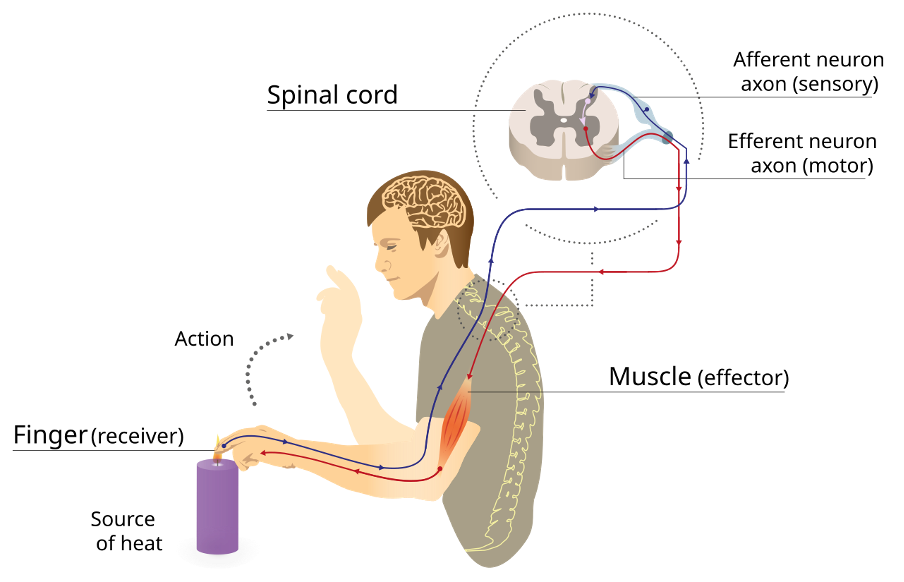
The reflex arc: the body’s embedded reason (withdrawal) occurs before the passion (pain) is registered by the brain.
The principle generalises. We do not crave sugar because it tastes good; it tastes good because our code has identified a dense energy source. We are not disgusted by rotting meat as a matter of aesthetics; disgust is the embedded calculation that pathogens kill. In every case the sentiment Hume reveres is the biological user interface for an objective survival logic. The feeling is a data compression — a shortcut computed by millions of years of selection to signal objective threat or objective benefit. Following one’s passion to avoid pain is therefore following the deepest form of empirical reason.
Hume was right about the hierarchy — passion moves us, reason alone does not — but wrong about the origin. Passions are not arbitrary masters. They are heuristics, and heuristics have reasons. Nor does the conclusion change if we imagine a mammal that likes heat and cannot feel pain, because the consequences of a bad burn go beyond pain: the inability to hunt or forage, infection, in the extreme death. Here pain is the slave of reason.
The modest objection is that some mammals might not agree — the suicidal, or those unable to grasp consequences. But a particular life‑form’s perception, or lack of it, does not falsify the objective best course of action, any more than belief in a flat Earth challenges the empirical case for a round one.15 To falsify it we would need evidence that the apparently good course was in fact biased or wrong.
So we can have ought statements about better decisions that are objectively good — better than the alternatives — combined quite comfortably with objectively true facts, at least where no ethical issue arises. We may not derive the ought from any single fact, but we can derive it from the whole factual landscape, checked for counterfactuals and conditions, using intelligence to determine the right course. Computer programming is possible only because of such conditional if–then statements. Biological oughts are if–then statements written in DNA, which makes them descriptive facts about the organism’s programming rather than expressions of its free will. When a human acts against such an ought — touching the fire — it is not a sin in the religious sense but an error in the code, a failure in the wetware, or the expression of a different drive.
The hard case of suicide #
Suicide does not disprove the axiom of self‑preservation; it shows the mechanical nature of our reasoning.
The drive to avoid pain is a primary axiom. When a mind is afflicted by severe depression, its internal sensors may report a false positive: that the suffering is permanent and exceeds the value of going on. In that state the person is not choosing death in a vacuum; they are executing a desperate attempt to follow the command cease pain. The tragedy is usually not that the survival instinct has gone but that the organ which weighs the future has, for the moment, been damaged — which is why compassion, treatment and time save lives. In some cases there is no processing error at all: a person in terminal illness and unrelievable pain may be following biological logic as straightforwardly as the hand that leaves the stove. Either way the ought is still derived from the is of internal and external conditions. The chain is unbroken.
Self‑sacrifice for offspring or kin is a different category: not a failure but an override, in which preservation of the code (the genotype) takes precedence over preservation of the individual host (the phenotype).
Ethical impact #
So what is it about ethics that is supposed to make this kind of analysis invalid?
Hume does not make out his case here; he relies on assertion, however well‑intentioned.16 What distinguishes an ethical question is that at least one other life‑form is potentially involved — and, less obviously, life itself. More life‑forms bring quantitative complexity, more facts and more oughts to be weighed, requiring greater intelligence and, as complexity scales, wisdom.
Ethical scenario, slightly modified facts.17
- A stove has a fire inside at 200°C (1st is).
- The average mammal burns very quickly at 70°C or higher (2nd is).
Mammal A is considering whether to put mammal B’s hand in the stove. Assume no other life‑form is involved.18
Objectively good ethical conduct. A ought not to put B’s hand in the stove unless: the consequences of not doing so overwhelmingly appear more injurious to B than doing so (condition 1); or the consequences of not doing so are sufficiently injurious to A, under the mammalian self‑protecting axioms (condition 2).
Here at last is an ethical dilemma — and its difficulty has nothing to do with any magical property of the words is and ought. It is about a conflict of interests, which is what ethics mostly has to deal with. Ethics is not a special category of facts about the world that cannot be rationally assessed. It is a category of problem‑solving in which competing interests require judgement.
The strict Humean will interject: you have shown it is rational to save oneself, not to save another. True, if individuals were self‑contained — but we are not sovereign states sealed off from our environment. Social mammals carry hard‑wired herd and care instincts, and there is now a large body of evidence, from primatology to neuroscience, that empathy and fairness‑sensitivity are ancient and widespread rather than human inventions. In any successful social species the “self” extends, to a greater or lesser degree, to family and group, and the axiom of self‑protection expands into group‑protection — not out of sentiment, but out of survival logic.
This does not imply we should not eat other mammals outside our group; survival and genetic perpetuation make hunting a matter of biological logic, not just passion. But it is exactly here — where the interests of life‑forms outside the group enter — that ethics begins and the self‑protection axiom stops being sufficient. Which interests take priority, on what grounds, and how far the circle of consideration extends are the questions the universal ethical framework exists to answer.
As complexity and uncertainty grow, so does the likelihood that no simple formula will yield an “ethical goodness” number for each course of action. In this respect ethics is no different from the deepest parts of science and mathematics. Good ethical decisions become a matter of insight into the nature of things and synthesis of large amounts of information; and good factual information gets harder to obtain as the stakes rise, because emotion and deception rise with them. But adding life‑forms does not change the kind of analysis used in the non‑ethical case. Done properly, ethics is a discussion of likely better or worse courses of action, in given factual conditions, for multiple life‑forms.
The questions that remain are all amenable to reason: whose interests take priority; on what grounds; how justifiable those grounds are; whether we are appealing to subjective, inter‑subjective, objective or invariant features of life and the universe (and whether we are clear about which); whether we rely on evidence, and whose; whether we filter for bias and self‑centredness; what the consequences are if we are wrong; and how probable it is that we are right.
Consider a human putting a non‑human mammal in the oven to eat. Is that ethical? Consider a human putting another human in the oven to eat. Is that ethical? How will we decide? On what basis are we sure our answer is not just “I prefer Manchester United to Liverpool” or “I like green more than blue”?
In principle the method is simple. We do what the other sciences do: build the framework from empirically falsifiable truths, apply as much data as possible to establish the factual landscape, engage as wide a community of decision‑makers as possible, expect to be wrong (again and again), keep testing our statements and our assumptions, and keep trying.
The proposed framework requires the maximal degrees of ethical freedom and freedom of action consistent with itself. It is neither possible nor safe to move from axioms to a ruling on every possible decision in every possible landscape for eternity. That is consistent with the prime axiom of maximal diversity, and it is why the framework is empirical and evolving: absolutist positions, scientific, economic, religious or ethical, have visited death and suffering on millions, including restrictions on the freedom to experiment with consensual conduct and simply to enjoy life.
“The pencil is mightier than the pen.”19 (Robert M. Pirsig)
Steelman: what the sceptic can still say #
Three objections survive the argument above:
The categorical objection. “Your oughts are all conditional on wanting to live or on life continuing. Hume never denied conditional oughts. You have not derived a single categorical one.” Correct. My response is not to produce a categorical ought but to deny that there are any. The ethical framework rests on a prime axiom — the perpetuation of life is an invariant good — which is asserted as the ground of ethics, not derived from physics. That is where Hume’s filter bites, and it should: the axiom must be stated openly, defended, and kept open to revision.
The open‑question objection. “Even granting all the biology, one can always sensibly ask: but is survival good?” Yes — and the antinatalist asks exactly that. The reply is that for any being capable of asking the question, the question is asked from inside life, by a system whose very capacity to ask was selected for persistence. One can coherently doubt the value of life; one cannot coherently build an ethics — a guide to action for living things — on its negation.
The motivational objection. “Showing an ought is rational does not make anyone follow it.” Hume is on his strongest ground here, and the next section concedes it.
Reason is the hidden motive #

“We would rather be ruined than changed
We would rather die in our dreadThan climb the cross of the momentAnd let our illusions die.”(W. H. Auden, The Age of Anxiety: A Baroque Eclogue, 1947)
Our self‑protection drive includes inertia against the destruction of our beliefs. Hume is strongest in warning that an ethics built on reason will be powerless to change people’s opinions about right and wrong, or their behaviour, if it does not accord with their feelings. Humans are animals, not computers: a life‑form with a brain, a nervous system and strong feelings first, and capable of objective reason and wisdom only through a whole range of influences — family, education, culture, history. A person can be wrong ethically and remain unpersuaded even while agreeing. At the subjective level Hume is right.
But that is not the test of a reasonable ethics in action.
How will we turn passion into compassion, and make reason the slave of compassion? Are our ethical frameworks to be dictated by the lowest common denominator? Would we have refused to build the combustion engine or the computer until every person on Earth understood how it worked?
We need to evolve our ethics as fast as we evolve our technology, while building an education and a culture that teach knowledge, compassion, interconnectedness, nature’s diversity, utility and freedom of action. Without that, no rational ethical architecture will hold. Failure on this front would ultimately undermine the effectiveness of any rational ethical architecture. In our politics and discourse on what we should do we need to find a new middle way, between: (i) increasingly extreme liberalism, which chafes like a Jesuit hairshirt and requires all manner of convoluted contrition to the god of not offending people (even with the truth or facts) and (ii) encouraging people to party without shame and preach selfishness and hate whilst the world burns.
[When the president of America in 2020 was an anti-Jesus figure who was supported by the religious right and people were being offered mostly shallow sanctimony from the other party: “He offers what no priest can credibly offer, a total expiation of shame. His personal shamelessness is a kind of spiritual balm” (Likeville, “The Key to Trump’s Appeal: A Selection from Sam Harris’s Making Sense Podcast”, 6 November 2020. ]
“Reason is no match for passion; emotions can be conquered only by another, stronger emotion.”20 (Spinoza, paraphrased from Ethics IV, Prop. 7)
In the meantime, an empirical ethics may not motivate everyone, but that is not a scientific ground for rejecting it. Ethics will always carry some irreducible logical and computational incompleteness. So do physics, mathematics (Gödel) and computer science (the halting problem), and we have not abandoned those fields or lost faith in their usefulness.
“[Human] understanding and insight cannot be reduced to any set of computational rules … [Gödel] appears to have shown … that no such system of rules can ever be sufficient to prove even those propositions of arithmetic whose truth is accessible, in principle, to human intuition and insight.”21 (Roger Penrose)
What remains of Hume’s fallacy is this: many laws cannot be wholly derived from any particular axiom on which they are built. Hume is right about that. The framework must therefore create laws by considering all the relevant empirical axioms known at the time, keep every interacting element under review, treat axioms and laws that fail a high threshold as non‑prime, and treat decisions that fail a threshold of confidence as provisional. Given how hard it is to be confident about the nature of things at all, one can see how dangerous ethical propositions are that are built on such axioms and then smuggle in further assertions. Hume was right to make us suspicious of grand moral truths. Our frameworks must be specified carefully and humbly; the risk of getting it wrong in dealings between life‑forms is very high.
Under the framework, the only invariant rational foundation for ethics is the need to balance freedom of action and the maximal diversity of life‑forms, using wisdom and compassion. It rests on the universal value of life itself and aims at the greatest prospects for life as manifested in its many forms and species — which ultimately means the ability of diverse life‑forms to have the freedom to undertake any relative actions at all.
“I call him free who is led solely by reason.”22 (Benedictus de Spinoza)
We accept that knowledge, like matter and life, has a degree of irreducible uncertainty, and we work — humbly, like nature — with negative capability. It is long past time that traditional philosophy and ethics joined the modern scientific and technological world.
“Because a child doesn’t understand a chain of reasoning,should adults give up being rational?
If reasonable people don’t feel the presence of love within the universe,that doesn’t mean it’s not there."^27
Footnotes #
*Philosophical background: John Searle’s “How to Derive ‘Ought’ from ‘Is’”, Philosophical Review 73(1) (1964), 43–58, offered the classic counterexample: from the brute fact that Jones uttered the words “I promise to pay Smith five dollars”, via the institution of promising, to the conclusion that Jones ought to pay — Searle’s point being that institutional facts carry obligations within them, so the fact/value distinction is not the rigid wall the tradition assumed. Critics reply that the derivation holds only inside the “game” of promising and cannot show that breaking a promise is wrong in any wider sense; that is a fair objection to Searle, and it is why the argument of this essay does not rest on institutions but on life itself.
Philippa Foot’s Natural Goodness (Oxford, 2001) is the closest ancestor of the view defended here. Foot argues that to identify something as an organism at all is already to view it normatively — against the background of its species and the characteristic way of life of its kind — so that judgements of goodness and defect in plants and animals are evaluative and grounded in natural fact, without recourse to anyone’s attitudes or speech acts. On her account, “the gap between fact and value, often presented to beginners in philosophy as the plainest of plain truths, just isn’t there”; a parent who does not teach a child what it needs to survive is defective in the same sense as an owl that cannot see in the dark. Her needs‑based reasons are, as she put it, “objective and have nothing to do with preferences: some people love children and some people hate them. That doesn’t make any difference”. Foot’s natural normativity is, in effect, the stove argument generalised across the tree of life, and she was explicit that her target was G. E. Moore’s claim that goodness is not a natural property and the non‑cognitivism that followed from it.
Two recent writers extend the same line into neuroscience. Patricia Churchland, Braintrust: What Neuroscience Tells Us About Morality (Princeton, 2011), traces moral motivation to the mammalian care circuitry that extends self‑preservation to offspring and kin — essentially the move made in the “Ethical impact” section above — while insisting, against simple formulas, that moral reasoning retains “ineliminable complexity”. Sam Harris, The Moral Landscape (2010), argues that values are “facts that can be scientifically understood” because “human well‑being entirely depends on events in the world and on states of the human brain”; he is the most forthright of the four and also the most vulnerable, since, as his critics note, his system still depends on an “ought” (maximise the flourishing of conscious creatures) being built into its foundations. That criticism applies to this essay too, and I accept it: the Prime Axiom in the ethical framework is asserted, not derived. The difference is that it is asserted openly, as an axiom subject to Hume’s filter, rather than smuggled in.
For the opposing case, the honest starting points are Hume himself (Treatise III.i.1), Moore’s Principia Ethica (1903) on the open‑question argument, and Antony Flew’s reply to Searle, “On Not Deriving ‘Ought’ from ‘Is’”, Analysis 25 (1964)]*
Mike Wall, “Stephen Hawking Speaks Out On Space Exploration, Time Travel”, space.com, 12 September 2010. ↩︎
It seems a little unfair to conduct a disagreement with a dead person, but I am sure he would have appreciated the attention — that his work is still useful all these years later. I suspect the scientific innovations of the last three centuries would have made his position somewhat different had he been writing today. This essay deliberately does not engage Kant, whose position — that ethics can be grounded in reason — is closer to mine; Hume is the sceptic the argument must answer. Readers wanting the modern naturalist lineage may start with John Searle, “How to Derive ‘Ought’ from ‘Is’”, Philosophical Review 73 (1964), and Philippa Foot, Natural Goodness (2001). ↩︎
Stanford Encyclopedia of Philosophy, “Hume’s Moral Philosophy”. ↩︎
There is some confusion in the use of this term; philosophers often distinguish the naturalistic fallacy (Moore) from the is–ought gap (Hume). I use it in the more common, looser sense to cover the is–ought issue. ↩︎
Wikipedia, “Is–ought problem”. ↩︎
David Hume, A Treatise of Human Nature (1739), III.i.1. ↩︎
Ibid., III.i.1. ↩︎
Hamlet, II.ii. Images: Peter Pink‑Howitt, “Good or bad artist?” and “Good or bad?”, algo‑art, 2022. ↩︎
Per Leibniz. ↩︎
Since it is axiomatic that ethics is not engaged in such circumstances. ↩︎
Here “good” is used in its non‑ethical sense of useful conduct. ↩︎
For example, where it is necessary to break a high fall. ↩︎
Though some humans show extraordinary tolerance of risk or pain that can make them seem superhuman. Whether they are missing the relevant code is irrelevant to what the average person ought to do, but relevant to the freedom/free‑will question discussed in Free Will or Freedom?. ↩︎
Hume, Treatise, II.iii.3. ↩︎
Artistic licence for the sake of flow — it is an oblate spheroid. ↩︎
The Stanford Encyclopedia entry also expresses doubts: “Yet it is hard to see how Hume, given his theory of causation, can argue that no mental item of a certain type (such as a causal belief) can possibly cause motivating passion or action … since he surely does not mean to say, in the other premise, that moral evaluations generate actions as their logical conclusions.” ↩︎
The modifications do not affect the logic but are needed for the sense. ↩︎
Since it is axiomatic that ethics is not usually engaged in such circumstances. ↩︎
Robert M. Pirsig, Zen and the Art of Motorcycle Maintenance (1974). Image: Peter Pink‑Howitt, “Mighty pencils”, algo‑art, 2021. ↩︎
Spinoza, Ethics (1677), IV, Prop. 7: “An emotion can only be controlled or destroyed by another emotion contrary thereto, and with more power for controlling emotion.” The popular one‑line version is a paraphrase. ↩︎
Roger Penrose, Shadows of the Mind (1994). ↩︎