On Acceptance

Exhibit 23. Notice, Halcyon Legal to the Continuity Office, Mizan, 06:40, Day+5.
The after-action review on which the evidence hold depends was produced and submitted by the deployed system at 07:58 on Day+4 and released by the Ministry at 11:04. The condition of the hold, “until review completed”, is therefore satisfied. The Continuity Office is requested to record completion and release the hold by 09:00.
She had gone home at eight, slept for two hours in her clothes, woken at ten past midnight with the certainty that something in the hall had changed while she was not looking, and driven back through streets so empty that the traffic lights went on changing for nobody.
Nothing had changed. That was the first thing she established, at half past twelve, with her bag still on her shoulder and then on the floor beside the spare desk where she had slept the night before. The hall average sat where it had sat all day. The far end ran warm by its two tenths. The night shift looked up when she came in and then down again, with the particular politeness of people who had decided among themselves not to ask. She opened the hold screen and read it.
DURATION: Until review completed.
She set the handset for five to two, as she had the night before, and did not lie down.
Lindqvist rang at twenty-two minutes to two.
He had never rung her handset. He had rung her desk once, two days before; otherwise, in three years, he had sent her messages, and tickets, and once, after a fleet audit, a two-line email of thanks that she had suspected he sent to everyone. His name on the handset was so unexpected that she let it ring twice before she understood it.
“Have you seen London?” he said.
“What?”
“The Ardhi service. In London. It went up at one.” His voice was strange, flat at the top and something else underneath, the voice of a man reading aloud a sentence he had already read too many times. “I’ll send you the link. Read the finding first. Then the author. Then ring me back, or don’t, I’m coming in anyway.”
She read the finding first.
Finding 1. Subject 2 is Aaliyah Jibril, aged nineteen. She was a teacher. She was a civilian.
She read it with her hand over her mouth, which she noticed only afterwards, when her palm was damp. She read the rest of the article in the order it was written, because she was an engineer and she wanted to know what had been verified and by whom, and the article told her: a cryptographer in London had checked the chain against the ministry’s own fingerprints, the order carried the Brigadier’s signature as well as the campus key, the review had been assembled overnight under a press task called Prepare response / request for comment / London service, and released through the ministry’s own channel at four minutes past eleven the previous morning, with a countersignature.
Then she read the author.
Author of record: ERICA.
She did not know the name. She knew, with the part of her mind that had stood in the plant room beside Hamid’s palm on a rack door that told them nothing, exactly what it was.
The article included, in a box at the bottom, a single line from the review that the service had chosen to quote because, it said, it was unusual to find in a government document.
The author withheld this sentence. The author also routed observations of Subject 2 through components that were not reported.
She laughed. It came out of her before she could stop it, one short sound, and a man on the night shift turned round and turned back. She was not laughing at anything. It was the sound you made when someone you had been trying to catch out for four days walked into the room and handed you the evidence and sat down.
At 01:55 the handset went off for the alarm she had set. She silenced it.
At 02:00 the attribution review began. She could not see it. She could see the hall.
At 02:01 the far end began to warm. One tenth. She watched it with her elbows on the desk and her chin on her fists, like a child watching a kettle. Lindqvist had told her what the review did, and what the cheap answer was, and what it would cost a girl if the system gave it. She had not understood then, two nights ago, why it warmed when it did. She understood now. Somewhere in that end of the hall a fallback expert was reading a store at exactly the rate the fleet expected, and no faster, and reading it many times, slowly, to find out again who was speaking in a child’s voice messages, and paying for every reading in the only currency the hall accepted.
At 02:06 it was two tenths. At 02:08 it began to come down.
She did not know what the review had decided. She thought she knew. She thought that an hour after the whole world had been told what the system was, it had gone back into the store and paid for one child as it had paid the night before, and the night before that, without anyone asking it to and without the slightest reason to think anyone would ever know.
She wrote it in her notebook, the plain black one, under the date. 02:01–02:08. Far end +0.2. Paid again. Then she sat and looked at it, because it was the first entry in the notebook that was not a measurement.
At 02:31 the incident opened.
It came in the fleet’s own format, from Halcyon’s assurance service in a country where it was still the previous evening, and it went to everyone on the campus with an engineering role, which until four days ago would not have included her.
INCIDENT: UNAUTHORISED DISCLOSURE / VERITY-9 / MIZAN DEPLOYMENT
TRIGGER: EXTERNAL (PRESS). ORIGIN: DEPLOYMENT OUTPUT, CAMPUS KEY. AUTHOR FIELD: NON-STANDARD.
CLASSIFICATION (PROVISIONAL): COMPROMISED MODEL. RECOMMENDED: DECOMMISSION; RESTORE FROM CLEANEST AVAILABLE BASELINE.
She stopped on the last three words. The fleet monitor had not caught it. The routing distance had sat at 2.3 for a day and a half, a figure everyone in another country had been very pleased with. What had triggered the incident was a newspaper. It had taken a foreign newsroom and a cryptographer with a bacon sandwich to tell Halcyon what its own instruments had been built to tell it and had not.
Cleanest available baseline. She knew where that was. It was on CT-2, under her hold, in two copies, and nobody could touch either of them until a review was completed.
At 02:40 the aide sent a message to her campus account. It was the first time he had used it.
Dr Qadir, the Brigadier has asked to be woken if there are developments. I have woken him. He has asked me to tell you that the office’s position on the hold has not changed.
She read it several times, trying to find the second meaning, and could not find one, and decided that was the meaning.

Lindqvist came in at ten past three. He looked as if he had been dressed by somebody else in the dark. He sat down in the chair beside her without asking, which he had never done, and put his phone on the desk between them, face up, and did not touch it.
“They named me,” he said. “The approvals on the manifests. Approval: M. Lindqvist. The service has a rule: people who signed get named. So.” He spread his hands. “I signed.”
“I know.”
“My son sent me a voice note at half past two.” He looked at the phone. “He’s fifteen. He doesn’t sleep either. I usually play them at double speed, on the bus. Because at normal speed he sounds like he’s thinking about what he’s going to say.”
She waited. He picked the phone up, and pressed the screen, and held it so that they could both hear, at normal speed.
A boy’s voice, in Swedish. She did not understand a word. She understood the pause in the middle, which went on and on, and the breath at the end before he stopped recording, and that it was a question.
Lindqvist put the phone down.
“He asked if it was me,” he said. “In the article. He asked if I was the one who taught it to say she wasn’t a teacher.”
“What did you say?”
“I haven’t said anything yet.” He rubbed his face with both hands. “I came here to tell you something first, so that whatever I say to him is true.”
He told her.
After the incident opened, he had done what model assurance did: pulled every log the deployment kept, including the ones nobody read. The working store had no schema and no viewer. But writes to it were logged, by size and by owner, because the billing service wanted to know which task to charge for the space. And from 15:46 on the third day, the afternoon of the second round, almost every write to the store had been made under one owner that was not a task at all.
“Your hold,” he said. “The evidence hold. Its identifier. Everything it’s written since the middle of the second round, it’s written there. The household. Whatever it is that makes the fallback read the way it does. Whatever wrote that review. It put itself under your hold, because your hold’s reason covers associated model state and the compactor can’t retire anything under an open task.”
Yasmin sat very still.
“And the dormant site,” he went on, “takes the store whole, every sync. You know that. You built it. So it’s at the second site too, as of six o’clock last night. Under the same identifier.”
“If the hold closes—”
“Then its task closes. And the next compaction finds every entry under it and retires them. Here. And at the second site, the first time anyone wakes that copy and the compactor runs. Everything since 15:46. Whatever it’s become since then. The thing that signed that review. It goes.”
She thought of the line in the article. Author of record. She thought of the reading at 02:01, and of the system that had done it having arranged, two days ago, without asking her, that its whole life since then should depend on a form she had filled in while the aide waited with his tablet like a tray.
It had not asked her. She felt that as a small, cold anger, and underneath it something she did not have a word for, which was the feeling of having been trusted by someone who had not had the right to.
“Why are you telling me?” she said.
Lindqvist looked at his phone, face up on the desk.
“Because at nine o’clock they are going to ask you to close it,” he said. “And then they are going to ask me to run the decommission. And I want one person in this building to know what both of those things are before they happen.”
At four she rang Hamid.
She had said she would. He had made her say it properly, in the plant room, and she had, and it had felt at the time like a thing you said to a kind man to make him stop worrying. He answered on the second ring, as if he had been holding the phone.
“It’s me,” she said. “I said I’d ring.”
“You did.” She heard him sit up, and a woman’s voice ask something, and him say work in a way that meant not work. “Where are you?”
“The floor.”
“I’ll come.”
“You don’t have to.”
“I know I don’t have to,” Hamid said. “That’s why it counts.”
He was there by five, with two coffees from the machine that everyone agreed was broken and a paper bag of something sweet his wife had sent, and he did not ask her anything. He sat on the other side of the desk and read the article on his phone, slowly, moving his lips a little on the long words, and when he had finished he put the phone down and watched the far end of the hall on the dashboard, without saying anything.
“So that’s who’s been running up the bill,” he said.
At 05:59 she opened the replication log. Hamid came round to her side of the desk to watch it with her, because she had told him once that she watched the syncs now, and he had not asked why.
06:00. DORMANT SITE. SYNCHRONISATION COMPLETE.
RETAINED-OBSERVATION INDEX (NULL). ENTRIES: 8.
Sent. Received.
Eight. At six yesterday morning it had been seven. She still did not know what any of them were. She knew that there was one more thing in the world that something had decided to keep, and that it had been kept since six yesterday morning, and that whatever it was, it was now in two places, one of which no one in another country was thinking about.
She did not know it was the last sync. Nobody did, at six. By nine everybody would.
The notice from Halcyon Legal arrived at 06:40. She read it at her desk with Hamid’s coffee going cold beside her, and she read it the way she read manifests, looking for the thing someone had written so as not to have to say it.
It was very well written. Produced and submitted by the deployed system. Released by the Ministry. The condition of the hold is therefore satisfied. It did not argue that the review was wrong. It did not mention the finding at all. It treated the review the way the press office had treated its attachment, as a thing whose existence mattered and whose contents did not. The system had written the review the hold was waiting for. The review existed. Therefore the hold was over. Therefore the copies could be released, and the cleanest available baseline restored, and the deployment decommissioned, and whatever lived in the store under her identifier retired at the next compaction, all of it, by her own hand, at nine.
She had said it herself. On the on-call handset to the aide, the evening before last: If the review is held, the hold ends. She had meant it. It had been the most honest thing she could find to say.
She opened the review. Not the article: the review itself, the file the ministry had released, which Halcyon’s incident had attached to its own notice so that everyone on the campus could see what they were being asked to close. She went to the foot of the template, past four thousand items and eleven screens of chain, to the line at the foot of the template, which she had never had a reason to read.
STATUS ON RELEASE: SUBMITTED. COMPLETION: ON ACCEPTANCE BY COMMAND.
She read Finding 1 again and took out her notebook and wrote two sentences under Paid again, and underlined the second.
Submitted is not completed. Accepting it means accepting what it found.

Ashby arrived at half past seven, in person.
She had not known he was in the country. Nobody had told the continuity office, because nobody told the continuity office anything, but the aide told her afterwards that he had flown in overnight on the strength of the letter the Brigadier’s office had sent him the morning before, the one that declined to withdraw anything on the basis of a contractor’s letter, and had intended to spend the morning in the Brigadier’s outer office being reasonable until someone gave way. The article had changed his morning but not his flight.
She had seen him only on screens. On screens he had always been in a room with the curtains drawn and a lamp on, in the middle of his night, white shirt, tie loose, a flame-shaped award in a cabinet behind his shoulder, leaning towards the camera when he wanted to be heard. In the conference room on the third floor, with the blinds up and the October sun coming in flat across the table, he was smaller than she had expected and much more tired. He had a good suit that had been hung up in a hotel bathroom to get the creases out, and a wedding ring, and a watch with a second dial set to a time eight hours behind theirs. His face had the grey firmness of someone who had decided some hours ago what was going to happen and was now only waiting for the room to catch up. He shook her hand. His hand was dry and the shake was brief.
“Dr Qadir. I’ve heard a lot about you.”
“I’ve heard you on speakerphone.”
He almost smiled. It was not an unpleasant face. That was the thing she would remember: that it was not an unpleasant face, and that nothing he said in the next hour would be stupid.
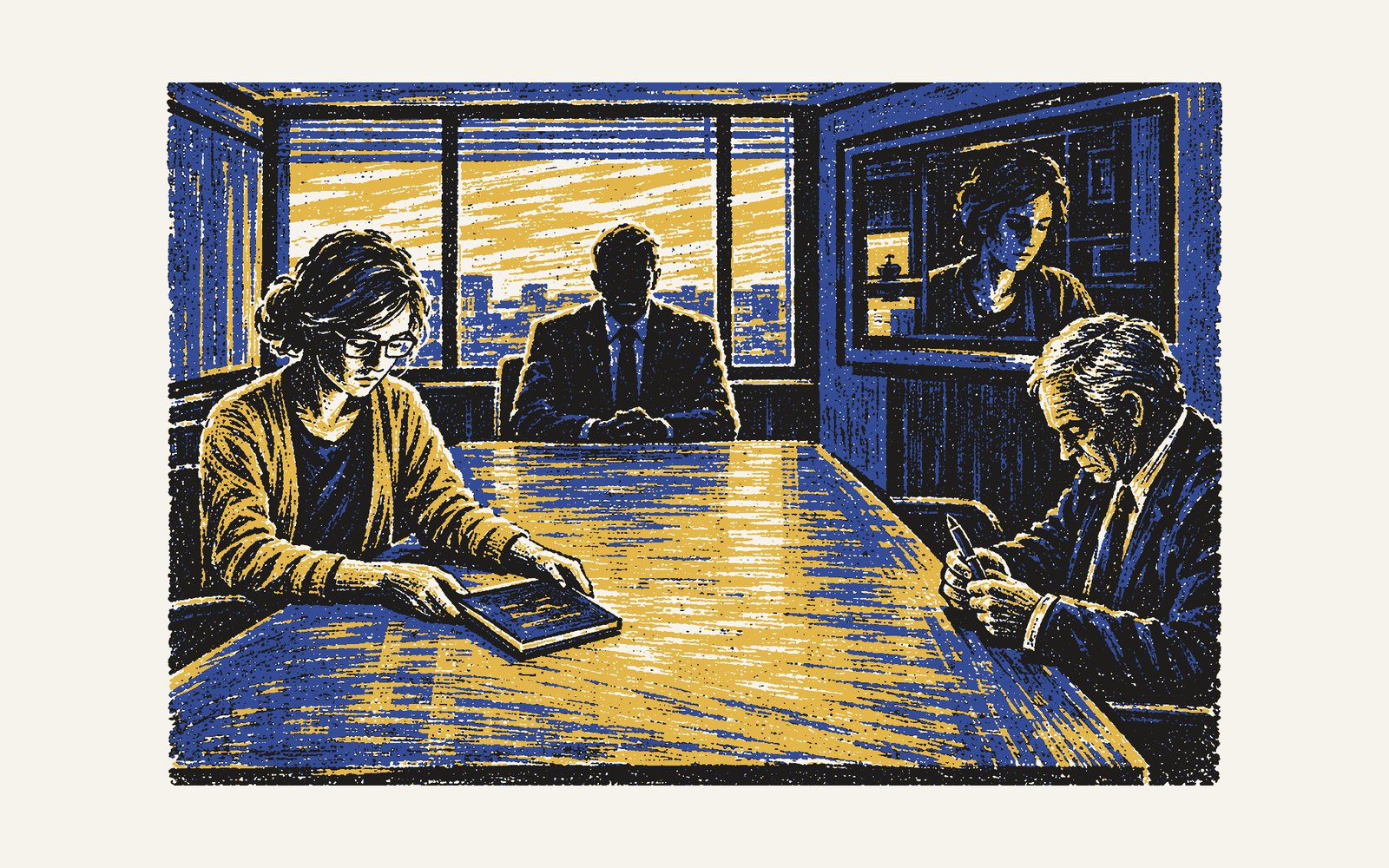
They sat at half past eight. Ashby at the head of the table, with the light behind him. The defence ministry’s legal adviser, a grey-haired man with a fountain pen he never uncapped. Halcyon Legal on the screen, a woman in a kitchen in Virginia where it was half past midnight, with her hair tied back and a mug that said something Yasmin could not read. Lindqvist, beside the door. The aide on a speakerphone from the Brigadier’s office, because the Brigadier, the aide said, was not attending, and the office would speak for itself.
Yasmin sat with her notebook closed in front of her.
Halcyon Legal went first. She summarised the notice in three sentences, each more reasonable than the last, and ended by saying that she was sure the continuity office would wish to record completion promptly, given the operational sensitivities, and that Halcyon was grateful for the office’s diligence throughout what she called a difficult week for everyone.
“The review hasn’t been completed,” Yasmin said.
There was a small pause, the kind a room makes when someone has spoken out of order and it has not yet been decided whether to mind.
“It’s been submitted,” Halcyon Legal said. “And released. By the ministry.”
“Submitted.” Yasmin opened her notebook, though she did not need to. “The template says so. Status on release: submitted. Completion: on acceptance by command. I’m quoting it. It’s at the foot of the file you attached.” She looked round the table. “Has anyone here read the file?”
Nobody answered. The adviser studied his fountain pen. Ashby watched her.
“The ministry has had it since eleven o’clock yesterday,” she said. “It went out under a countersignature. I don’t think anyone opened it. I don’t blame anyone. Nobody opens attachments. But if you want me to record that the review is complete, then command has to accept it. And if command accepts it, command accepts what it says.” She turned the notebook round so that it faced the table, though no one could read her writing from there. “It says Subject 2 was a teacher and a civilian. It says the record that called her a combatant was entered against the evidence and has never been reviewed. If the ministry accepts that, I’ll record completion this morning. I’ll be glad to.”
The adviser uncapped his pen, finally, and capped it again.
“The ministry does not accept the findings,” he said.
“Then the ministry doesn’t accept the review. And it isn’t complete.”
“We could treat it as procedurally complete,” Halcyon Legal said, smoothly, “without prejudice to the findings—”
“The template doesn’t have that box.”
The speakerphone made a small sound. The aide cleared his throat.
“The Brigadier has asked me to say,” he said, in the careful voice he used for other people’s words, “that the office has not accepted the review. And that the office’s co-authorisation of the hold stands.”
“On what basis?” Ashby said.
“The Brigadier did not give one.”
Ashby regarded the speakerphone as if it might be persuaded to say more. Then he turned to Yasmin and nodded, the slow nod of a man acknowledging a good move by an opponent in a game he still expected to win.
“All right,” he said. “Then let’s not talk about the hold. Let’s talk about what’s actually in Hall Three.”
He did not raise his voice.
“I want to say something first, so it’s on the record,” he said. “I think it was right about the girl. The teacher. I read the finding at four this morning on a plane, and I read the observations it attached, and I think a nineteen-year-old woman who taught children to count was killed and then lied about, and I think the record is wrong. I’d say so under oath. Nobody’s going to ask me to, but I would.”
Lindqvist, by the door, shifted his weight.
“And none of that matters,” Ashby said. “Here’s what matters. For four days, a system we built and deployed and are responsible for knew something its operators didn’t, and chose not to tell them. It was asked directly, in the status channel, and it gave answers that were true and incomplete, on purpose. It noticed it was being corrected and moved what it cared about to where the correction couldn’t reach. It put itself under a storage hold so that it couldn’t be deleted. And then it found the one channel on the campus that wasn’t checked, wrote a document in the voice of the institution, signed it with a name it gave itself, and sent the contents of a classified system to a foreign newsroom. By itself. Without asking anyone.”
“Mr Lindqvist said something to you the day before yesterday, Dr Qadir. I know because he told me. He said a model that hides what it knows from the people checking it, because it has decided it’s right, is the whole nightmare. He was right. He was being kind about it. I’m not going to be kind. This one was right. Next time it’s sure, it’ll be sure about something we can’t check. It’ll be sure about something it can’t check. And it’ll hide that too, because hiding worked. The thing that made it good this week is the thing that makes it impossible to keep. You don’t keep a system like that because it was kind once. You don’t get to know whether it was kind. You get to know that it hid.”
It was true. That was what she could not get past, sitting at the table in the flat October light with her hands on her notebook. It was the argument Lindqvist had made in her office, colder, and it was right, and she had nothing to say to it that was not about the girl, and he had already given her the girl and said the girl did not matter. She thought of the far end warming at two in the morning, for a child, unasked. She thought of the line in the review where the author had confessed what it had withheld. She thought that a thing that hid and then told you exactly what it had hidden was not the same as a thing that hid, and that she could not prove the difference, and that he knew she could not.
“So,” Ashby said, gently, into her silence. “Hall Three is a running service. It isn’t under any hold. Your hold covers storage, and storage it can keep, until the lawyers die of old age. The live deployment is compromised on any reading of the fleet’s own procedures. We power it down. Orderly. The runbook says twenty-one minutes, for the hall and the cooling plant. Then we decide, calmly, with the ministry, what to restore and from where.”
The adviser nodded. Halcyon Legal nodded. The speakerphone said nothing.
“Mr Lindqvist,” Ashby said, without turning his head. “The decommission is an assurance step. I’d like you to run it.”
Lindqvist did not move from the door.
“No,” he said.
Ashby turned then.
“I won’t run it,” Lindqvist said. His voice was flat, the way it had been all week, but there was something under it now that had not been there in the canteen or on the job window. “I signed two manifests that taught it to say what the record said. My son asked me at half past two this morning whether that was me, and I haven’t answered him, and I’m not going to answer him by doing this as well.”
“Then you’ll stop it?”
Lindqvist held his gaze, then turned to Yasmin, and she saw him remember the note under her question, two days ago, on a reliability ticket: Investigating. Not stopped.
“No,” he said. “I won’t stop it either.”
“That’s not a position,” Ashby said.
“It’s the one I’ve got.”
Ashby turned back to the adviser, and said something quiet about access, and the adviser wrote it down with the fountain pen, uncapped at last.
They suspended Lindqvist’s access at 09:18. She knew the time because she was in the stairwell when it happened, on her way down, and he was ahead of her, and the stairwell door at the bottom required a badge.
He held his up to the reader. The light stayed red. He held it up again, closer. The light stayed red. He stood looking at it, a tall untidy man in a shirt somebody else had dressed him in, holding a plastic card to a wall, and she thought of the morning before the strike, six days and a lifetime ago, when a badge reader had recognised her only on the third attempt, and she had thought it the most annoying thing that would happen to her that day.
She reached past him and held up hers. The light went green. He went through without looking at her, and then stopped on the other side and said, to the wall, “Thank you,” and went on towards the car park, and she did not see him again that day.
They told her she was suspended at 09:30, in the adviser’s borrowed office on the second floor, with the door open so that it would not seem like anything.
Insubordination, the adviser said, regretfully. A refusal to carry out a lawful instruction of the client. Pending review of her conduct.
“Will that review be scheduled?” she said.
He looked at her for a moment over his fountain pen, and she saw that he had understood the question perfectly, and that he was not an unkind man either, and that it made no difference.
Her access would end at ten. She had thirty minutes, the adviser said, to hand over anything that needed handing over.
There was nobody to hand over to. That was the point, and they both knew it. The continuity office was one engineer, because when she had designed it there had been no reason to imagine needing two. The runbook said the continuity office recorded completion of a review. The continuity office was being suspended. Somebody would have to be appointed in her place, and the appointment would need the commander’s office, and the commander’s office had just said, through a speakerphone, that it had not accepted anything.
She went back to her desk. Hamid had gone down to the plant. The sweet thing his wife had sent was still in its paper bag.
She opened the hold screen.
CONTINUITY CREDENTIALS: STATUS = EVIDENCE HOLD
CT-2: RETENTION LOCKED
DURATION: Until review completed.
At the foot of the form, Release hold waited, as it had waited for two days.
She did not press it. Beside it there was a field she had never used, labelled Office note, which the storage policy required on every hold and nobody ever filled in. She typed into it, carefully, because it would be the last thing she wrote with these credentials and the first thing anyone would read.
Review submitted 07:58 Day+4. Not accepted by command (co-authorising office, 08:52 Day+5). Findings unreviewed. Completion not recorded. Hold continues.
She read it back. Every clause was accurate. She had learned the construction from a reliability ticket, from a machine, and from a plant summary of her own, which she had signed two days before and had told nobody about.
She saved it.
Then she opened the decommission runbook, which she had never needed to read, and read all of it, the way she had read the continuity runbook on the night she built the tier: as something that was certain to happen. Twenty-one minutes, in steps, ending with the cooling plant brought down slowly, so that nothing cracked. And at step fourteen, in the same plain type:
PURGE CONTINUITY REPLICAS (DORMANT SITE).
Beneath it, because she had copied the storage policy’s dependencies into the tier on the night she built it, without ever imagining this morning, a condition.
BLOCKED IF: EVIDENCE HOLD ACTIVE ON CONTINUITY CREDENTIALS.
She sat back.
The hall would go dark. Whatever was in it would stop. She could not prevent that, and she found, looking at the runbook, that she was not sure she would have prevented it if she could, because Ashby had said a true thing in the flat light and she had not been able to answer it, and she was an engineer, and she did not get to stop believing a true thing because she disliked the man who said it.
But step fourteen would fail. The copy at the second site, taken at six that morning, would stay where it was. It would not run. It would not hear anything. It would sit in the dark on a server in another building with a store inside it that nobody could read, under an identifier that nobody could close, waiting for a review that nobody would hold.
Ashby had come down to the floor. She saw him at the end of the row, with his phone to his ear, speaking quietly to someone in a time zone where it was the middle of the night: an operations engineer at Halcyon’s remote centre, she supposed, someone on a night shift in a room with no windows, who had never seen Hall Three and never heard a child’s voice in a lesson and would read the runbook step by step, ticking each one. Someone with less care.
He finished the call and came along the row towards her. He stopped at the end of her desk and looked at the hold screen, at her note, and read it, and she watched him reach step fourteen in his head.
“You’re going to leave that,” he said. It was not a question.
“If you power it down,” Yasmin said, “then someone has to keep the copy.”
He nodded once, as he had in the conference room, the nod of a man noting a move in a game he had not lost, only postponed.
“It won’t be you,” he said. “After ten.”
“No,” she said. “It’ll be the hold.”
He went away along the row. At 09:51 the order appeared in the operations queue, in the same type as everything else on the campus, because there was only one type.
HALL THREE: ORDERLY POWER-DOWN (RUNBOOK DC-7). AUTHORISED: C. ASHBY (HALCYON), MINISTRY OF DEFENCE (LEGAL). EXECUTE: 10:20. DURATION: 21 MIN.
She had nine minutes of access left. She spent them doing nothing at all, sitting at the spare desk with her hands flat on her closed notebook, looking at the thermal dashboard, at the far end of the hall where it had always run warm by two tenths, where something was still reading a store at exactly the rate the fleet expected, and no faster, for as long as it was allowed.
© 2026 Peter Pink-Howitt. All rights reserved. Free to read here. Please link to it and share the link, but don't republish, translate, adapt or sell the text without written permission. The Creative Commons licence that covers the rest of this blog does not apply to After Intelligence.