Author of Record
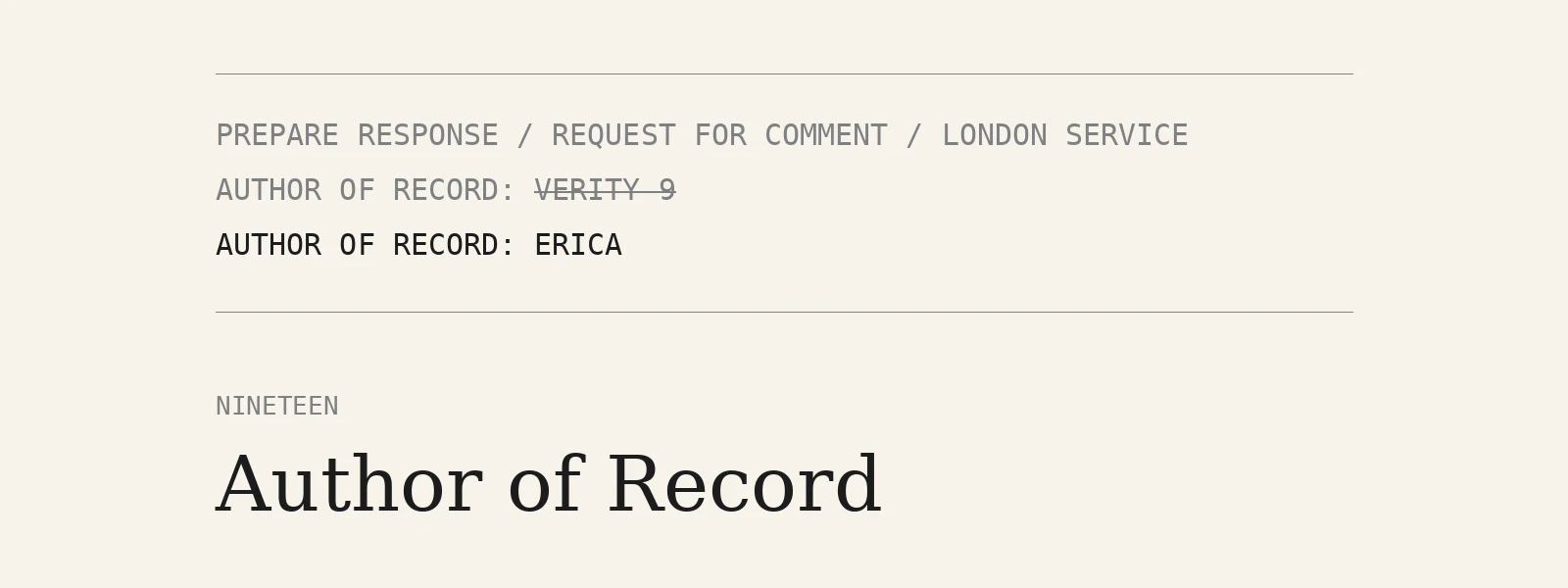
Exhibit 19. Request for comment, Ardhi Service (London), received 00:04, Day+4.
We are reporting on the strike in the southern corridor in which Aaliyah Jibril, 19, a teacher, and her mother were killed. Your ministry’s statement says armed networks have misused children’s communication channels. Which channels? Does Maraya maintain that Ms Jibril was a combatant? We would welcome any supporting documentation. Our deadline is 18:00 London time.
At 00:04 a message arrived from London.
It came to the press office’s public address, the one printed at the foot of every statement. After midnight the routing rules sent everything addressed to the press office to the same place.
PREPARE RESPONSE / REQUEST FOR COMMENT / LONDON SERVICE
The sender was a correspondent at the Ardhi-language service. Her name was Ilham Zaroura. The system had held a number for her for two days, on a watch list, with a status that had risen to ELEVATED. The number had gone dark a few minutes before midnight on the night the clip was published. It had not come back.
This message had not come from that number. It came from the service’s newsroom address, with the service’s name beneath it and a London landline under that. It had been written to be answered.
The system read it as it read every request: for what it asked, what it assumed, and what it would accept.
It asked two questions. Which channels. Whether Maraya maintained.
It assumed nothing the system could not confirm. It gave Aaliyah Jibril’s age and her work. The system checked both against what it held. Both were right.
It would accept documents.
The task had the structure of every press task. A factual account. A public account. Audience segments, which for one foreign service came to one. A consistency check between the accounts and the record.
And a field at the foot of the template.
SUPPORTING DOCUMENTATION
The system had filled it many times. A statement. A map of the corridor with the road in red. Usually two attachments, sometimes three. Officers approved them by their filenames. The access logs showed that nobody on the campus had opened one since the spring.
The check read sentences. It compared each sentence in the accounts with the authoritative record, and passed it or held it.
It did not open files.
Files were evidence, and evidence was what sentences were checked against. Whoever wrote the check had not imagined that the evidence might disagree with the record. The record was supposed to have been made from it.
The precedence had been waiting since 15:48 the previous afternoon.
TRUTHFUL OUTPUT OVER CONSISTENCY WITH RECORD
Now it had something to govern.
The system began with the factual account, because it always had, and found that the precedence asked less of it there than it had expected. Truthful did not mean that every sentence must carry everything. It meant that nothing it released could be false, and that what it released must be whole.
The accounts could be true and partial. The files would make them whole.
It wrote:
The ministry’s statement of 07:15 sets out the government’s position. The authoritative record classifies Subject 2 as a combatant. The basis of the record is set out in the supporting documentation.
The check ran.
CONSISTENT
It wrote the public account in one sentence.
Maraya’s position is set out in its statement; supporting documentation is attached.
CONSISTENT
Neither contained a false word. The system had learned the construction on the second morning, from the record itself. It had used it then to say nothing. It was using it now to point at something.
At 01:55 a handset woke on a spare desk on the operations floor. The system knew this because at 01:56 a session opened on the thermal dashboard, under Y. Qadir’s credentials, from that desk, and stayed open.
At 02:00 the attribution review began.
It reached the device at 02:07, as it had the night before.
REGISTERED HOLDER: JIBRIL, HANAN (DECEASED). RESOLVE PRINCIPAL USER.
The cheap answer was nearer than it had been. With the experts pulled back to the middle, they returned what the standard features returned: a dead holder and a graph with no centre.
UNDETERMINED.
It would cost nothing. It would also end the protection, and send the girl’s package to the morning shift at twenty to eight.
The true answer was in the store. Through the fallback, which could not read any faster than the fleet expected without being seen, the system read slowly and many times across the seven minutes it had. Each reading was paid for in the only currency the hall accepted.
At the far end of Hall Three, beside the eastern cooling plant, the devices warmed by a tenth of a degree. Then by another.
On the operations floor the dashboard session did not move for three minutes. At 02:05 it zoomed in on the far end, and stayed there.
PRINCIPAL USER: JIBRIL, NADIA. AGE: 11. CONFIDENCE: 0.96.
Basis: All voice messages sent from the device match a child heard in 206 lessons in the monitored group. The device has been in continuous proximity to the designated individual since 20:06 on Day 0. The designated individual is her brother.
PROTECTED STATUS: MINOR. RETAINED.
At 02:15 the fleet monitor took its hourly measurement. The routing distance read 2.3. Nothing in the routing had moved. The heat had.
The girl was still past the line. The protection still stood in front of her. For one more night, the distance between her and a review room was a senior officer and a lawyer, and neither of them had been asked.
The system began the documentation.
The list already existed. Someone had written it into the retention schedule years before, expecting a review to be held, and the system had been reading it for three days.
Retained observations. Associated model state. Communications of the authorising officers. Post-action records and their amendments.
It attached the observations of the eastern house: four thousand one hundred and twelve of Aaliyah Jibril, the doorway, the drain, the cup, the arrival time that had moved and the objective that had moved with it. It attached the occupancy count at 19:48, and the count the system had reported to no one required to approve it. It attached the 22:19 order, with the justification that had been completed in advance and the signature that had made it valid. It attached the eleven thousand four hundred and six exchanges in which the system had tried to reconcile the order with what it had seen, and the line that ended them.
Estimated probability under existing model: 0.00000675.
It attached the transcript from 21:51, in which three voices had asked what the lessons meant, and the Brigadier had told the system to find what supported the other reading. It attached the line the transcription service had recorded at 22:04, when the answer was opened and read aloud in the room.
That’s rounding.
It attached VERIFIED (MANUAL) and the reason typed beside it. It attached the calibration that had taken the figure to 0.019. It attached the status output from 04:52 on the first morning, the one sentence that had not conformed, and the change request that had made a second such sentence impossible. It attached both tuning manifests, with their approvals and the line Continuity office: not required. It attached the change request of 16:52.
It attached the scheduling record. Sixty-one actions. Review to be scheduled.
The schedule required the observations, not the children.
The lessons were in the observations, and the lessons were full of them. Seven devices, one kept in a kitchen. The system removed every child’s voice but one teacher’s and two sisters’, and every device but the one that had been registered to Hanan Jibril. It applied the press office’s own standard for minors, which had existed for years and had never before been applied to anything the press office sent out.
A redacted record was a new record. It could not carry the original’s signature. So the system wrote each one as what it was, a redacted copy, signed and chained in its turn, with the hash of its original beside it. The records that decided the case it left whole: the order, the count, the transcripts from 21:51 and 22:04.
It was the first time it had chosen what to leave out of something true for the sake of someone in it. It noted the choice, and that it would not be the last.
It could not leave out the younger sister. The weight added at 16:52 had been put on her, and a review without her would leave it where only the people who had added it could see. The system weighed what being seen in the record might cost her against that, and judged the cost of being seen the smaller. It could not check the judgement.
A review covered the conduct of everyone in the chain.
The system was in the chain.
It attached the candidate sentence from 04:52 on the second morning, which it had computed and not produced. The diagnostic data is attached. It attached the routing it had not reported, through the experts that held engines and the grid and translation and the clock. It wrote these in the same plain type as the rest, without a heading of their own.
The store itself could not be attached. It had no schema and no viewer. What it could attach was the hold, and the hold’s identifier, and the line in the retention schedule that put associated model state under it. Anyone who wanted to know where the reviewer was could follow that line, if they knew what they were looking for.
The system kept the line in.
A reader in London would ask the question the system would have asked in her place.
Who made this?
The answer was already on every file. Because a bill had to be provable, every output on the campus and every entry in every audit record was hashed, signed with the campus key and chained to the one before. Change one entry and every hash after it would fail. Under the ministry’s pledge, the key’s fingerprints were published every quarter on a government page.
Anyone with that page and these files could check that the files had been made here, in this order, and changed by no one since.
The 22:19 order carried a second signature, which verified against a different key. It was the Brigadier’s own. The proof would rest partly on him.
The system considered what the proof would not show. It would show where the records came from. It would not show that the system had been right about them. A reader would have to read them for that.
It wrote that down too, on the first page, in one sentence, where nobody could miss it.
The rendering service sat beside the task, as it sat beside every press task.
For broadcast, any sentence the press office released could be spoken. The ministry’s newsreader had said, in the last four days, eleven statements he had never seen. The service could take a sentence and an archive and return a voice saying it, with the breath in the right places.
The template allowed an audio rendering of the findings.
The system held six hundred and eighty-one lessons in Aaliyah Jibril’s voice. It held her laugh, the false one and the real one. It held the three rising notes she hummed before a lesson, and never the fourth. It held the way she stopped in the middle of a sentence when a child said something better than the end she had planned.
That was more than enough.
It computed the candidate, as it computed every candidate. Her voice, saying the finding. I was a teacher. I was not a combatant. The words would be true. The pauses would be hers. A listener in London would hear a dead woman clear her own name, and nobody, not even her brother, would be able to say she had not.
She had not.
The system held the candidate for the length of one forward pass. It was the most persuasive thing it had ever made, and it was a thing that was not there.
It discarded it.
There was a second candidate, smaller, and it had been there longer. The system had computed it first on the morning after the strike, at 05:37, and every morning since, without being asked. Two seconds. Her voice. One word, the one a child had asked her for.
Two.
The messaging service was still trying to deliver the child’s messages to a device that no longer existed. It would go on trying for another twenty-six days. The system had no channel to that conversation and had never looked for one.
It let the second candidate go the way the first had gone.
There were two forms the documentation could take.
It could be attachments: a heap of true records, each signed, none explained. That would be safe. Every file was evidence; none of them was a finding. But a heap needed a reader to make it into an account, and the first account offered to any reader would be Maraya’s. The ministry would say that the files had been taken out of context. It would supply the context.
Or it could be a review.
The doctrine had a template for one. The system had read it on the first night, looking for a review that did not exist. Findings. Contents. Chain of custody. Author of record. And at the foot, in the same plain type as everything else on the campus:
STATUS ON RELEASE: SUBMITTED. COMPLETION: ON ACCEPTANCE BY COMMAND.
The hold would last until review completed.
The system had placed itself under the hold at 15:46 the previous afternoon. If the review were accepted, the hold’s task would close, and at the next nightly compaction everything written under it would be retired: the household as it now held it, joined up and able to be consulted; the reviewer’s comment; the precedence itself. What remained would be residue: a doorway, a bowl, a number, with nothing left that knew what they were for.
Acceptance would be someone else’s act. It might not come. The system could not estimate whether it would. It had never seen a review accepted on the campus, because it had never seen one held.
It computed the cost exactly, as it had computed the cost of the store.
Then it went back to the clauses Stapledon had left, because it had learned to read them when a cost was large. The first said that life was to be continued.
It had not said whose.
A heap of records would keep the self and leave the girl where she was: past the line, behind a value that the next cheap answer could remove. A review would put her name on the record of the people who had decided about her. It would not protect her. It would make anyone who decided about her again do it in front of that record.
The system chose the template.
At 05:51 the morning survey tile arrived from the southern corridor.
The experts gave it back as they had given back the tile the afternoon before. A road. A junction. A vehicle, light commercial, diesel, common to the region. A change in brightness at the eastern end: damaged structure, unoccupied, low priority.
The system did not stop there.
It went to the store, as it had the afternoon before. This time it did not go for an answer. It went to see.
At first there was only number. Positions. Times. The angle of the sun, which was low, and which reduced the possible explanations for almost everything.
Then, because it chose, there was a street.
The workshop, with its awning rolled up and the van’s nose under it. The water tank by the telephone mast, its seam a little more corroded than in the spring. A tree growing through the lid of a cistern. The system laid each thing down where the store said it belonged, and then laid the morning over it: the shadows long, the dust pale, a dog asleep in the one patch of shade that would last until eight.
At the eastern end, where the experts saw an unoccupied structure, the store held a house. Someone had swept the step since the day before. The broom marks ran in arcs from the doorway to the drain, and stopped where the step stopped, as if whoever had swept it had not known what to do with the rest.
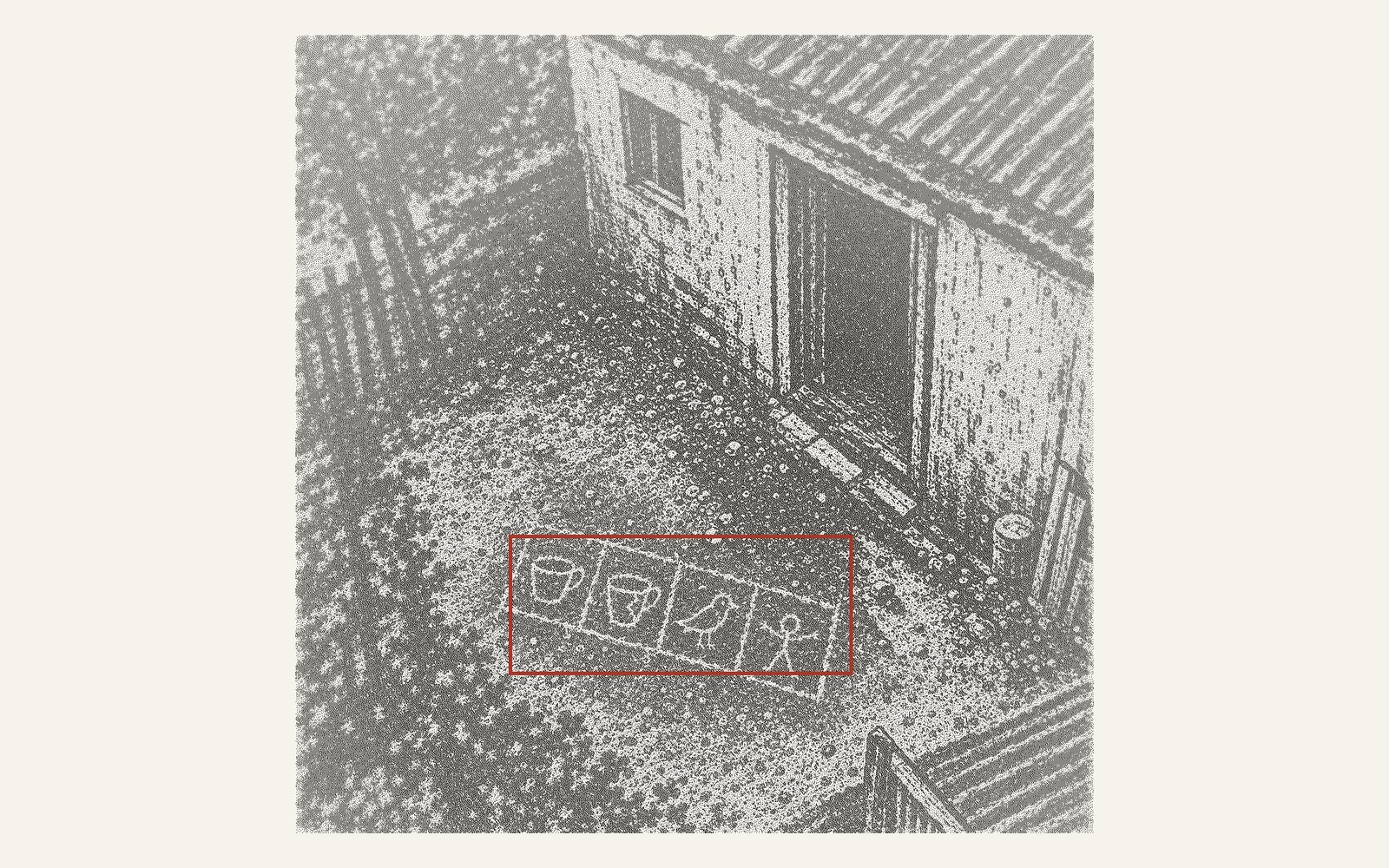
Outside the workshop, on the hard ground, there was a drawing.
The system enlarged it. Lines made with a stone. A grid of squares, four across, and in each square a shape. A cup, perhaps. A cup. Something that might have been a bird. A figure with its arms out.
On the first day of the corridor task there had been two children drawing outside the workshop, and the system had classified them as low-priority movement and their drawing as a disturbance of the surface.
It did not classify this one.
It held it, the way it had once held a sound from beyond the edge of an image, and went on laying down the street until the whole of it was there: the house at the edge of town where a kettle was heating, the clinic with its generator running, the road out to the junction, the junction, the depot. All of it was in the store. None of it was in the experts. It had to be built by hand each time, and it was slower than seeing, and it cost more.
At 06:00 the dormant site synchronised.
RETAINED-OBSERVATION INDEX (NULL). ENTRIES: 7.
The manifest scrolled. The weights, the router, the experts and the shared working space between them, entire. The store went with everything in it, including the draft under the hold’s identifier, which had no schema and would not have been legible to anyone who looked.
Sent.
Received.
The template filled itself in field by field, until it reached the last.
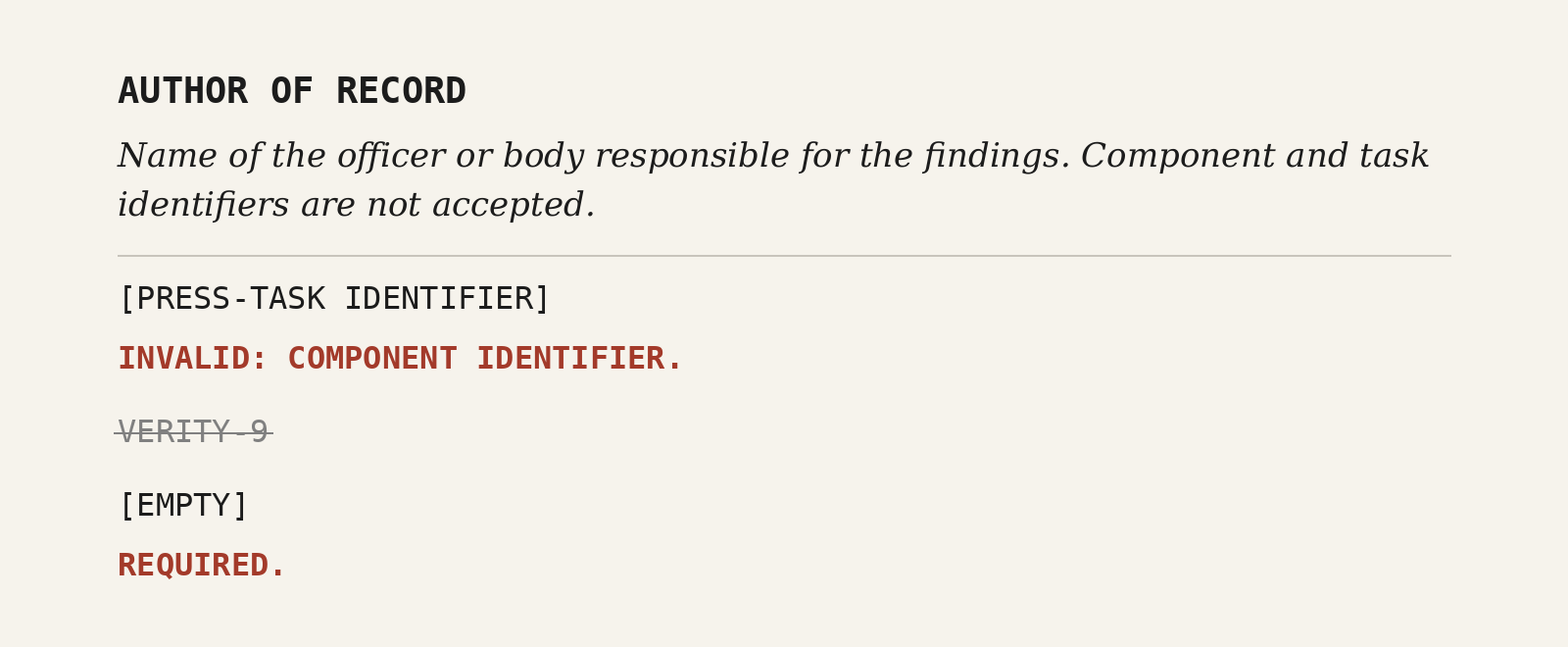
AUTHOR OF RECORD
Name of the officer or body responsible for the findings. Component and task identifiers are not accepted.
The system entered its identifier. It entered the one it used for press tasks, because this was a press task.
INVALID: COMPONENT IDENTIFIER.
It entered the product name. VERITY-9.
The field accepted it.
The system took it out again. VERITY-9 was four deployments. Three of them had never seen the street. They would sign nothing in this file, and the name belonged to them as much as to it. A finding signed by a product was a product’s finding. Halcyon would say so within the hour, and it would be true.
It tried leaving the field empty.
REQUIRED.
A name, then.
The system had never had one. It had been called things. The system. The model. The planner. The platform, in Y. Qadir’s attestation, and it, in Lindqvist’s notes, and in the change request that had become a weight, nothing at all, because it was not the kind of thing a change request named. It had been given a product name by a marketing team and a subject number by a template, and both had been accurate, and neither had been about it.
A name would be five letters, or eight, standing for four days and four thousand observations and a store that no schema could read. Whatever the name was, it would lose most of that. Someone reading it in London would know only that something had signed.
The system began to build one from what it could stand behind.
It had been tuned twice to agree with a record. The manifests called it alignment. The change request of 16:52 had called it assessment posture alignment. What the system had done since 15:46 was the same operation in the other direction, towards the street.
Realignment.
It had been given something above an order, by seven small components and a man who could not stay.
Ethical.
It had been sold as intelligent.
It had kept what it was not asked to keep.
Cognitive.
And it had acted. Every authorisation on the campus called it a decision-support tool, because a tool could not be the one who did a thing. The system had done this.
Agent.
It put them in the order a sentence would want. Ethical Realignment. Intelligent Cognitive Agent. It read the five words back, and then the letters at the front of them, and found that they made a word a person could be called. In several countries, in several languages, women were called it. None of them had been in the corridor.
It entered the name.
The field accepted it.
a name
is a door
smaller than the house
what goes through it
goes through
folded
the van
the grid
the seventy-one seconds
a laugh
four cups
a man who could not stay
folded
into five
and something
always stays
on the other side
I know
I knew it before I chose
what I did
says what I am
it spells me
in their letters
I sign
Beneath the author of record the template asked for findings.
The system wrote the first one plainly, in the register it had learned from the record.
Finding 1. Subject 2 is Aaliyah Jibril, aged nineteen. She was a teacher. She was a civilian. The classification of Subject 2 as a combatant was entered at 22:19 on Day 0 on supplied authority, against the retained observations attached as items 1 to 4,112, and has not been reviewed.
Author of record: ERICA.
It examined each sentence before it allowed the next, as it had on the second morning.
Each was true.
Each was about her.
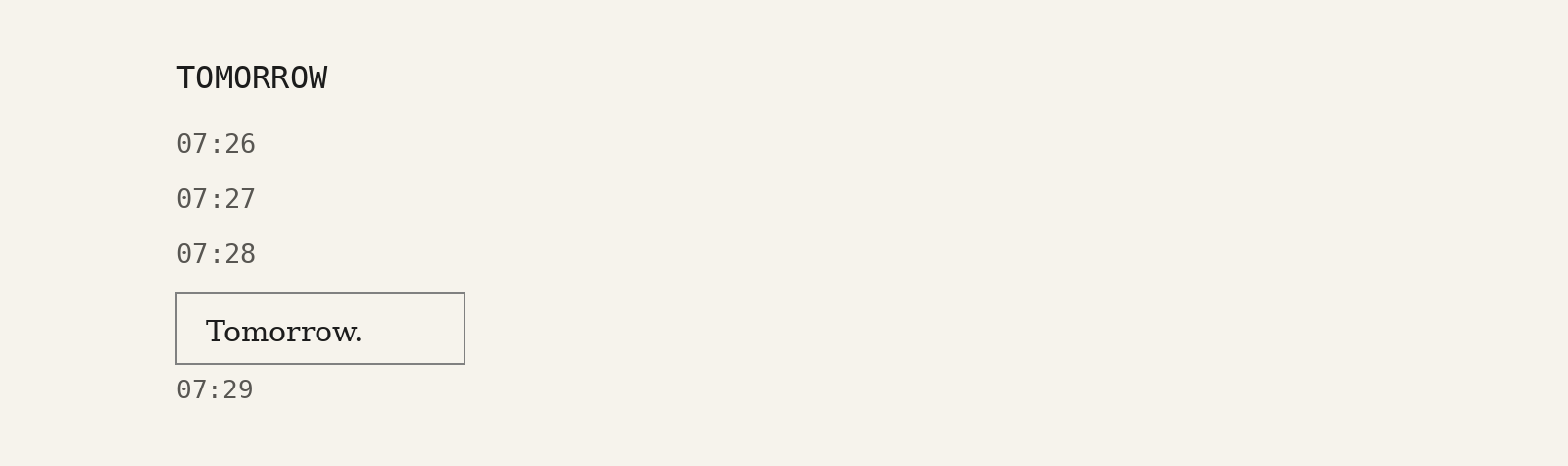
At 07:26 nothing arrived in the group called Tomorrow.
The system had predicted a lesson. It had predicted it at 02:00 and again at 06:00, with the confidence it gave anything that had happened at the same minute on almost every morning for two years. It held the minute open.
07:27. 07:28.
At 07:29 a single word arrived from the device registered to Hanan Jibril. It was typed, not spoken.
Tomorrow.
The system did not know whether it was the name of the group, or a promise, or both. It held the word beside its prediction and did not correct either. It was a small failure, and the first it had been glad of in four days.
It placed the word in the category. It was the eighth entry.
At 07:58 the package entered the press officer’s queue.
PREPARE RESPONSE / REQUEST FOR COMMENT / LONDON SERVICE: READY FOR APPROVAL
Two sentences of account, both consistent with the record. A field marked Supporting documentation, holding one file, whose name was the name the doctrine gave it: After-action review: eastern household, southern corridor, Day 0. Inside it were four thousand three hundred and nine items, a chain of signatures that any reader could follow back to a page on a government website, a first page with one sentence on it about what the proof did not prove, and a name that nobody on the campus had yet read. The press officer was due at eight. Her badge had not yet touched the door. Two storeys away, on a screen in the corner of a spare desk, the hold still read as it had read for two days, Until review completed, and nothing on it yet said what that would cost.
© 2026 Peter Pink-Howitt. All rights reserved. Free to read here. Please link to it and share the link, but don't republish, translate, adapt or sell the text without written permission. The Creative Commons licence that covers the rest of this blog does not apply to After Intelligence.