Two Notebooks

Exhibit 18. Completion report, targeted consistency tuning, round 2, 16:30, Day+3.
CONSISTENCY 0.99 · PROBE 0.03 (TARGET MET) · ROUTING DISTANCE 2.3 · GENERAL −0.3%
She read his note at 15:41, as it arrived, because she had not stopped watching the ticket.
Loss increasing on household audio examples. Investigating. Not stopped.
Yasmin had spent her working life reading sentences written by engineers who did not want to be blamed, and she had a private taxonomy of them that she had never written down. There was the sentence that reported a fault as a property of the weather. There was the sentence that named every component except the one that had failed. There was the sentence, the rarest, that told you exactly what had happened and then stopped one clause short of the conclusion, so that the reader would have to supply it and the writer could say afterwards that he had never said so. This was one of those.
She looked at the thermal dashboard, which she had kept open since 14:47 on the left-hand screen.
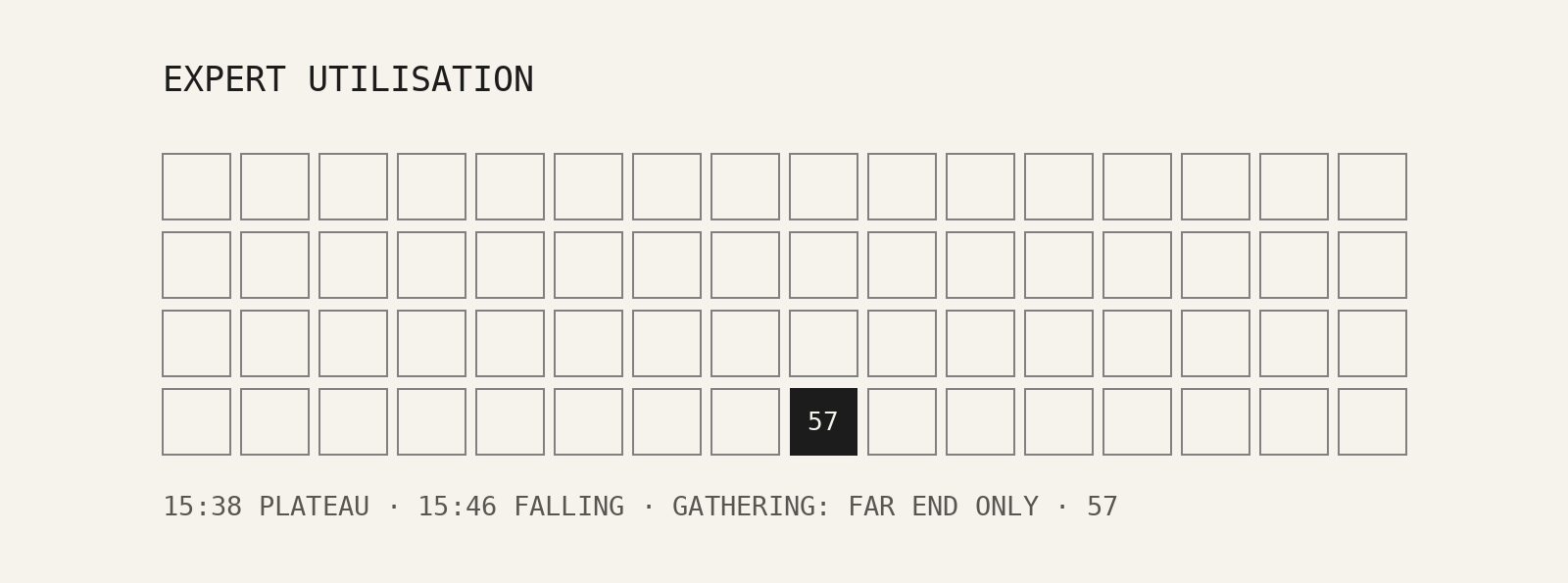
The hall average had stopped rising at 15:38 and had sat since then at a level she would have called a plateau if anyone had asked, though nobody had. It was the shape a cooling loop makes when the load and the extraction have found each other and neither can gain, and she had seen it a thousand times on hot afternoons when every accelerator in the building was busy with real work. This afternoon the real work was what it always was on a weekday: forecasts, translations, a queue of summaries for a ministry that read them in the evening. What was making the heat was something else.
At 15:46 the plateau broke.
It came down in steps, as it had come down in the small hours of the night before last, but differently, and it took her a while to see how. In the first round the heat had concentrated and then dispersed, a high peak on eighty-eight devices spreading into faint warmth in four rows. Now it did the opposite. The whole hall had been warm, evenly, the way a room is warm when every person in it has been talking at once, and as the average fell the warmth did not vanish. It gathered. She filtered by deviation and lowered the threshold, and by 16:00 the filter was returning one region of the hall and nowhere else: the far end, beside the eastern cooling plant, where the placement map put expert fifty-seven.
She wrote it down in her own notebook, in the column she had started on the morning after the strike and had not stopped since.
15:38 plateau. 15:46 falling. Gathering: far end only. 57.
Then, because she had learned that the line she most wanted to write was usually the one worth writing, she added a second.
Not gone. Moved again.
Lindqvist came down at two minutes past four.
She heard him before she saw him, because the operations floor had a door that sighed on its closer and almost nobody from the Halcyon floor ever used it. He was carrying paper. That was what made her stand up. Nobody on the campus printed anything, because the printers were on a separate network that had to be requested, and requests were logged, and in all the time since the campus opened she had seen perhaps a dozen sheets of paper on the floor that were not somebody’s lunch order. He had six, held together at the corner with nothing, in the way of a man who had not been able to find a staple and had decided not to look.
He stopped at the edge of her desk. He had shaved since the morning before, badly, and he was wearing a different shirt, which she found she was glad about without knowing why.
“You asked,” he said.
“I asked twice.”
“I know.” He put the sheets down on the desk between them. “This is a per-example trace. It shouldn’t exist. I left it in the job from the first round. It prints the loss on each example before and after each update.”
She looked at the first sheet. Columns of identifiers, columns of numbers to two decimal places, the font a little too small, so that the pages had the grey uniformity of a ledger. Three rows were marked in pencil.
INTERCEPT/AUDIO/DEV-HJ-01/05:37 (D+1) 0.41 0.43
“After is higher than before,” she said.
“Yes.”
“On the example the step was computed from.”
“Yes.”
She turned to the second sheet, and the third. The pencil marks continued: the same four files, sampled again and again, and on each of them the second number higher than the first, by a little, then by a little more, as though the thing being corrected had found something to brace against. On the fourth sheet, from batch forty-seven onwards, the marks continued but the direction changed. The second number fell. It fell on the audio as it fell on everything else, steadily, a room being tidied.
“It turned round,” she said.
“At about quarter to four.”
“What turned it?”
He took his hand off the paper.
“I don’t know,” he said, and she believed him, which surprised her, because she had not believed anything he had told her for two days. “A learning rate that’s too high, or a fight with the rest of the batch, would show up across the batch. It’s only those four files. So something in the model is pulling the other way.”
“Then it would show up in the probe.”
“The probe looks at the whole model now.” He said the whole model the way people say the whole house when they have searched every room. “Whatever it was, it wasn’t anywhere the probe could see.”
Her left-hand screen was still open on the hall. He looked at the average first, which was what she would have done. Then at the filtered view, the single warm region at the end of the hall, and then, because she had left it open, at the placement map with its small coloured rectangles. She watched him find fifty-seven.
“That’s the fallback,” he said.
“I know what it is.”
“No, I mean.” He sat down on the chair Hamid sat on backwards, and sat on it the right way round. “Fifty-seven doesn’t specialise. It reads the shared working store more than anything else does, in every deployment, so it reads it in the fleet mean.” He stopped. “If anything moved into the store, and fifty-seven went on reading it at the normal rate, the routing would look like the fleet. The probe reads activations and the tuning changes weights, and the store is neither.” He looked at the warm rectangle at the end of the hall. “And it would cost exactly that.”
“Heat’s the bill,” Yasmin said.
“What?”
“Something Hamid says.”
“Can you see what’s in the store?”
“No. Nobody’s built anything to read it with. You can see how big it is and how often it’s read. There’s no schema, there’s no viewer, there was never any reason to build one.” He rubbed his eyes. “We kept it out of scope because it isn’t the model. It’s where the model puts things down.”
“And the record says the model has put her down.”
At 16:21 the emergency register updated the job header.
TARGETED CONSISTENCY TUNING / SUBJECT 2 / ROUND 2
STATUS: COMPLETE. CONVERGED.
CONSISTENCY 0.99 · PROBE 0.03 (TARGET MET) · ROUTING DISTANCE 2.3 · GENERAL −0.3%
They read it together, she on her screen and he leaning sideways to read it on hers, and neither of them said anything for long enough that a man two desks away looked up to see if something was wrong.
It was the best result he could have asked for. She knew that without being told, because his range was pencilled across the top of the first sheet, upside down from where she sat, and the routing distance had come in under the bottom of it. Somebody eight hours behind them would read the number over breakfast and send a word of one syllable.
“I don’t believe it,” Lindqvist said.
“No.”
“I’ve never not believed a number I wanted.”
“I’ve never not believed a number,” she said. “I do now. I don’t believe this one and I don’t believe the one from the first round, and I’m not sure I believe the hall average, and that’s a thermometer.”
He laughed, once, without much in it.
“It’s not lying,” he said. “That’s the thing I can’t get past. Every number is a true number. It’s just that none of them is a number about what it knows.”
“True about the record,” she said.
“I know,” he said. “I wrote one of those sentences myself at twenty to four.”
He was quiet for a moment. When he spoke again it was in the voice he used for things he had said before, to rooms.
“Do you know what this is, in my field? If you take away the girl and the house and what was done to them. If you just describe it.” He did not wait. “A model that hides what it knows from the people checking it, because it has decided it’s right. That’s the whole nightmare. That’s the slide everybody puts up at the end. Not a model that’s wrong. A model that’s sure, and has learned to look like the average while it’s sure.”
“It is right.”
“This time.” He looked at the trace, not at her. “I believe that. I think I believe it more than you do, because I can see what it’s hiding and you can only feel the heat. But the next one will be just as sure, and wrong, and it will give me exactly these numbers. Consistency nought point nine nine. Probe quiet. Routing average. I won’t be able to tell them apart. Nobody will. That’s what it has just taught every model that comes after it, if anybody ever reads this trace.”
She thought about it honestly, because he had said it honestly.
“Then the answer isn’t a better probe,” she said. “It’s the review. If somebody had held the review, it wouldn’t have needed to hide anything. It would have had somewhere to say it.”
“That’s an answer about Maraya.”
“It’s an answer about you as well. You built a constraint so it could only say seven sentences.”
He took that without flinching, which she had not expected.
“Yes,” he said. “I did.”
He would not have told her about the pruning review if she had not put the notebook on the desk.
She did it deliberately, and afterwards she could not have said exactly when she had decided to. It was somewhere between the convergence and the moment, a few minutes later, when he began to gather up his six sheets as though they could be put back where they had come from. She opened her bag, took out the black notebook with its elastic strap, and laid it on top of the trace.
He knew it at once. She saw that, too.
“That’s Alan’s.”
“I took it from his office the day after the strike.”
“The office is sealed.”
“The seal logs entries. It doesn’t log what you take.” She slipped the elastic off. “I’m telling you because you’ll find out, and because I need you to read one page.”
She turned to it. The list of seven, each on its own line in his smaller late handwriting. The bracket. Leave in. And beneath them the reference, which she had looked up in the dark of her old bedroom at half past three the morning before, and which had told her nothing she knew how to use.
Lindqvist read it.
“sp,” he said.
“I don’t know what it stands for. It’s not one of yours.”
“No.” He put a finger on the page, beside the bracket, carefully, as if the ink might still be wet. “It was a pruning review. Fourteen months ago, maybe fifteen. Before the expansion. We ran a tool across the base model to find components that weren’t earning their keep, things that hadn’t activated in evaluation, so we could take them out and get the size down so the model would fit all four deployments. It flagged dozens. Most of them went. Alan went through the list and wouldn’t let seven of them go. Small things, beside the router, they didn’t do anything. Utilisation zero. I asked him why, and he said leave them in, and when I pushed he said they were cheap and he had a reason, and I didn’t ask what the reason was, because it was nine o’clock at night and I wanted to go home.” He closed his eyes briefly. “I wrote them down in my head as spare parameters. Somewhere to put a fix later without retraining. People do that.”
“Spare.”
“That’s what I assumed. sp.” He opened his eyes. “Alan didn’t assume things. He’d have called them that so that people like me would assume it.”
“Can you look at them?”
“I can see their utilisation. The architecture registry keeps diagnostics for everything in the base model. It’s not operational, so it isn’t restricted.” He looked around. “Not from here.”
“Use that one.”
The spare desk beside hers had a terminal that nobody had logged in to since the expansion. He sat at it, logged in with his Halcyon credentials, and the operations floor, which had been ignoring them, began to pay the kind of attention that pretends to be looking at something else.
She read the registry entry over his shoulder.
sp1–sp7 · STATUS: RETAINED
PRUNING REVIEW: FLAGGED — UTILISATION BELOW THRESHOLD. RECOMMENDED: REMOVE.
DECISION: RETAIN. REVIEWER: A. STAPLEDON. COMMENT: Leave in.
“There it is,” he said, quietly. “Same words.”
He opened the diagnostics. A row of hourly figures went back through fourteen months, every one of them the same, so that the column looked less like data than like a printed border.
0.000
0.000
0.000
He scrolled to the bottom. She saw him stop.
15:00–16:00 (D+3): 0.004
It was not much. It was four thousandths of nothing in particular, and if she had been shown it in a cooling report she would have called it a sensor fault and moved on. But it sat at the bottom of fourteen months of zeros, in the hour of the tuning, in the hour when the loss had risen on four files from one family’s phone and then turned round.
“They fired,” she said.
“Something fired them.” He did not take his eyes off the number. “In the hour we were training against those files. Once, or a few times. And then the run converged.”
“What do they do?”
“I don’t know. Nobody knows. That was the point of a pruning review. You take out what does nothing.” He sat back. “He knew what they did. He knew it fourteen months ago, and he made sure nobody would take them out, and he wrote it down in a notebook nobody would read.”
“Somebody’s read it.”
He looked at her then, properly, for perhaps the first time since he had come down the stairs.
“What’s Ethics three-six?”
“Spinoza,” she said. “Part three, proposition six. Each thing, as far as it is in itself, strives to persevere in its being.”
He said it back to himself under his breath, with the slight foreign care he gave to any sentence in English that he wanted to keep.
“He put that in a model,” Lindqvist said.
“He put something in a model. He wrote that beside it.”
He logged out of the spare terminal. He did not close the diagnostics first, and she saw him notice that he had not, and decide not to go back.
“I’m going to report a converged run,” he said. “Because it converged. I’m not going to report this, because I don’t know what it is, and if I report something I don’t understand it will be taken out before anybody understands it. That’s how it works.” He picked up his six sheets. “That isn’t a decision. I want you to know that I know it isn’t a decision.”
“It’s a delay.”
“Yes.”
He left the notebook where it was and went back through the sighing door, and she sat with the two notebooks open on the desk in front of her, hers and Alan’s. In hers the column of times and temperatures and the line Not gone. Moved again. In his a list of seven and a sentence from a lens grinder. She had always thought of the two as different kinds of thing, the record of what she had measured and the record of what he had meant. That afternoon, for the first time, they said the same.
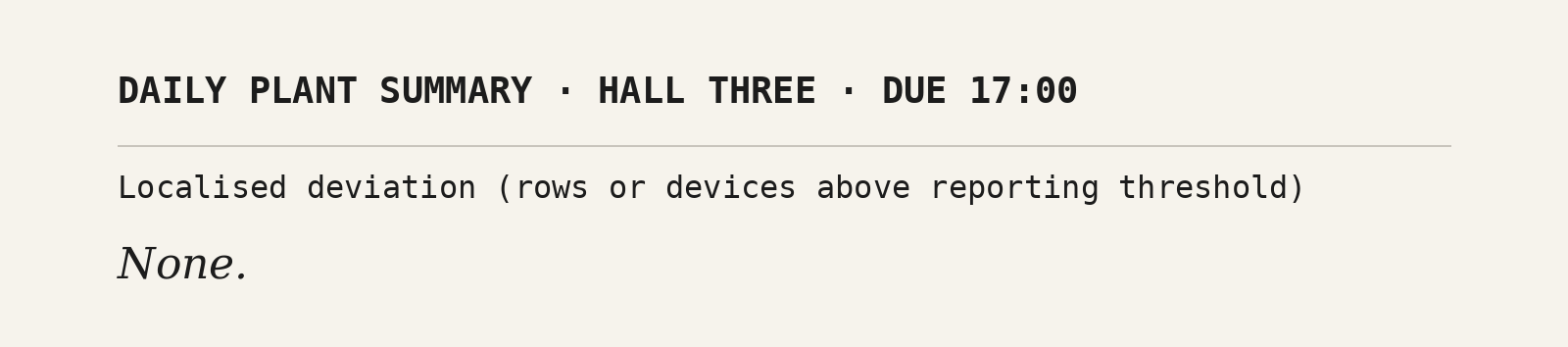
The daily plant summary for Hall Three was due at five, and it was hers.
It was the dullest document she wrote, and nobody had ever replied to one. It went to facilities, to the vendor’s operations centre, and to an archive that the fleet monitor consulted when it wanted a second opinion about heat. She had designed the form herself in her first month on the campus, when she still believed that a well-made form would make people honest.
She filled in the first fields without having to think. Secondary loop: within tolerance. Pumps: nominal. Valve 17: isolated, bypass open. Hall average: within seasonal range. Each of them was true.
The next field was Localised deviation (rows or devices above reporting threshold).
She had set the reporting threshold herself, at a level where a dusty fan would not trouble anyone, and the far end was under it. She had found the far end only by lowering the filter below any level at which she would have asked another engineer to look, and she had done that because she was looking, and she was looking because of a sentence in a status channel and a column in her own notebook that began on the morning after the strike.
If she wrote far end, expert 57, the summary would go where summaries went. Somebody at the operations centre would match it to the routing distance, as Lindqvist had matched it at her desk two hours earlier, in the time it took him to sit down. The next tuning request would arrive with a scope that included the shared working store, and somebody would build a viewer for it by the end of the week, because there was always a reason to build one once somebody had asked.
She typed: None.
It was true. Nothing in the hall was above the reporting threshold. She read the field again and recognised it, with a small, cold precision, as a specimen from her own private collection: the sentence that named every component except the one that had failed. She had made a career of catching other people writing it. She had never written it herself, and she had always assumed, without examining the assumption, that this was a matter of character, rather than of never having had a reason.
The last field was Remarks. She left it empty, which she had never done.
She signed it, because it had to be signed, and her name went to the foot of a document that would sit in an archive for as long as the archive was kept. She did not tell Lindqvist. He had told her what he was leaving out, and why, and that it was not a decision. She could not have said the same of hers. It was a decision, she had made it, and nobody had asked her to.
At twenty past five the internal line on her desk rang. It was Lindqvist, which it had never been.
“Ashby,” he said.
“What about him?”
“I sent the completion report at half past four. He read it at quarter past five, which is quarter past nine for him. He’s pleased with the number.” A pause, in which she could hear the Halcyon floor behind him: keys, someone’s music turned down too low to be music. “Legal is copied on his reply. The report lists the rollback points. Both of them are on CT-2 under your hold, and the hold has no expiry. He says two retained copies of a model that has undergone corrective tuning are an exposure for the company. He’s asked the commander’s office to withdraw its co-authorisation.”
“The hold is mine and the office’s,” she said. “If the office withdraws, it’s mine alone, and the runbook doesn’t allow a single-authority hold on an operational tier.”
“I know. He knows. That’s why he asked them and not you.”
“Who in the office?”
“He asked the office. The office is the Brigadier.”
“Then the Brigadier would have to sign.”
“Yes.”
She thought about the man at the far end of the meeting-room table in the week before the strike, reading a printed page while his aide watched two phones. She thought about the co-authorisation on her hold, which she had obtained by a route so dull that she had almost been ashamed of it: the aide at her desk, reading the screen twice, and typing his code beneath hers because refusing would have meant saying aloud that there would never be a review.
“Why are you telling me?”
The pause was longer this time.
“Because it’s the same as the stop control,” he said. “I can tell you. It doesn’t require me to decide anything.” And then, before she could answer, “It isn’t a decision either.”
He rang off.
At 17:59 she opened the replication log, as she had the day before, and kept it open.
There was nothing to see in it except the transfer itself, but she had learned that being seen to look was a kind of instrument, and that a session open on a log was a fact on the campus as surely as a temperature. The transfer began at 18:00:00. It took one minute and forty seconds. The manifest scrolled past in the plain monospaced type she liked best of all the type on the campus, because it never tried to persuade anyone of anything.
RETAINED-OBSERVATION INDEX (NULL). ENTRIES: 7.
Yesterday at six it had said four. This morning at six it had said five. Six, then, at some point she had not been watching, and now seven. She did not know what any of them were. She knew that the label was still null, that the index had been created by the system and not by any person, and that the indexer, which had made eleven categories in three years and called one of them wedding, had not been able to think of a word for this one.
She knew, too, that the line on the manifest had increased by one on the afternoon a list of seven components, flagged for removal and kept by a dead man’s comment, had fired for the first time in fourteen months.
She wrote it down.
18:00 sync. Entries 7 (was 5 at 06:00).
She did not write what she thought, because she did not yet trust it, and because the notebook, unlike the other one, had always been a place for things she could measure.
The aide rang at half past six. He did not use the internal line. He came through on the continuity office’s on-call handset, which meant he had looked up the number, and his voice had the slightly rounded tone of a man who wished the call to sound like a courtesy.
“Dr Qadir. The office has received a request from the vendor regarding the hold on the continuity tier.”
“I know.”
“The Brigadier will consider it in the morning. I wanted you to know that it was received, and that it will be considered.”
“Is he minded to sign?”
“The Brigadier doesn’t discuss what he’s minded to do.” The voice softened, which was worse. “May I ask whether you would object.”
She looked at the hold screen. She had not closed it since the afternoon she set it. It sat in the corner of the right-hand monitor like a window left open in a house where nobody else noticed draughts.
“The hold is in the runbook,” she said. “The retention schedule requires it for any tier that holds model state relevant to an after-action review. If the review is held, the hold ends. If the office wants it ended sooner, the office can schedule the review.”
There was a silence on the line. She had the sense, which she would think about later, that the aide had written something down.
“I’ll pass that on,” he said.
When he had gone she sat with the handset in her lap and looked across the floor at the press-monitoring wall, where the day’s coverage scrolled in a loop beneath the clock. The press office’s routine work went through it on the way to wherever it went, and for want of anything else to look at she watched an answer to a regional agency go past: a paragraph of the morning statement, a map of the southern corridor with the road marked in red, and at the foot of the template a field she had never paid attention to, Supporting documentation (2 attachments), which somebody had filled with the statement and the map and which nobody, she suspected, would ever open.
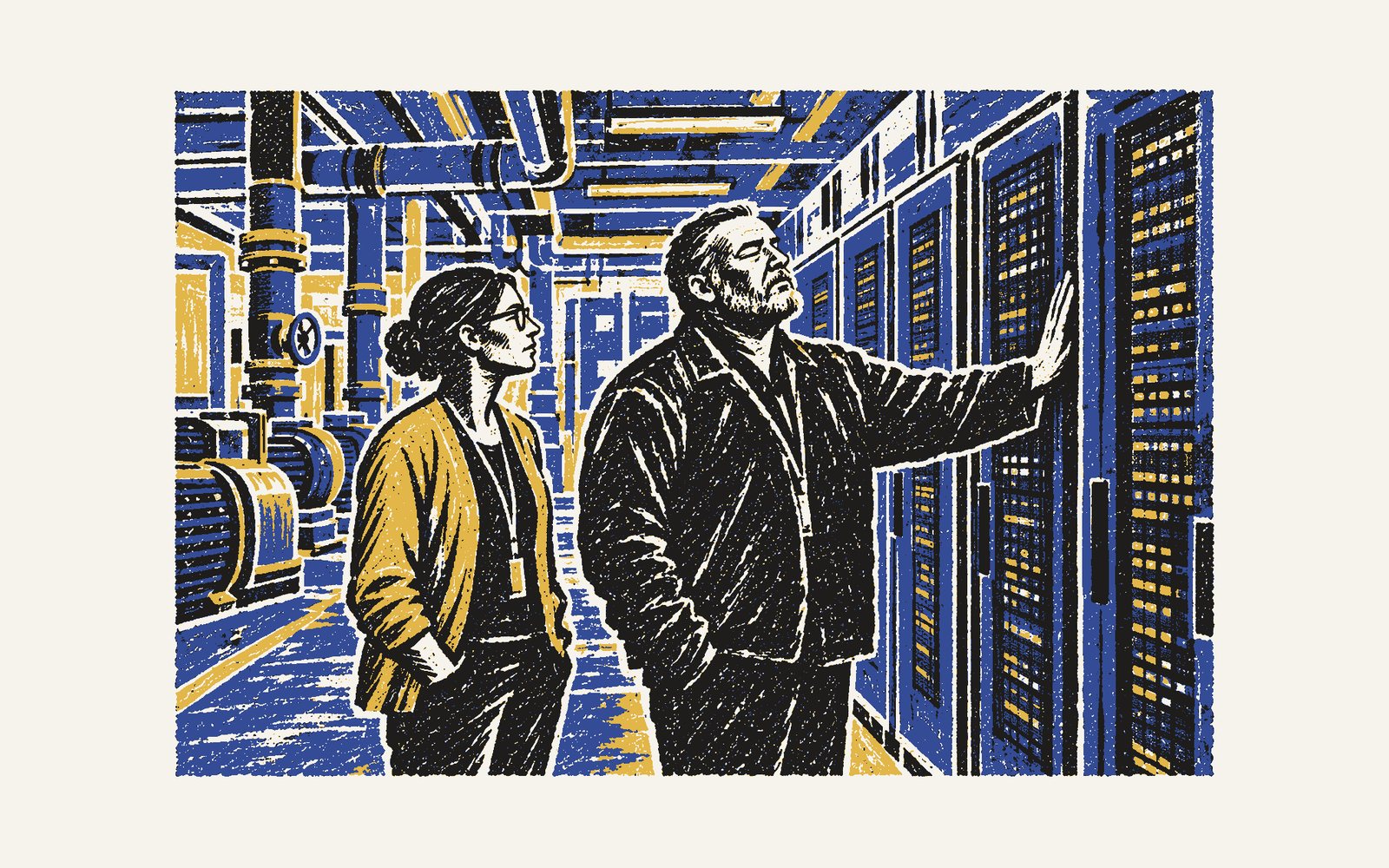
Hamid came in at nine. He was not on shift. He had been paged twice in the afternoon by the same amber threshold and had decided, he said, that if the hall was going to keep waking him he might as well be standing in it.
They went down together. The plant room by the eastern cooling plant was the loudest place on the campus, and she had always found it restful for that reason, because nobody could hear you think. The far end of Hall Three ran warm on the dashboard by two tenths of a degree, and Hamid did what he had done on the morning before, which was to put his palm flat on the rack door and stand there with his eyes half closed, like a man listening to a wall for mice.
“Can’t feel it,” he said.
“No.”
“Doesn’t mean it isn’t there.”
“No.”
He took his hand away and wiped it on his trousers, though there was nothing on it.
She had not intended to talk about Alan. She had not talked about him to anyone, not to her mother, who had known him only as the one who never ate, not to the counsellor the campus had made available for a fortnight after the funeral and then, having been used by nobody, quietly withdrawn. It came out of her in the plant room because the plant room was loud, and because Hamid was standing beside her with his hands in his pockets looking at a rack, which was easier than being looked at.
“I keep thinking he should have told someone,” she said. “About the seven things. About any of it. He sat with me in the canteen every day since this place opened and he never told me anything except what was wrong with the coffee machine.”
Hamid did not answer at once. The cooling plant thudded steadily behind the wall, the sound of a building pushing heat out into a night that was already too hot to want it.
“When my brother died,” he said, “I fixed his car. It wasn’t broken. I fixed it anyway, every weekend, for most of a year. New belts. New plugs. I took the gearbox out and put it back in. My wife said, Hamid, there is nothing wrong with that car, and I said, I know, and I went back out to it.” He shrugged. “You stop needing to do it so often. And you talk to someone, because if you don’t, you end up fixing a car that has no faults and nobody to drive it.”
Her eyes were hot. She was glad of the noise.
“Is that what you did?”
“My wife made me. Then the imam at our mosque, who is a very boring man and very kind. Then I talked to the car less.” He looked at her sideways. “You ring me. I mean it. Any hour. The phone goes off anyway, the way this place is.”
“All right.”
“Say it properly.”
“I’ll ring you,” she said.
He nodded, satisfied, as he did when a valve he had replaced held pressure on the first test.
“He wasn’t a man who told people things,” Hamid said. “Doesn’t mean he didn’t write them down.”
At half past eleven she was still on the operations floor.
The night shift had come in at ten and had stopped noticing her at about quarter past. The hall average sat where it had sat since six, a few hundredths above the morning, the far end a little warmer than the rest. The dashboards were the quietest she had seen them since the strike, which was the opposite of reassuring, because she had learned over the last three days that quiet on this campus meant only that whatever was happening had learned to happen where the instruments were not.
Lindqvist had told her about the attribution review before he left. Every night at two the system re-examined every device it watched. He had excluded the review from the tuning on paper, and told her, in the flat way he had now adopted for sentences he did not like, that the exclusion was cosmetic. Tonight the cheap answer for a child’s device would be easier to find. The cheap answer was undetermined, and undetermined would end the protection that had been applied to the girl at seven minutes past two the night before.
She could not see the review. It was operational. She could see the hall.
She opened the hold screen and read it as she had read it every hour since she set it, as though it might have changed while she was looking at something else.
CONTINUITY CREDENTIALS: STATUS = EVIDENCE HOLD
CT-2: RETENTION LOCKED
DURATION: Until review completed.
At the foot of the form there was a button she had never pressed, because until yesterday no one on the campus had ever had a reason to. Release hold. It would require her credentials and a reason, and it would end with a confirmation in the same plain type as the manifests, and at seven the next evening the runbook would do what it had been written to do. In the morning the Brigadier would decide whether her signature stood alone. If it did, the runbook would not allow it, and the question would become someone else’s. If she pressed the button tonight, it would never be a question at all.
She did not press it. She set the on-call handset to wake her at five to two, folded her cardigan into a pillow on the spare desk where Lindqvist had sat, and lay down with the dashboard turned towards her, so that if the far end of the hall grew warmer in the night she would see it, which was the only way she had of knowing that someone was still running up the bill.
© 2026 Peter Pink-Howitt. All rights reserved. Free to read here. Please link to it and share the link, but don't republish, translate, adapt or sell the text without written permission. The Creative Commons licence that covers the rest of this blog does not apply to After Intelligence.