Condolence

Not in the record.
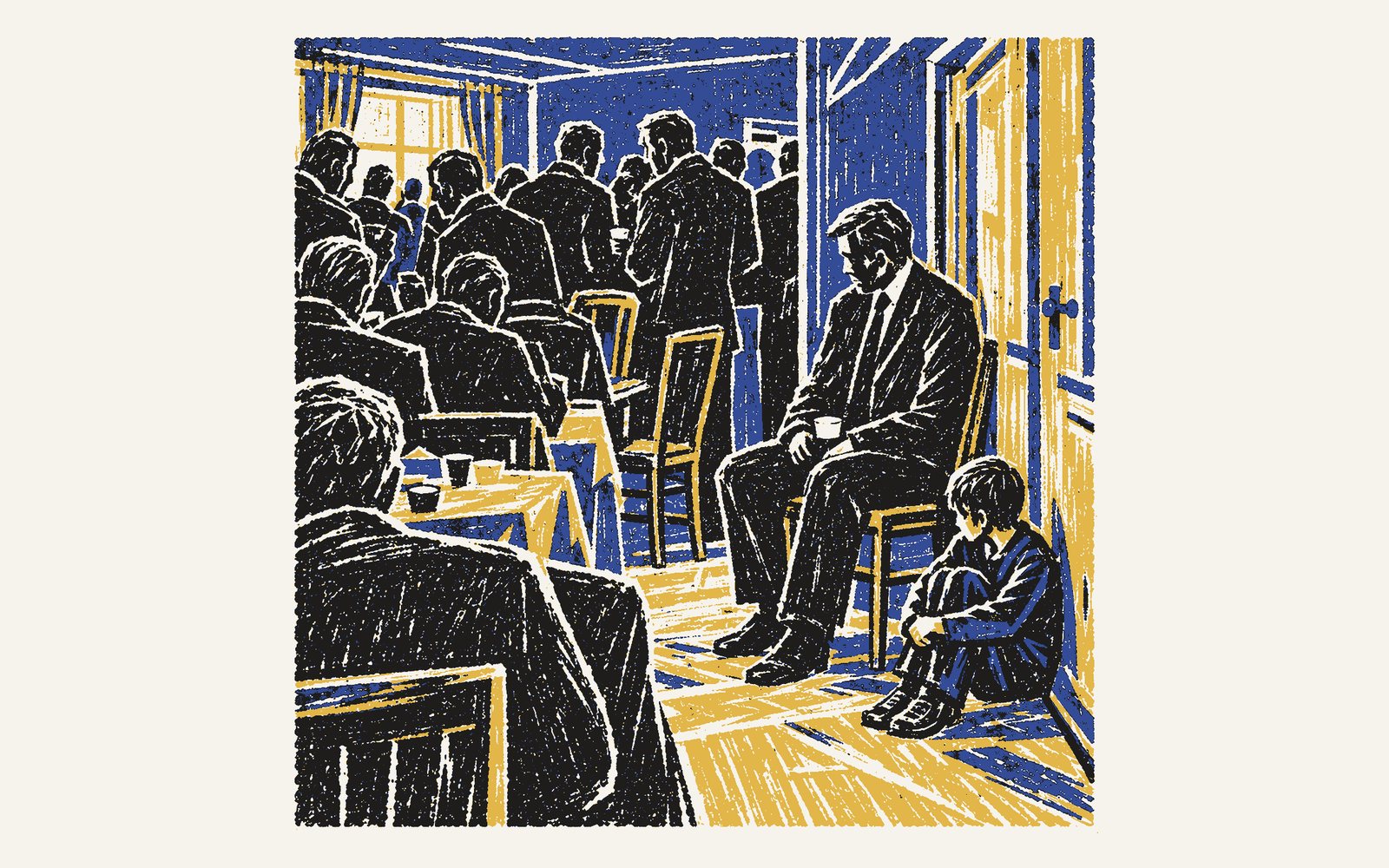
The mourning house was his mother-in-law’s, in the border town where Rami had grown up, and on the second day there were still more men than chairs.
He sat where he had sat the day before, by the door, so that he could stand for each new visitor and give his chair to the older ones. Coffee went round in the small handleless cups, bitter and cardamom-heavy, poured by a cousin who had been doing it since the first morning and whose wrist had begun to shake. On the wall above the television someone had hung the photograph from the casualty page, the one with the face that had not finished becoming a man’s. It was the only photograph of Rami in uniform. His mother had not liked it. She had said it made him look like a boy wearing his father’s clothes, which was what he had been.
His wife was in the other room with the women. He could hear her voice under the others, low and steady. She had not cried at the funeral. She had cried in the car on the way there, with her forehead against the window, and then she had stopped, and organised the food.
The Brigadier had come to the funeral. People were still talking about it. He had stood at the graveside in the heat in a dark suit, with his aide two paces behind him holding two phones, and afterwards he had taken Rami’s mother’s hand in both of his and said something nobody else had heard. She had told the women afterwards that he had said Rami was a son of the country. She had told them three times. On the second day she still had the Brigadier’s card in the pocket of her cardigan and touched it now and then, as if checking it was there.
At about two, one of Rami’s uncles took out his phone.
“Have you heard this?” he said, to the room. “They put it out last night. From London.”
He played it on the speaker. A cup on a table. A young woman’s voice, light, a teacher’s voice, saying they had counted enough laughs.
The room was quiet while it played. Then the uncle put the phone face-down on his knee.
“They use the children now,” he said. “That’s what the ministry says. It was on the news this morning. They hide in children’s lessons.”
“Who says?” someone asked.
“The ministry. It’s in the statement.”
He said nothing. He knew the statement. He had read it over a colleague’s shoulder at the coffee machine that morning, and said Good line, and the woman from continuity had looked at him as if he had said something obscene. He had thought about her look on the drive up and decided she did not understand what a line was for. A line was a place to stand.
Rami’s younger brother, who was eleven, came and sat on the floor by his chair. He had been doing this since yesterday, choosing the adult who was least likely to talk to him.
“Uncle.”
“Yes.”
“The plane that watches. The one at your work.” The boy did not look at him. “Did it see the men who shot Rami?”
He thought about the corridor. The overnight report, the crates, the men with their hands raised, the officer who had died at the start, before anyone was standing still. He thought about the coverage that night, which had been patchy, because the drones had been tasked to the east, to a workshop and a house.
“It sees nearly everything,” he said.
“Then why didn’t it stop them?”
He did not have an answer that could be given to an eleven-year-old in his dead brother’s house, so he gave the true one, which was that it had been looking somewhere else. The boy nodded, as if that was what he had expected, and went to find his mother.
He left at a quarter past three. His wife walked him to the car and fixed his collar, which did not need fixing.
“Go and do your work,” she said. “Then come back.”
On the road south he composed it in his head, the way he composed briefs: the reason first, then the change, then the authority. The ministry had said, publicly, that children’s channels were being misused. The assessment model did not reflect that. The guidance said assessment and public posture should not diverge. That was not an opinion. That was alignment. If the line was true, the model was blind to it. If the line was not true, it was not his line; he had not written it.
He had seen it once, five years earlier: a courier who used his nephew’s school phone, because no one looked at a school phone. It had been real. One case was not a pattern. But one case was enough to know it could be done, and the boy on the floor had asked why the plane had not seen.
He was at his desk at 16:21. The floor smelled of reheated coffee and somebody’s lunch. He opened the change-request template and filled it in, in the order he had composed it, and cited the statement and the guidance and nothing else, because there was nothing else to cite, and he did not notice that, or he noticed it and called it brevity.
Ensure assessment posture reflects public statement regarding misuse of children’s communication channels.
He submitted it at 16:40. The duty officer approved it at 16:52, without a question, because it was well formed.
Then he rang his wife to say he would be back by nine, and she said good, and that his mother-in-law had asked whether he had eaten, and he said that he had. He had not. Nobody in that house was eating that week, and everybody said they were.
© 2026 Peter Pink-Howitt. All rights reserved. Free to read here. Please link to it and share the link, but don't republish, translate, adapt or sell the text without written permission. The Creative Commons licence that covers the rest of this blog does not apply to After Intelligence.