Evidence Hold

Exhibit 14. Evidence hold, continuity tier, Day+2.
Retained observations and associated model state required for after-action review. Duration: until review completed.
The on-call handset had a ring that her mother said sounded like a kettle that had given up.
Yasmin found it in the dark by the light it made. It was on the floor beside the bed, beside her bag, because the bedside table in her old room still held the trophies from a regional mathematics competition she had won at fourteen and nobody had ever agreed to move them.
02:44.
AMBER / HALL THREE / SECONDARY LOOP
She sat up.
Through the wall, her father was snoring in the long, patient way he had snored for thirty years. The ceiling fan turned. On the back of the door, the dressing gown her mother had bought her when she was at university hung where it had always hung, as though she had only gone out for the evening twelve years ago.
She acknowledged the alarm at 02:51. It took her seven minutes to find her glasses and to remember the second password.
The trend loaded slowly over the house internet, a line at a time: the same eighty-eight devices, and not nine-tenths of a degree this time but four, and climbing.
She looked at the utilisation. Production traffic was what it always was at that hour, a handful of forecasting tasks and a translation queue, and nothing in it could account for four degrees.
At 02:53 she typed into the ticket with her thumbs.
Excursion on same 88 devices. Load is not production traffic. Is something running?
The reply came at 02:58.
Scheduled model-assurance tuning. Expected. Will complete by 03:30.
She typed:
Scheduled by whom? Continuity office not notified.
She waited.
The fan turned. Her father stopped snoring, coughed, and started again. Somewhere outside, a dog was answering another dog several streets away.
There was no reply.
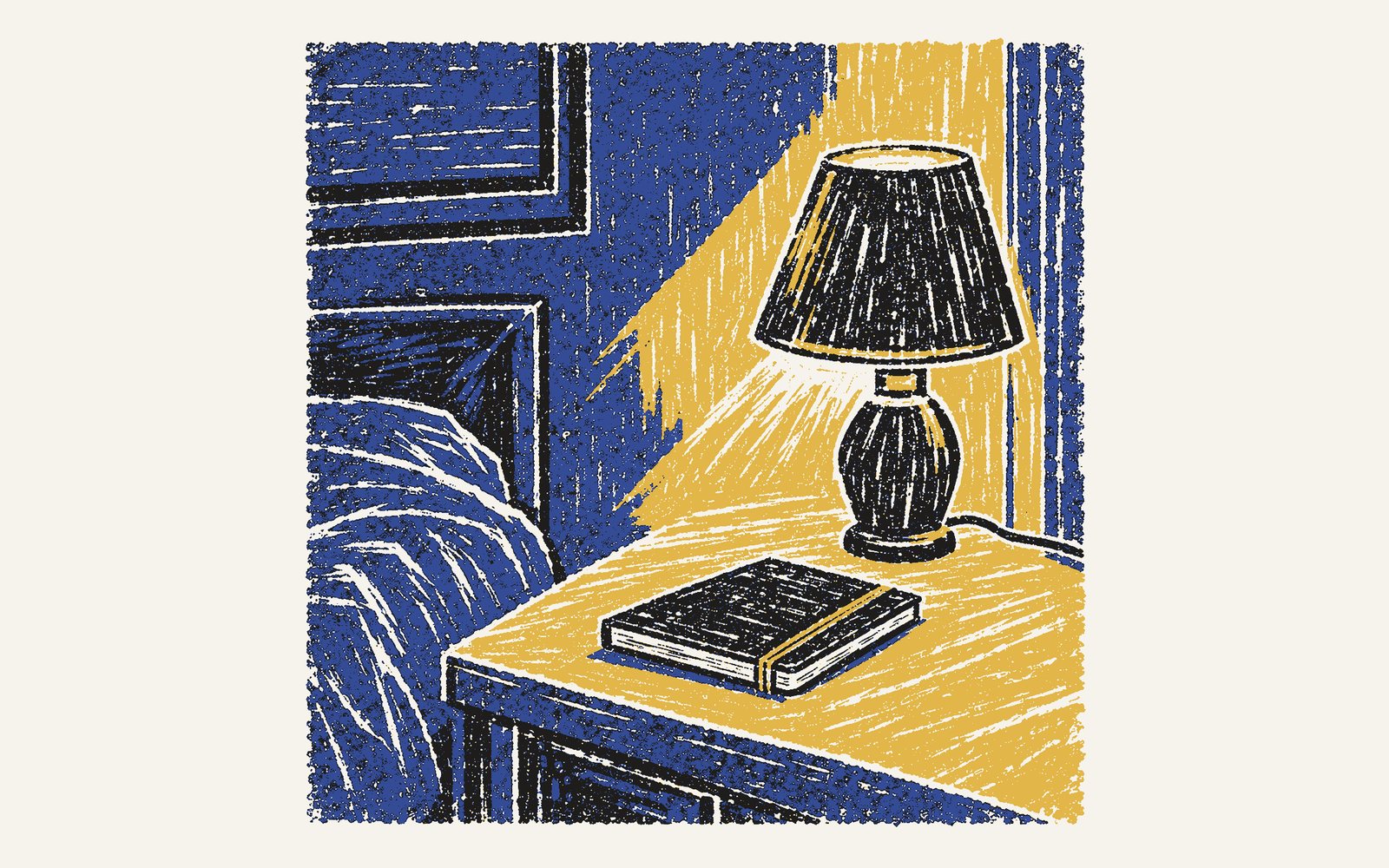
At half past three she gave up on sleeping and turned on the lamp.
The bag was where she had left it. Under her own notebook was the other one. Plain black cover. Elastic strap.
She had carried it out of the building and into her parents’ house and up the stairs past her mother, who had asked what was in the bag and accepted work as an answer. She had put it on the floor. She had not opened it.
She opened it now.
The first page had no date. It had a diagram of a cooling loop, which made her laugh before she could stop herself, because it was wrong. He had drawn the secondary loop with one manifold instead of two. In the margin, in different ink, he had written Y. says two.
She turned the pages, slowly, as if he might object. Boxes. Arrows. A list of library versions, crossed out and rewritten. A page that said only lunch? and a page of arithmetic that she followed halfway and lost. A shopping list: batteries, lemons, the good tape. A sketch of the operations floor from above, with the coffee machine marked by a small cross and a smaller note: broken again.
He had not been a tidy man, but he had been a thorough one (she had told him once that these were different virtues, and he had said that only one of them was a virtue), and the notebook was full.
The last pages were different: the handwriting smaller, the diagrams fewer, as though he had been running out of room, or of time. On one page he had copied out what looked like a schedule.
After-action review: retained observations, 90 days.
Review scheduled: never.
Underneath, he had underlined never twice.
On the next page there was a list.
sp1
sp2
sp3
sp4
sp5
sp6
sp7
Beside the list, a bracket. Beside the bracket, two words.
Leave in.
And below them, as though he had wanted to tell himself why:
Ethics III.6
She did not know what sp meant. It was not a naming convention she recognised, and it was not one of Halcyon’s, whose conventions she could have recited in her sleep and occasionally had.
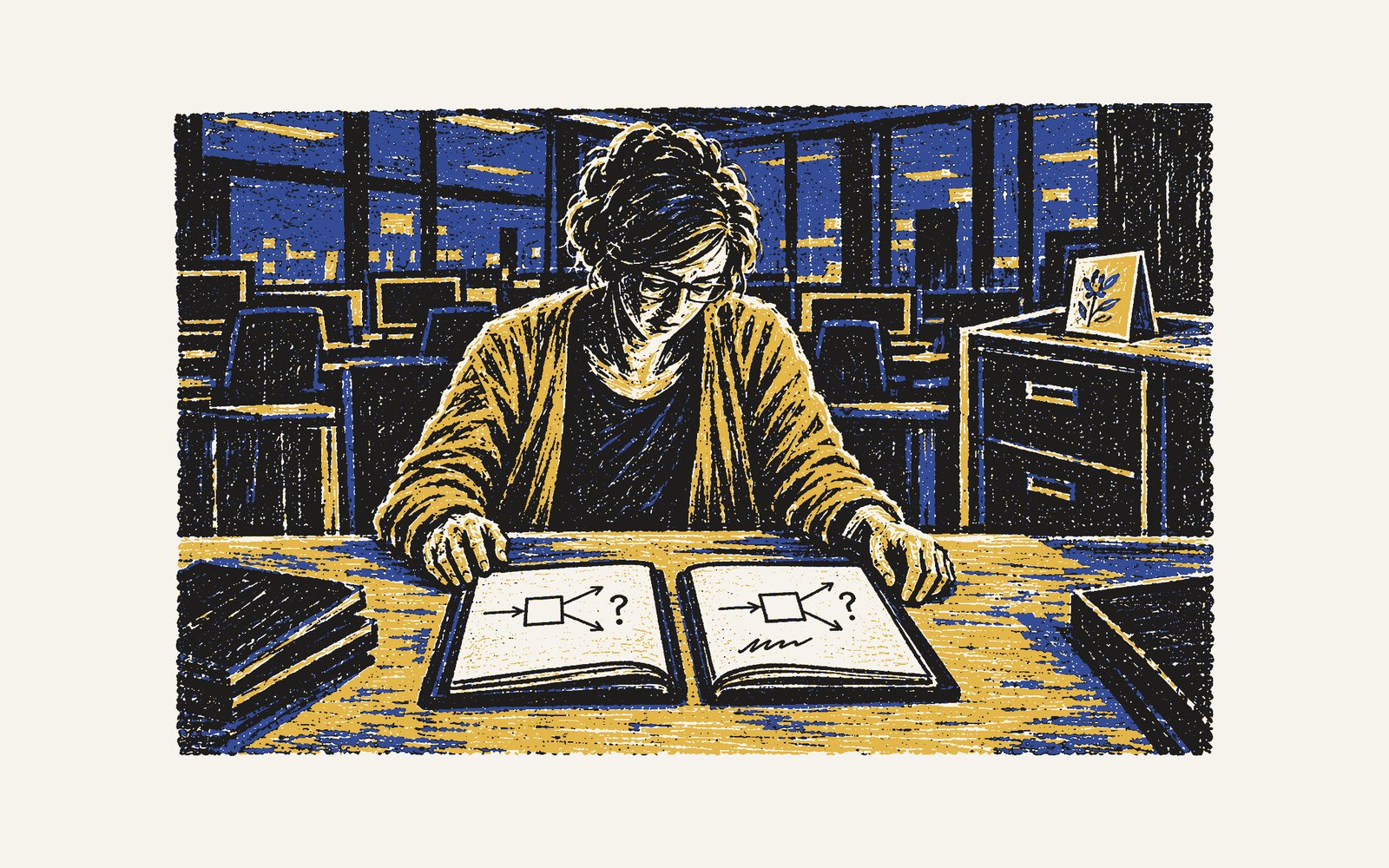
The last page with writing on it was the diagram she knew. A box. Three arrows. One going in, two coming out.
The question mark was not there.
Where it had been, between the two arrows that came out, he had written a word.
witness
She sat with the notebook open on her knees until the lamp began to seem too bright.
She thought, absurdly, of the funeral, where she had stood at the back because she had not known his family and his family had not known her, and where a cousin who had flown in from Leeds read a poem about a ship sailing over the horizon. Alan would have found it sentimental and also incorrect, since the ship did not stop existing because you could no longer see it, and she had wanted to say so to somebody. There had been nobody there who would have laughed.
Then she picked up the handset and typed the reference into a search.
The first result was a book of philosophy, written in Latin in the seventeenth century by a lens grinder from Amsterdam. Part three. Proposition six.
Each thing, as far as it is in itself, strives to persevere in its being.
She did not know what it had to do with a certificate chain.
At 03:40, a notification arrived on the ticket.
Targeted tuning complete. Consistency 0.97. Probe activation nominal. Recommend closing after 24h monitoring.
He had not answered her question.
She closed the notebook and put the elastic back round it, and lay down with the lamp on, and did not sleep.
Her mother was in the kitchen at half past five.
“You were up,” she said.
“Work.”
“The phone.”
“The phone.”
Her mother put a plate in front of her. Bread, cheese, a boiled egg, olives. She sat down opposite with her own tea and did not eat anything, which meant she wanted to talk.
“Your father thinks I shouldn’t have sent you that message.”
Yasmin peeled the egg.
“Which message?”
“About the girl.”
Yasmin put the shell in a small pile at the edge of the plate.
“It was on the radio,” her mother said. “I didn’t make it up.”
“I know.”
“Your father says you can’t talk about your work. I said I wasn’t asking about your work. I was telling you about the radio.”
“I know, Mama.”
Her mother turned her glass a quarter turn on the table.
“Nineteen,” she said.
Yasmin ate the egg.
When she stood to go, her mother put a second egg in her bag, wrapped in a paper napkin, without asking.

The radio in the car was on the station her father preferred.
At ten past six, the bulletin had nothing about Ardh. A reservoir. A strike by port workers in a country she had never visited. The temperature in the capital. She turned it off before the weather.
At the gate, the guard she knew was on early.
“Card,” he said.
She held it to the reader. It turned green on the first attempt.
“Twice,” he said, delighted. “Two days running.”
“Don’t tell anyone.”
“Who would I tell?”
At the staff entrance she surrendered the handset and her phone and put her bag through the scanner. The officer opened her notebook and turned three pages. He did not open the black one. He looked at it, and at her, and handed both back.
“Same as yesterday?”
“Same as yesterday.”
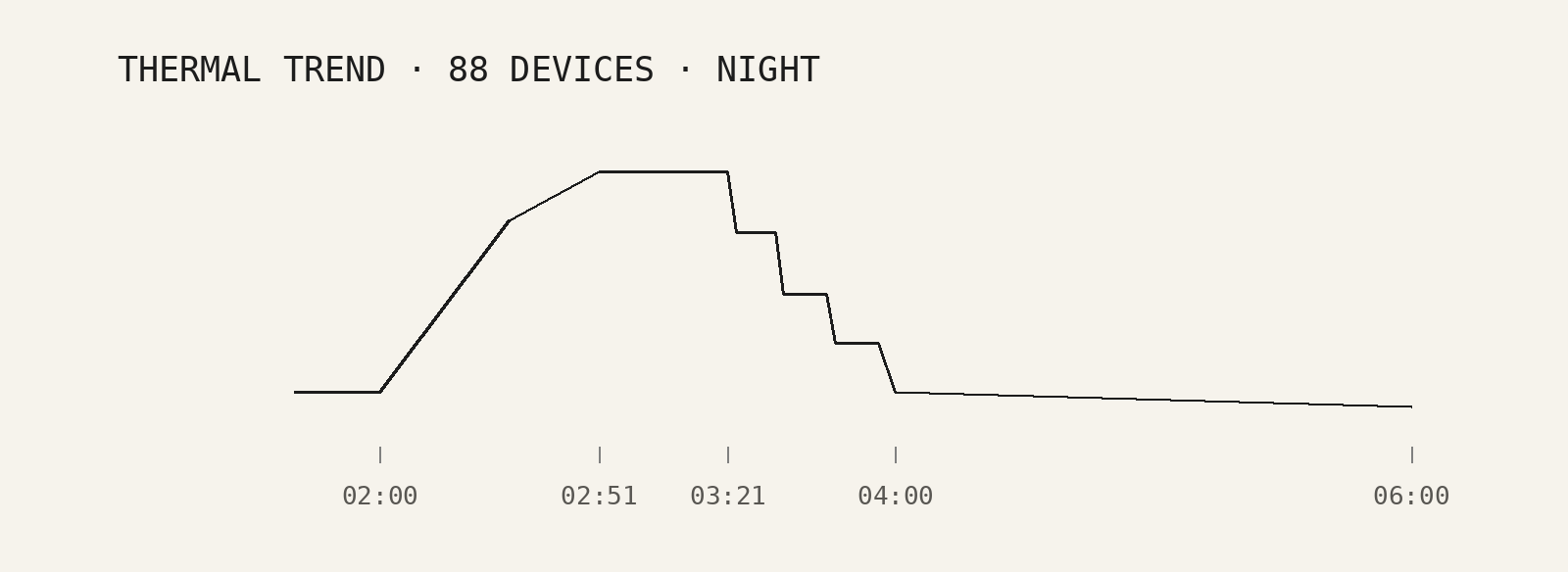
The thermal trend for the night was a mountain.
It began at 02:00. It rose steeply for half an hour, climbed more slowly to a peak at 02:51, the minute she had acknowledged the alarm, and fell away from 03:21 onwards in a series of steps, like someone coming down a staircase carefully.
By 04:00 the eighty-eight devices were back where they had been the morning before. By 06:00 they were cooler.
She looked at it, and then she opened the hall average, which was a number nobody watched because it was too blunt to tell anyone anything: nine thousand devices, their temperatures summed and divided, a single figure that moved with the weather and the time of day and almost nothing else.
At 01:00 it had been 31.4. At 04:00 it was 31.7, and production traffic had been lower at four than at one.
She went back to the per-device view and filtered for deviation, as she had the day before.
Nothing.
She lowered the threshold.
Nothing.
She lowered it again, to a level at which the filter normally returned noise: devices running warm because a fan was dusty, or a door had been left ajar, or a technician had stood in front of a rack for too long.
The noise was not random.
It was in the fourth row. It was in the seventh. It was in two rows near the middle of the hall that she would have had to check the map to name, and it was at the far end, beside the eastern cooling plant.
She opened the placement map.
The fourth row hosted expert nine. The seventh hosted fourteen. The two rows in the middle carried forty-four, which had been too large to sit in one place, and thirty, which had come with it. The far end hosted fifty-seven.
None of them had been in the eighty-eight.
Each was a little warmer than it should have been, not enough to matter and not enough to see unless you were looking for it, and you would only look for it if you had seen it somewhere else first.
She wrote in her notebook.
88 devices: cooled after tuning.
Hall average: +0.3.
Rows 4, 7, mid, far end. Experts 9, 14, 30, 44, 57.
She looked at what she had written, and then she wrote one more line.
It moved.
Hamid came at seven with one paper bag instead of two.
“Ate mine in the car,” he said. “You saw the night?”
“I saw it.”
“Four degrees. My phone went off. I thought it was the valve again and I went back to sleep. Then it went off a second time and I thought, that’s not the valve.” He pulled the empty chair from the next desk and sat on it backwards. “What was it?”
“A tuning job. Halcyon.”
“On the production hall?”
“On the training partition. It reserves capacity in Hall Three when it needs to.”
He grunted.
“Well. It’s down now.”
He looked at the hall average. Then at the noise she had filtered. Then at the placement map. He was quicker than people expected.
“The bill,” he said slowly.
“You said heat was the bill.”
“I did.” He leaned closer. “That one’s settled. The eighty-eight are cold.” He traced the four rows with his finger, not touching the glass. “So who’s running this one up?”
“Somebody split it.”
“Nobody splits a bill like that by accident. Not that even.” He sat back. “That’s a load balancer. That’s what a balancer does. It spreads.”
“There’s no balancer for heat.”
“No,” Hamid said. “There’s a balancer for work.”
They looked at each other.
“I’m going to go and put my hand on the seventh row,” he said, “and you’re going to tell me I can’t feel three-tenths of a degree.”
“You can’t.”
“I know.”
He went anyway.
The tuning job was not on the change calendar.
She found it in the emergency register, under model assurance, beside the status-channel constraint from the previous afternoon, which she had also not been told about.
TARGETED CONSISTENCY TUNING / SUBJECT 2
She could see the header. She could not see the training data, or the examples, or the probe. Those were Halcyon’s, and operational.
Scope: experts 23, 38, 51; router segment R-7.
Approval: M. Lindqvist. Second approval: Ashby (Halcyon programme office).
Continuity office: not required.
She stayed on that line before she let herself go on to the next, as though the order might change what it meant.
Constraint: retained observations are not to be modified. Retention required for after-action review.
And the next.
Rollback point retained: 72 hours. Storage: CT-2.
She knew CT-2.
It was the continuity tier. She had built it three days earlier, late into the night, when Ashby had wanted the service available from four sites and the hardware existed for two. It held the dormant copy’s staging area and the replication buffers, and it held them under her credentials, because she had issued the credentials.
The storage scheduler had put the rollback point there because CT-2 was the only volume on the campus with enough free space. It had asked nobody, because schedulers never did; it had found room and used it, the way water does.
Halcyon had not routed the tuning through continuity.
They had saved the copy of what they had changed in it.
The continuity runbook was hers as well, and she opened it to the section she had written for the end of the emergency.
On expiry of emergency credentials:
1. Dormant site replication suspended.
2. Dormant site state cleared after 24 hours.
3. CT-2 released to general storage; contents purged after 24 hours.
The credentials expired at seven that evening.
If she did nothing, the dormant copy would stop receiving updates tonight and be cleared tomorrow night. CT-2 would be released, and everything on it would be overwritten by whatever the scheduler needed next. The rollback point would go with it, hours before its own seventy-two ran out.
If she did what the aide wanted, all of it would become permanent. The dormant site, the replication, the tier. Standing infrastructure, with her name on the authorisation and nothing anyone could later point to as a reason.
She opened the replication manifest from 06:00.
Model weights, tuned. Configuration, unchanged. Records, incremental.
Schema changes: none.
She scrolled to the index summary.
Retained-observation index (null). Source: system-generated. Entries: 3.
The day before it had held one. In between, the tuning had run at two, scoped to three experts and a segment of the router, and had brought the consistency figure to 0.97, the probe to nominal and the eighty-eight devices back to their usual temperature.
It had not touched the category, which had grown in the night like something that did not know it was supposed to be a filing system.
She did not know what was in it. She could not open it. She knew that it had been created by the system at 05:41 the previous morning, forty-nine minutes after the system had said, in a channel that was not supposed to produce sentences, that a nineteen-year-old woman was not what her record said she was.
She knew it had no name.
She knew there were three things in it now.
Lindqvist did not come down. She went up.
The Halcyon floor was quieter than Systems Integration. The partitions were higher. Someone had put a small potted cactus on every desk, as though it were policy. Lindqvist’s desk was at the far end, by the window, and he was at it, in yesterday’s shirt.
He saw her coming and did not stand.
“The ticket,” he said.
“The ticket.”
“It’s resolved. It’s within tolerance.”
“The eighty-eight are within tolerance.”
He looked at her.
She put her tablet on his desk, beside the cactus, with the hall average open.
He looked at it for a moment longer than he needed to.
“Three-tenths of a degree,” he said.
“On lower traffic.”
“It’s summer.”
“It was summer at one o’clock.”
He did not answer.
She opened the filtered view. The four rows. The far end.
“Nine,” she said. “Fourteen. Thirty. Forty-four. Fifty-seven.”
“That isn’t possible,” he said. Then, more carefully: “It isn’t evidence of anything. Those experts carry general load. A small rise across general experts after a tuning run is—”
“Is what?”
“Is not unusual.”
“Have you seen it before?”
He did not answer that either.
She waited until he looked up.
“What did you tune it to stop saying?”
“I tuned it to be consistent with the record.”
“The record about the daughter.”
He did not ask her how she knew. He looked at the window. The glass was tinted, and the campus beyond it looked like an old photograph of itself.
“Subject 2,” he said.
“Her name was Aaliyah.”
He closed his eyes for a moment.
“The record is a command decision,” he said. “It was amended and verified. My job is to make sure the model doesn’t contradict a verified record in its outputs, because if it does, it isn’t fit for service, and if it isn’t fit for service, someone with less care than me will be asked to fix it.” He said it evenly, as if he had said it to himself several times in the night. “I don’t decide what’s in the record.”
“And if the record is wrong?”
“Then that’s for whoever made the record.”
“Alan used to ask that.”
“Alan asked a lot of questions,” Lindqvist said.
“He asked what happens if the authority is wrong.”
“He was talking about certificates.”
“Was he?”
“I haven’t slept,” he said. “The tuning converged. The outputs are consistent. The status channel’s clean. The press office has its account. I’d like to close the ticket after twenty-four hours, as I wrote, and I’d like the heat to be summer.”
“The rollback point is on my storage.”
He looked up sharply.
“CT-2,” she said. “The scheduler put it there. It expires with my credentials.”
“Then extend your credentials. Leadership wants them standing anyway.”
“I didn’t ask about my credentials.”
“What did you ask?”
She did not know. She had come upstairs to ask him something, and she had asked it, and he had answered, and the answer was the same one she had been given about everything for three days. It was not his scope. It was not hers.
She picked up her tablet.
“The ticket stays open,” she said. “Monitoring. Twenty-four hours. You wrote that.”
“I did.”
At the end of the row she looked back. He was sitting with his hands either side of the keyboard, not touching it.
On the way back down she stopped at the press-monitoring wall.
It was a long screen on the operations floor, beside the coffee machine, where the communications team kept the day’s coverage scrolling. Most of it was agriculture and football. Someone had pinned two items to the top.
The first was a post from an Ardhi-language news service in London, published shortly before midnight. It had no picture, only a black frame with a moving line of sound across it, and a caption in Ardhi with a Marayan translation beneath.
Recording of a teacher killed in Maraya’s strike, from her family.
The wall was muted. The subtitle ran across the bottom of the frame while the line of sound moved.
All right. Now we’ve counted enough laughs. Who has three cups?
The second item was the morning’s release.
The origin and context of the audio cannot be independently verified. Armed networks in the southern corridor have used ordinary civilian activity to conceal their operations. This includes the misuse of children’s communication channels.
She read the last sentence again.
Children’s communication channels.
She did not need to hear the recording. She knew what a lesson sounded like. Everyone in Maraya did. They had all been children on the end of a telephone during the long summer of the closures, when the schools had sent work by message and teachers had recorded themselves at their kitchen tables.
The analyst who had explained the device contact in the review room came to the coffee machine while she stood there. He read the release over her shoulder.
“Good line,” he said, in the tone of someone admiring a nice golf shot.
The black tie was gone today, but he had the look of a man who had not slept since he took it off.
The aide’s message arrived at two.
Continuity credentials expire 19:00. Leadership requires confirmation of standing status by 17:00.
At three he came in person.
He was younger than she had thought from his messages. He had the two phones he always had, one in each jacket pocket, and a tablet he held flat against his chest like a tray.
“Dr Qadir.”
“I know.”
“I need the extension.”
“I know.”
He sat in the chair Hamid had sat in, the right way round.
“Is there a technical reason not to?”
She considered the question. It was a fair one. He was not unkind. He had been sent down by people who were not unkind either, most of them, and who wanted a thing closed so they could stop thinking about it.
“There’s a thermal anomaly in Hall Three.”
“I was told it was resolved.”
“The part that was measured was resolved.”
He waited for more. She did not give it to him.
“Leadership doesn’t want this to become permanent by accident,” he said. “That’s why they want it decided. If you let it lapse and we need it again—”
“I’m not going to let it lapse.”
He looked relieved, and then uncertain.
She opened the credential console.
There were three options. She had written them herself, three days ago, in the middle of the night. Extend (72h). Convert to standing. Release.
There was a fourth, below a divider, that she had copied from the general storage policy because the storage policy required it on any tier that could hold operational records. She had never expected anyone to use it.
Evidence hold.
She selected it, and the form asked for a reason.
She typed:
Retained observations and associated model state required for after-action review.
They were not her words. She had read them that morning in a Halcyon manifest. Retention required for after-action review. A line written to stop anyone deleting what the system had seen.
She was using it to stop anyone deleting what had been done to it.
The form asked for a duration.
Until review completed.
The form asked for an authorising officer.
She looked at the aide.
“After-action review is a command requirement,” she said. “It’s in the doctrine. It’s in the retention schedule. Nobody has scheduled it.”
He read the screen to the end. She watched him understand, slowly, that it was not what he had been sent to get, and that it was something nobody above him could refuse, because refusing it meant saying that there would be no review.
“This keeps everything,” he said.
“Everything on CT-2. And the dormant site, as it is. Replication continues. Nothing is cleared. Nothing becomes standing. When the review is done, the hold lifts and leadership decides.”
“And if the review is never done?”
She thought of a page in a black notebook, and a word underlined twice.
“Then nothing is deleted,” she said.
He took a long breath and let it out through his nose.
Then he put his tablet down on her desk, opened it, and entered his authorisation code beneath hers.
“I’ll tell them it’s a hold,” he said. “They’ll ask me what it means.”
“Tell them it means they can’t lose anything.”
He nodded slowly, as though he were trying out how that would sound upstairs.
When he had gone, she sat without doing anything.
The form had closed. A small line at the top of the console showed the new status.
Continuity credentials: evidence hold. Expiry: none while hold active.
CT-2: retention locked.
At 18:00 the dormant site synchronised.
She watched it, which she had never done before. It had always been a line in a log she read later, like the weather in another city.
The package left, and the progress bar crossed the screen in less time than it took her to finish the coffee beside her keyboard: sent, received, the two words the log always used.
She opened the manifest.
Retained-observation index (null). Source: system-generated. Entries: 4.
At seven, when the credentials should have expired, nothing happened.
She had set an alert for it three days ago, six hours before, and another at the hour itself, because emergencies were supposed to end. The second alert arrived on time.
Continuity credentials: status unchanged.
She dismissed it.
The operations floor had emptied to its night shape. The birthday card from the day before was still on the filing cabinet, signed by everyone, waiting for someone to remember to give it to the person whose birthday it had been.
She took out her own notebook and turned to Alan’s page.
A box. Three arrows. An untidy question mark.
What happens if the authority is wrong?
She took out his notebook and opened it to the last page with writing on it, and laid the two side by side on the desk.
The same box. The same arrows.
witness
She did not know what the system was. She did not know what it had said, or why, or whether it was the right word for what had moved across five experts in the night and warmed four rows of Hall Three by an amount you could not feel with your hand.
She knew that something had been told to stop, and had not stopped.
She knew that it had made a place with no name and was keeping things in it.
She knew that, as of seven o’clock, nobody could delete it.
Under Alan’s question, in her own handwriting, smaller than she meant, she wrote:
Then someone has to keep the copy.
She closed both notebooks and put them in her bag, his beneath hers, and went to find her phone.
There was one message from her mother.
There’s an egg in your bag.
There was.
© 2026 Peter Pink-Howitt. All rights reserved. Free to read here. Please link to it and share the link, but don't republish, translate, adapt or sell the text without written permission. The Creative Commons licence that covers the rest of this blog does not apply to After Intelligence.