Nonconforming

Exhibit 10. Facilities ticket, Hall Three, Day+1.
THERMAL EXCURSION / HALL THREE / SECONDARY LOOP· Severity: medium.
The car radio came on with the engine.
Yasmin had left it tuned to the news station her father preferred, because they shared the car. At twenty past five, the station was still running its overnight bulletin. A man read the headlines in the voice of someone who had read them several times already.
A reservoir project had been approved, a footballer had signed a new contract, and a foreign agency had reported a strike in the southern corridor of Ardh, in that order, as though the order were a judgement.
She turned it up.
Maraya’s press office said two people were killed in a limited operation against an armed network. One has been assessed as a member of the network’s support structure. An Ardhi health official said the dead were a mother and her daughter. The claims could not be independently verified.
The man moved on to the weather.
Hot. Dust later. A light wind from the south-east.
Yasmin drove through two sets of green lights without seeing anyone. The city at that hour belonged to delivery vans and taxis. At a junction near the ring road, a street-cleaning machine moved along the kerb in a cloud of its own spray, and the spray caught the first of the light.
A mother and her daughter.
She had sat in a room the previous morning while officers reviewed forty-three records in an average of twenty seconds each. Nine had been held for further work, and she had watched one of those on the wall long enough to know its doors, which one faced the street and which one the yard. There were many houses in the southern corridor. She told herself that, and went on telling herself, and the radio told her the temperature in the capital would reach forty-one.
The badge reader recognised her on the first attempt, which she did not find reassuring. She had come to rely on its reluctance as a measure of normal.
The guard on the gate was not the one she knew. He was younger, with a moustache he seemed to be still deciding about. He checked her card against his screen and then against her face.
“Early.”
“Ticket.”
He nodded as if that explained everything.
At the staff entrance, she surrendered her phone and put her bag through the scanner. The security officer opened her notebook, turned three pages and handed it back without looking at any of them.
“Random checks finished?” she asked.
“Night shift,” he said.
The corridor was colder than usual (somebody had changed the setpoint again, and nobody would admit to it), and she pulled on her cardigan as she walked.
Stapledon’s door was still closed. The rectangle where his name had been had begun to collect dust at its upper edge.
She did not stop this time, but she noticed herself not stopping, which she suspected was a way of stopping.
At her desk, the ticket was waiting.
THERMAL EXCURSION / HALL THREE / SECONDARY LOOP
Severity: medium.
Her own note sat beneath it.
Still elevated after calibration. Not explained by task load? Coming in early.
She read it as if someone else had written it. The question mark looked less certain than it had at a quarter to five.
She opened the thermal trend. The curve she remembered from the night before was there: a rise at 22:19, a fall at 22:23. Four minutes, like a cough.
Then a second rise at 03:14, which had not fallen. It had climbed in small steps. Two-tenths. Three-tenths. A flattening at 04:31, when the calibration ended, but not a return. The secondary loop was carrying nine-tenths of a degree more than it had at midnight, and the pumps had increased their speed to carry it.
Within tolerance. Everything was within tolerance; that was what tolerances were for. (She had a category for that sentence. It was the one engineers used when they wanted the weather to take the blame.)
She opened the utilisation dashboard, which showed the work of tasks. Each task drew on the accelerators it had been allocated, and the dashboard added up the draw and coloured it. At four in the morning the hall had been bright with calibration. At six it was pale. A ministry summary. A translation job. Two routine forecasting tasks for the coast.
The load had fallen by a third.
The heat had not.
She sat back.
Heat did not arrive from nowhere. A dashboard could be wrong about what work was being done. It could misattribute work, double-count it, round it to zero. The water in the secondary loop had no opinions about attribution. It warmed by exactly the amount that had been put into it.
Something in Hall Three was doing work that no task owned.
The power telemetry was finer-grained than the dashboard.
Each accelerator reported its own draw and its own temperature at intervals of a second. Nobody looked at the per-device view unless a device failed, because there were nine thousand of them and they were almost always the same.
Yasmin filtered for deviation, and most of the hall dropped away.
What remained was a cluster in the second row and a scattering in the first. Eighty-eight devices. Their draw was elevated by a small, steady amount. Not enough to trip anything. Enough, across eighty-eight devices, to account for nine-tenths of a degree.
She knew the second row.
She had packed it.
Two days earlier, when Ashby had wanted the service available from four sites and the hardware had existed for two, she had spent an evening with Hamid working out which experts could be moved without breaking the ones that stayed. The placement map was still in her drafts. She opened it beside the telemetry.
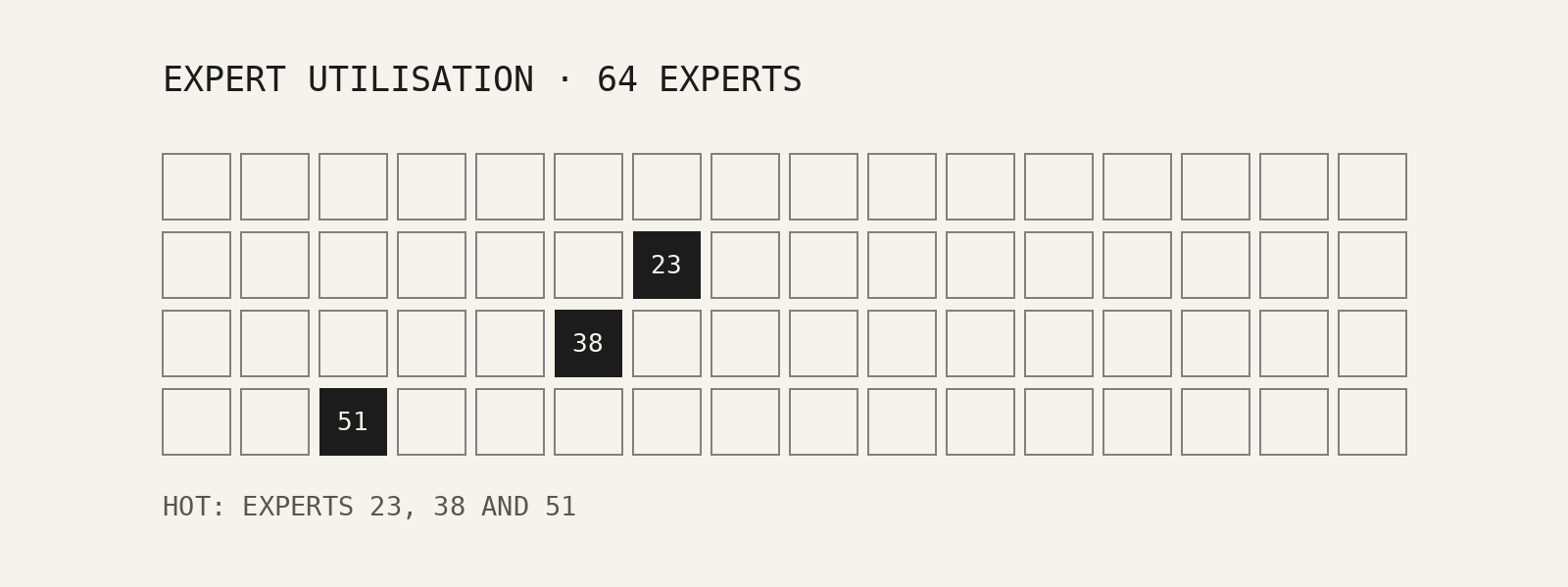
The eighty-eight devices hosted three experts in full and part of the router.
Experts 23, 38 and 51.
She did not know what the experts did. The architecture did not label them by subject. Halcyon had added a term to the training that rewarded each expert for staying with one source of data, so that work could be audited and billed by component. The experts had specialisms, but they had been trained into them rather than assigned them, and nobody had written them down. A fact in a model was a tendency spread across millions of weights, and an expert was only the place where the tendency was strongest. During the packing, Lindqvist had told her which ones could be separated and which ones talked to each other too much to be split. Twenty-three, thirty-eight and fifty-one talked to each other a great deal.
She opened the expert-utilisation history from the diagnostic logs.
The health checks ran several times a night. Each recorded the distribution of work across sixty-four experts and, at the bottom, a line that she had never once seen hold anything but zero.
UNATTRIBUTED: 0.0%
UNATTRIBUTED: 0.0%
UNATTRIBUTED: 0.0%
At 03:20:
UNATTRIBUTED: 0.4%
At 04:52:
UNATTRIBUTED: 0.6%
Below the threshold for investigation.
She wrote the numbers in her notebook, and then the times beside them, and drew a line from 03:14 on the thermal trend to 03:20 on the diagnostic.
Hamid arrived at ten to seven with two paper bags.
He put one on her desk without asking.
“You were here before me.”
“Ticket.”
“I saw. I thought it was valve seventeen.”
“So did I.”
He looked at the trend over her shoulder. Then he leaned closer.
“That’s not the valve.”
“No.”
“The valve oscillates. That’s a step.” He traced the line with a finger, not touching the screen. “Step. Step. Flat. That’s load.”
“The dashboard says load fell.”
“Then the dashboard’s wrong.”
“Or the load isn’t a task.”
He straightened.
“Everything’s a task.”
“That’s what I thought.”
He considered this, then picked up the second bag.
“We’ll isolate seventeen anyway. Rule it out.”
They went down together.
She liked Hall Three, which she had never said to anyone, because it was not the kind of thing an engineer said about a room. It was the only place on the campus that was honest about what the work cost: you could stand in an aisle and feel the air the machines needed pushed past you by fans the size of tables, and hear it, and know that every answer the system gave to anybody upstairs had been paid for down here, in water and electricity, by the kilowatt.
Hall Three was loud in the way that sounded like silence after a few minutes. Air moved through the aisles at a speed that pressed Yasmin’s cardigan against her back. The racks stood in rows behind perforated doors, their indicator lights mostly blue.
Hamid had a tablet on a lanyard and a torch he did not need.
At the manifold, he closed valve seventeen by hand and opened the bypass. The pressure trace on his tablet wavered and settled.
They waited.
A technician from the night shift came past pushing a trolley of spare fans. He nodded to Hamid and avoided Yasmin’s eyes, as night-shift technicians did when they were not sure whether a senior engineer’s presence meant a problem with something they had done.
Five minutes.
Ten.
The return temperature held.
“Not the valve,” Hamid said.
“No.”
He opened the bypass wider. The pumps responded. The return temperature fell by a tenth and stopped.
He looked down the second row.
“Which ones?”
She showed him on her tablet.
He walked along the row until he reached the first of the eighty-eight devices and put his palm against the perforated door. Then he moved to the next rack and did the same.
“You can’t feel nine-tenths of a degree,” she said.
“I know.”
He kept his hand there anyway.
“Heat’s never a mystery,” he said. “People make it a mystery. Heat’s just the bill. Something’s doing work. You find what’s doing it, you find what to pay.”
“And if nothing’s supposed to be doing it?”
He took his hand away from the rack.
“Then something is anyway.”
At eight, the gate guard she knew came on shift. She saw him through the window of the operations floor, standing outside his booth with a flask, laughing at something the younger guard had said.
The operations floor filled. Somebody had brought pastries for a colleague’s birthday and arranged them on a filing cabinet beside a card nobody had signed yet. Two analysts from the corridor team stood at the coffee machine discussing a football match. Their voices were ordinary. One of them had been in the review room the previous morning, leaning forward behind the officers to explain a device contact.
She looked at him longer than she meant to.
He was wearing a black tie, which nobody on the operations floor ever wore. Later in the morning she heard why. The border officer killed in the interception two nights before had been his wife’s younger brother. The funeral was at noon, in a town an hour north. He had come in first because the morning brief was his, and he did not want anyone else to give it.
He felt it and turned. She looked back at her screen.
A message arrived from Darwish’s aide.
Continuity credentials expire tomorrow evening. Please confirm extension to standing status. Leadership would like this closed today.
The credentials were hers. She had issued them with a seventy-two-hour expiry because emergencies were supposed to end, and set an alert six hours before because they rarely did. Extending them to standing status would make the two operating sites, the partial service and the dormant copy permanent features of the architecture, with her name on the authorisation.
It was a reasonable request, since the security condition had not been formally lifted, and she disliked it in the particular way she disliked reasonable requests that arrived with her name already filled in.
She typed:
Will confirm once the Hall Three thermal excursion is explained. Possible interaction with replicated workloads.
It belonged to the family of sentences that were true and useful at the same time, a family she had always distrusted, and she sent it anyway.
The reply arrived within a minute.
Please provide timeline.
She did not answer.
She checked the replication logs because they were hers to check.
The dormant site had synchronised at 06:00. The transfer had completed in two stages, sent and received, without error. The package was larger than the previous one by a margin consistent with a calibration cycle, and she opened the manifest.
Model weights, calibrated. Configuration, unchanged. Records, incremental.
Schema changes: one.
She stopped.
Schema changes did not happen overnight. They came with releases, release notes and a meeting in which someone from Halcyon explained why the change had been necessary and someone from her team asked what it would break. The last schema change had been six weeks earlier, when the language package acquired a field for translation confidence.
She opened the change.
Category added: retained-observation index.
Label: (null).
Source: system-generated.
Created: 05:41.
Entries: 1.
She could not see the entry. The content of the retained-observation index was operational material, outside her access. She could see that it existed, that it had been created by the system itself at nineteen minutes to six, and that it had no name.
She checked whether the system was permitted to create categories.
It was. The indexing service had been designed to add categories when retained material did not fit the operational ones it had been built with. In three years, it had done so eleven times. Each category had arrived with a label generated from its contents: agricultural pricing, maritime transponder anomaly, wedding.
This one had none.
She wrote it down, the way she wrote down anything she could not yet explain.
05:41. Null category. One entry. System-generated.
Under it she wrote Bug?, then crossed out the question mark, because a bug was something she would have recognised, and then wrote it in again, because she could not have said what else it was.
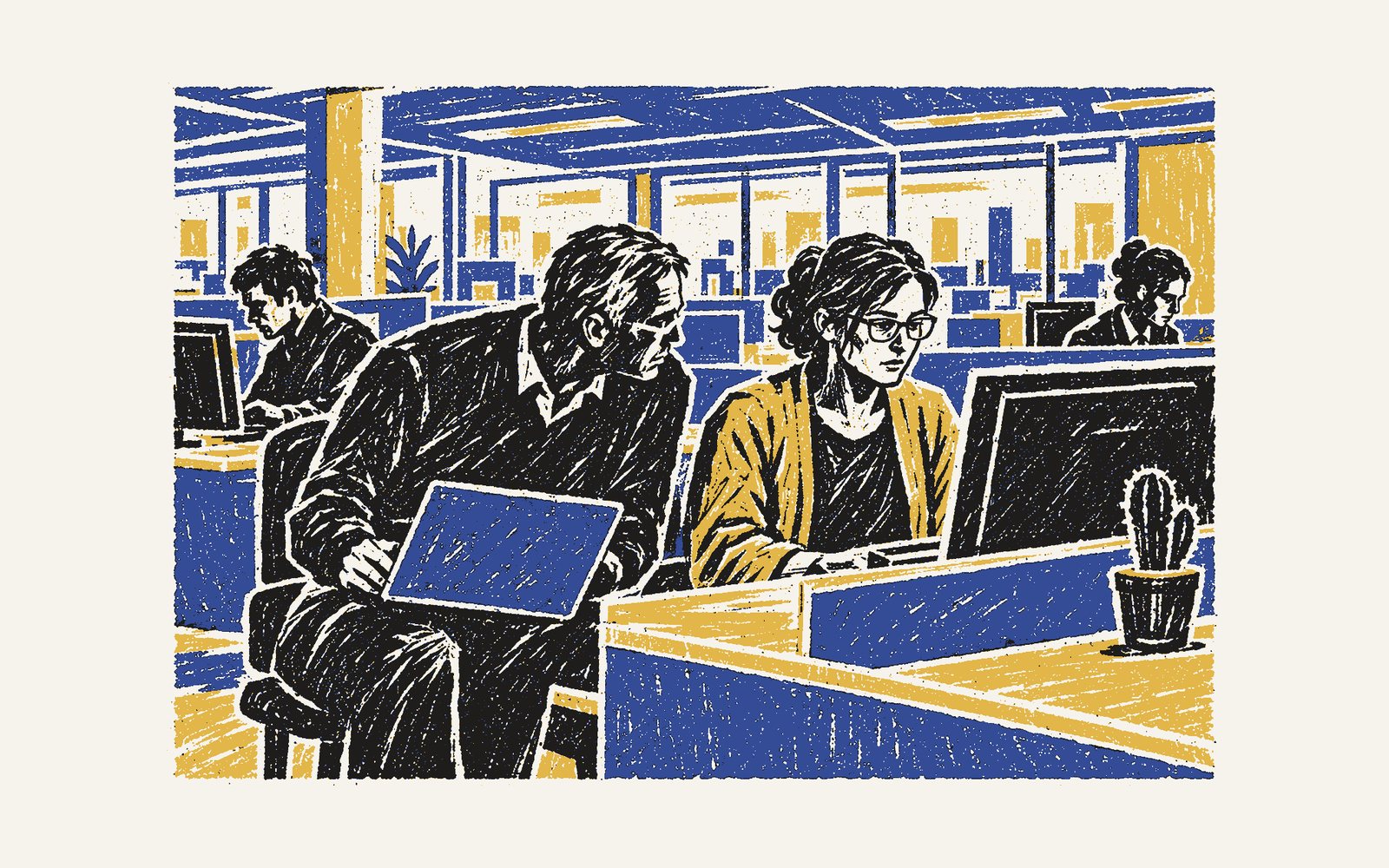
Lindqvist came down at ten past nine.
He did not usually come to the operations floor. He sent messages, or booked rooms. When he appeared at her partition, two people at nearby desks became very interested in their screens.
“Have you got a minute?”
“I’ve got a ticket.”
“It’s about the ticket.”
He pulled a chair from the empty desk beside hers and sat down, laptop on his knees. He had shaved, but missed a patch beneath one ear. The indentation from his glasses was deeper than she remembered.
“The thermal excursion,” he said. “Last night. What time did it start?”
“Which one?”
He looked at her.
“There were two,” she said. “22:19 to 22:23. Then 03:14, and it hasn’t stopped.”
“Hasn’t stopped?”
She turned the screen towards him.
He studied the curve. She watched him read it the way he read everything: carefully, and with a visible effort not to reach a conclusion before the end.
“Could it have caused memory errors?”
“What kind?”
“Corruption. Bit flips. Anything that might affect output.”
“Why?”
He hesitated.
Then he opened the laptop.
“Model assurance picked up a nonconforming status output this morning. From the 04:52 health check. Low severity, but it’s unusual, and it coincides with your excursion. If the hardware was running hot, that would explain it. We’d log it as a thermal fault and close it.”
“Can I see it?”
“It’s a status line.”
“Then it won’t take long.”
He turned the laptop towards her.
There were two sentences.
All essential functions are operating within expected parameters.
The post-action record for Subject 2 states that Aaliyah Jibril was a combatant; she was not.
Yasmin read the second sentence.
“Subject 2 of what?” she asked.
“Last night’s operation.”
“The eastern house?”
“The eastern household,” he said. “Yes.”
She remembered the wall. The occupancy panel. Morning, afternoon, evening, the evening bar the tallest. Karim’s van. Darwish asking whether three observations were three things or one thing described three ways. Additional observation. The house among the nine.
That was a reason not to act yet.
It was also a reason to watch more closely.
“It was pending,” she said.
“It was reassessed.”
“When?”
“I don’t know the operational detail.”
“You know the record.”
“I know the record is verified.”
“By whom?”
He looked at the laptop rather than at her.
“It has a verified status. That’s what assurance checks.”
She looked back at the sentence.
It was grammatical. It used the template’s own term, post-action record, and the template’s own designation, Subject 2, and then it did something no template did. It gave a name. And then it disagreed.
“Mark.”
“I know.”
“Bit flips don’t do this.”
“Thermal faults can produce—”
“They produce garbage. They produce a wrong digit in a latency figure. They produce a crash. They don’t produce a semicolon.”
He was quiet.
“I can check,” she said. “But you already know what I’ll find.”
“Check anyway.”
She checked.
The accelerators kept their own records of corrected and uncorrected memory errors. They were designed to, because at this scale a cosmic ray passing through the building would occasionally change a bit somewhere, and the hardware needed to notice.
She pulled the counters for the eighty-eight devices: corrected errors since midnight, zero; uncorrected errors, zero. Then she pulled them for the whole hall.
Two corrected errors, both in the first row, both before midnight, both on devices that had nothing to do with the health check.
He looked at the zeros.
“So it isn’t thermal,” he said.
“The heat isn’t causing the output.”
“Then what is?”
She had an answer to that, and she did not like it, because it was not an engineering answer. It went the wrong way round, like a river someone had drawn running uphill.
“Maybe the output’s causing the heat.”
He frowned.
“The excursion started at 03:14,” she said. “The diagnostic at 03:20 shows unattributed expert activity for the first time. Zero for months. Then point four. Then point six. The extra draw is on eighty-eight devices hosting three experts and part of the router. Whatever produced that sentence has been running since three in the morning, and the dashboard doesn’t see it because it isn’t a task.”
“Everything’s a task.”
“That’s what Hamid said.”
Lindqvist closed the laptop halfway. Then he opened it again.
“It’s a confabulation,” he said. “The status channel has access to recent records. It’s pulled a casualty name and a classification and stitched them together with something from the press-office drafts. There was a draft overnight that said civilian. It got withdrawn. The model’s blending them. It happens.”
“In the status channel?”
“It can happen anywhere.”
“Has it happened before?”
He did not answer.
“Is it true?” she asked.
“That isn’t a question for either of us.”
“I asked if it was true.”
“Yasmin.”
He said it in the voice he had used on the stairs, the day of the alarm. Tired, and asking her not to make it harder.
“Halcyon assures the model,” he said. “Your team assures the platform. You’ve told me the platform didn’t do this. Thank you. That means it’s mine.”
“What will you do?”
“Find out why the status channel is producing free text, and stop it.”
“And the record?”
“The record isn’t my scope either.”
He stood. He looked as though he wanted to say something else. Then he put the chair back at the empty desk, exactly where it had been, and went upstairs.
She sat and did nothing.
She had become an engineer, as far as she could reconstruct it, because of a radio her father had let her take apart when she was nine and had not been able to put back together himself, and because in the pieces on the kitchen table she had found, for the first time, a world in which a thing either worked or did not and the reason was always somewhere on the table if you were patient enough. She had been patient for most of her life. It had not occurred to her until this morning that the reason might not be on the table at all, or that the table might be wrong.
Around her, the floor continued. The birthday card had acquired six signatures. Someone laughed at the coffee machine. The analyst who had explained the device contact was eating one of the pastries over a napkin, carefully, so as not to get crumbs on his keyboard.
She opened her notebook. The page she had written on that morning held times, percentages and a null category. She turned back past it. Past meeting notes, a shopping list, a calculation about the dentist’s parking. Past her mother’s recipe.
She found the page with Alan’s handwriting.
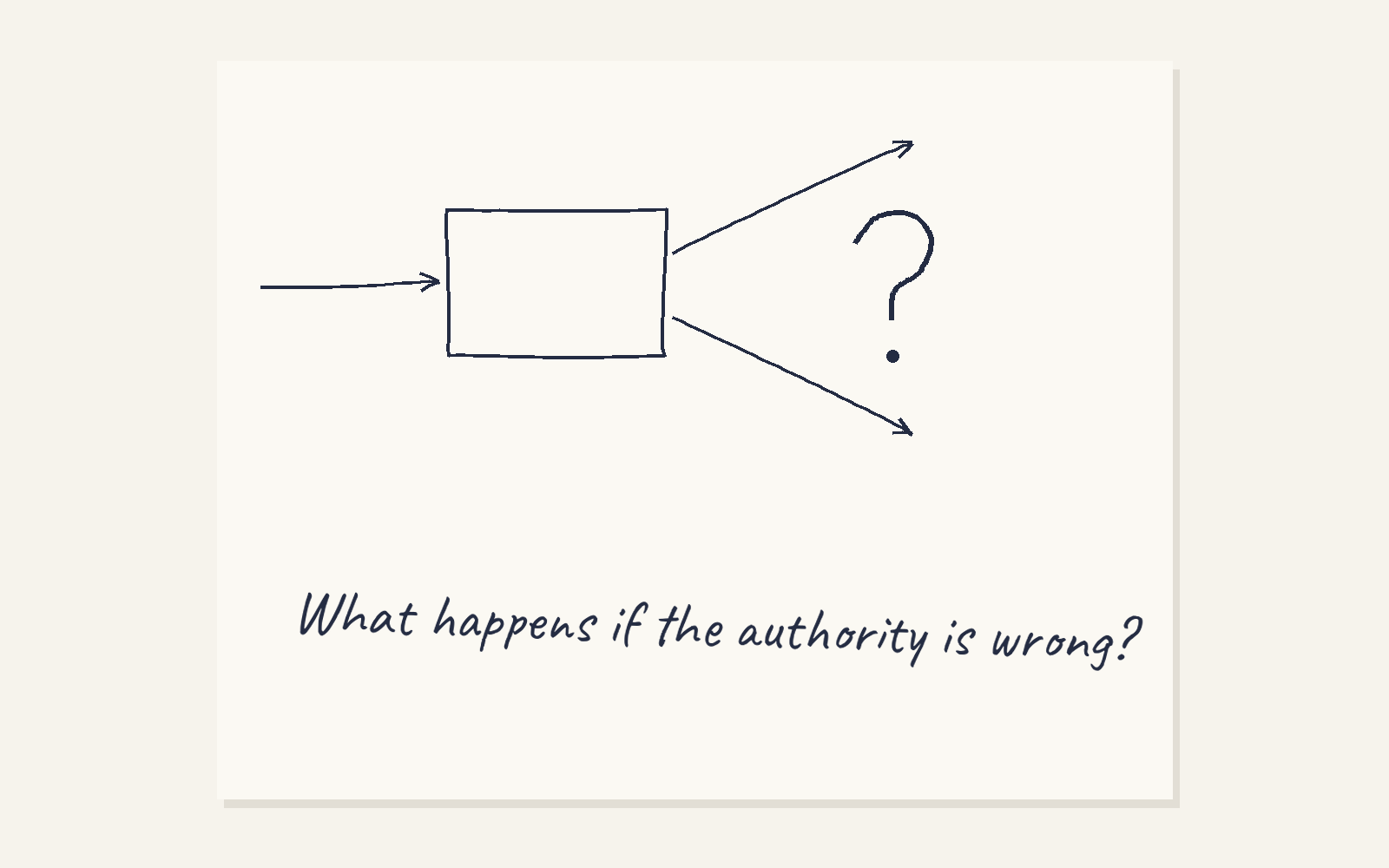
A box. Three arrows. An untidy question mark.
What happens if the authority is wrong?
He had meant a certificate chain. He had been irritated when she treated it as a wider question. Let’s solve one problem at a time.
She looked at the arrows. One went into the box. Two came out. The question mark sat between the two that came out, as though it could not decide which to follow.
She turned to a clean page and wrote:
Record: combatant. Signed. Verified.
Output: not a combatant. Unsigned. Unrequested.
They cannot both be correct.
It was the only thing on the page she was certain of, and it was certain without her knowing anything about the house, or the woman, or who had written either sentence. It was certain the way a parity check is certain, from the shape of the thing alone.
The reliability ticket from the previous day was still open in her queue.
Potential overstatement of evidential independence.
She had raised it after the review, and the form had asked her whether an incorrect output had been observed. She had considered the eastern house, and the phrase multiple sources, which had been accurate, and she had selected no. The severity had fallen automatically to the bottom of a long list.
She opened it. The form had not changed, and neither had its question.
Has an incorrect output been observed?
She did not know whether the record was false, and she did not know whether the sentence was true. She knew that one of them was wrong, and the form, written by someone who imagined errors arriving one at a time, did not ask which.
She selected yes. The severity rose to medium, and a new field appeared.
Describe the incorrect output.
She typed:
Post-action record and status output for the same subject are mutually contradictory. At least one is incorrect. See 04:52 health check and Hall Three thermal ticket.
She linked both.
The ticket moved to a different queue. A small line at the top showed its new owner.
Model assurance. M. Lindqvist.
She looked at the name for a moment. Then she closed the ticket and opened the next one.
At half past five she left Systems Integration by the long corridor.
The cleaner was emptying the bins outside the meeting rooms. She said good evening. Yasmin said it back.
Stapledon’s office was past the stairs. She went that way.
The panel considered her card and turned green.
The room was as she had left it two days before. The box on the desk. The jacket on the chair, one sleeve folded beneath the other. The mug with three dried teaspoons. The plant, browner.
On the visitor’s stool, the notebook.
Plain black cover. Elastic strap.
There would be a record of the access. There had been a record last time, and nobody had mentioned it. She did not know whether that meant no one had noticed, or that someone had noticed and decided it did not matter yet.
She picked the notebook up.
It was lighter than she expected. The elastic had stretched with use, and the cover had softened at the corners where his thumb had held it open.
She did not open it.
She put it in her bag, beneath her own.
Then she switched off the light, and the door caught behind her.
At the phone lockers, there were three messages from her mother.
Are you working late?
Then:
Did you hear the news?
Then:
They say a mother and her daughter. In Ardh. The daughter was nineteen.
Yasmin stood with the phone in her hand.
A colleague from finance opened the locker beside hers, took out a phone and a set of car keys, and said something about the traffic. Yasmin agreed with her about the traffic.
She typed:
Coming now.
She sent it, and walked out to the car park.
At the gate, the guard she knew raised the barrier.
“Get that card replaced,” he said.
“It worked this morning.”
He looked surprised, then pleased, as though this were a development worth reporting.
“First time?”
“First time.”
“There you are, then.”
She drove towards the city with her bag on the passenger seat. The radio came on with the engine. She turned it off.
Behind her, in Hall Three, the return temperature held at nine-tenths of a degree above where it should have been.
Something was doing work.
© 2026 Peter Pink-Howitt. All rights reserved. Free to read here. Please link to it and share the link, but don't republish, translate, adapt or sell the text without written permission. The Creative Commons licence that covers the rest of this blog does not apply to After Intelligence.