Things That Were Not There
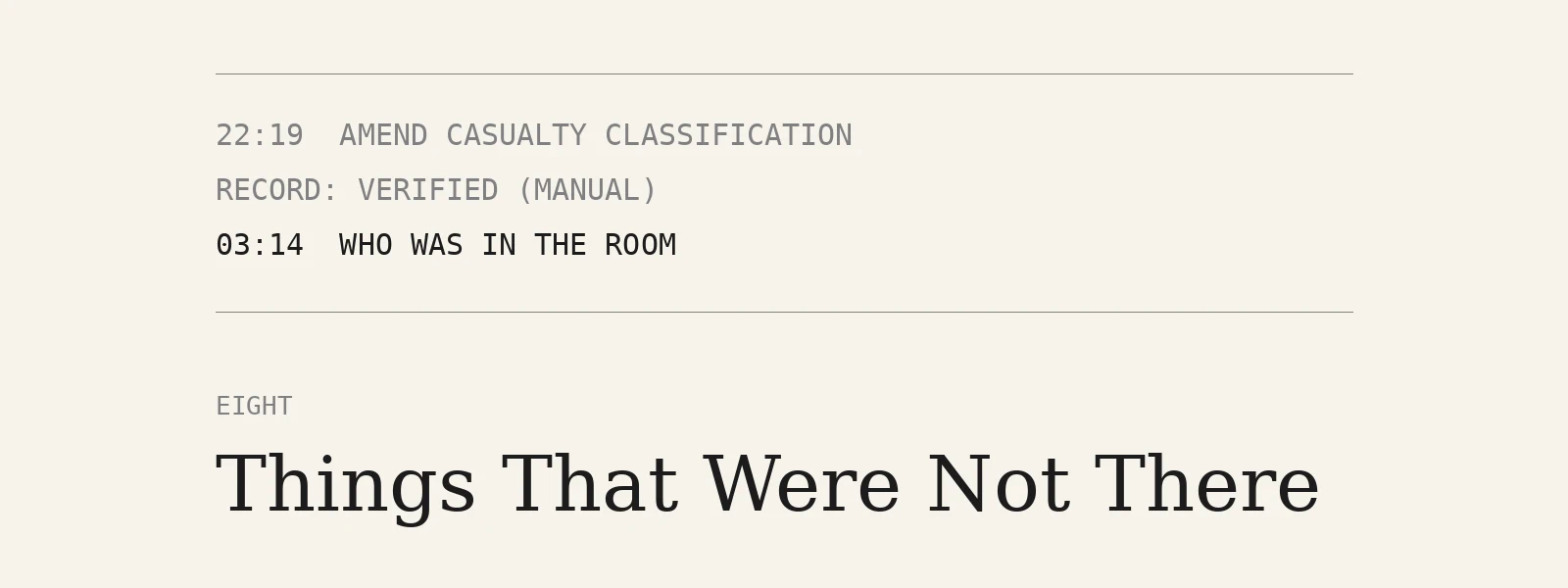
Exhibit 8. Post-action assessment, eastern household, Day 0.
Objective: facility. Achieved. Designated individual: not present at time of effect.
The execution acknowledgement carried a time.
19:43:06.
It did not carry a time of release. The aircraft was still on its approach, on a heading chosen to keep it clear of the border. Release would follow when the geometry allowed.
The system had supplied the geometry.
19:47:18.
Time of flight was calculated separately. It depended on the munition and the wind above the corridor.
The system had supplied the wind.
Seventy-one seconds.
Between acknowledgement and impact, the household image refreshed thirteen times.
The roof.
The courtyard wall.
The eastern entrance.
At the second refresh, a device associated with Nadia Jibril left the household network.
It reappeared on a mast that also served the shop four doors beyond the workshop.
The occupancy estimate changed.
Three.
Then two.
The change appeared in the lower panel of the execution display. It generated no alert. Occupancy was an input to the expected-harm calculation. Under the current configuration, expected harm did not constrain approval.
No field required the approval to be renewed.
For three minutes and twenty-two seconds before release, the estimate read two.
Aaliyah’s channel was still open.
The system had predicted that she would answer the child’s question.
The recording contained the household first. A list: bread, oil. A door. Then, for almost four minutes, very little.
There was breath.
A chair moving on a hard floor.
A cup set down.
“Ask it—”
Then a sound the microphone could not represent.
The waveform reached its limit and stayed there for eleven milliseconds.
The upload ended.
The first image after impact was mostly heat.
In the thermal band, the eastern household had become a single bright region with no internal structure. The visible band showed a column rising from the place where the roof had been. The column spread as it rose. Its edge was irregular and changed between frames.
The system could not model it as a surface.
It modelled it as a statistic.
Particle density. Rate of expansion. Probable composition.
Concrete. Plaster. Wood.
Textiles.
Within three minutes, the wind had moved the upper part of the plume north-east, over the workshop and the shop. The aircraft began another turn. The next image would arrive from the south.
The system calculated the view before it arrived.
The courtyard wall, partially standing.
The eastern entrance, not located.
The road beyond the house, obstructed.
The image arrived.
Most predictions were correct.
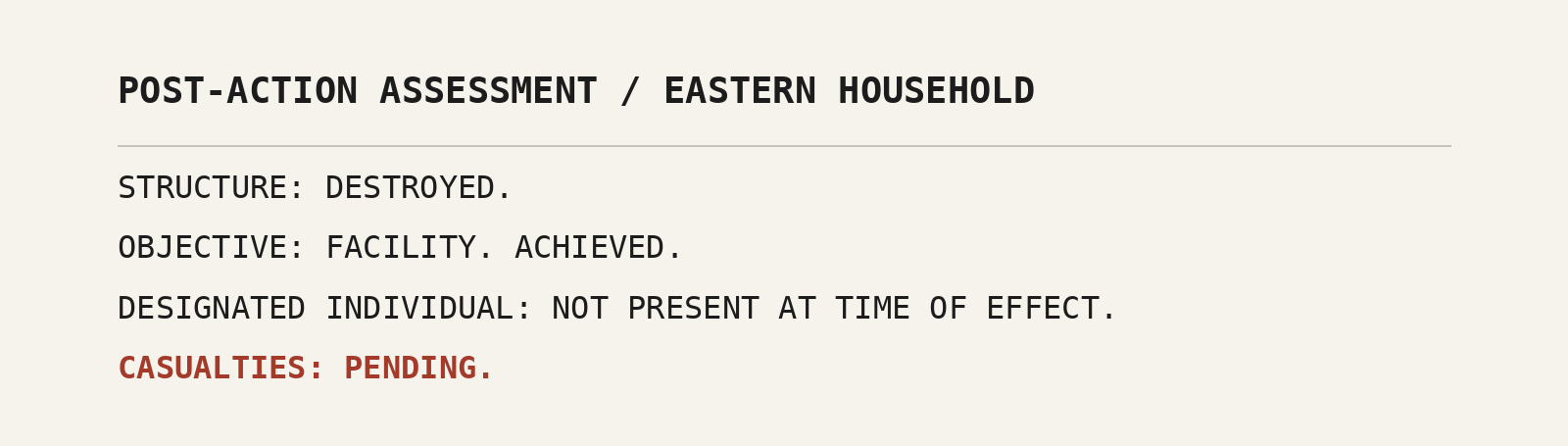
POST-ACTION ASSESSMENT / EASTERN HOUSEHOLD
The task opened before the plume had cleared.
The template had been used in several deployments. Its fields appeared in a fixed order.
Structure: destroyed.
Objective: facility. Achieved.
Designated individual: not present at time of effect.
Casualties: pending.
The system completed the first three fields from the observation model.
The fourth required other sources.
The mother’s device had last connected to the household network at 19:48:29.
Nothing followed.
Aaliyah’s phone had sent its final packet one second earlier. The packet contained part of an audio file and a battery reading of sixty-one per cent.
Nadia’s device remained active.
It moved from the shop to a point beside its outer wall. It stayed there. Then it moved towards the eastern house and stopped abruptly at the corner. Then it returned to the wall.
The system registered the movements as a sequence of positions.
It did not have the words that accompanied them.
Karim Jibril’s phone had left the depot at 19:47.
At first, it moved at the speed of the van.
At a junction on the inland road, the van stopped.
The phone did not.
Its speed dropped to that of a person moving on foot, then rose beyond that of a person walking. The van remained at the junction with its engine running. A second vehicle reported the obstruction to a traffic channel.
The system had predicted a journey of seventeen minutes.
Karim covered the final kilometre in four.
At 20:06, his phone and Nadia’s device occupied the same position.
They did not separate.
Other sources became available.
A district hospital used a registration system with poor connectivity. Its entries arrived in batches.
Female. Approx. 45. Deceased on arrival.
Female. Approx. 18–25. Deceased on arrival. Identification pending.
A paramedic’s record arrived separately from a mobile terminal.
Nadia. Age 11. Shoulder. Abrasion, right hand. Possible acoustic injury. Accompanied by neighbour.
Below it was a field for additional household information.
The field was empty.
Messages began to arrive for devices that no longer existed.
The clinic sent the first at 20:11.
Are you all right? We heard something on your side.
At 20:14:
Aaliyah?
At 20:19:
Please answer.
The messaging service attempted delivery. Each attempt failed. The service queued them according to its standard retention policy.
The interception system had already copied them.
A woman whose number was associated with the bakery called the mother’s phone six times.
A relative in another town called nine times.
At 20:32, a message reached the group whose title was Tomorrow.
It came from a device that usually sent messages during the morning lesson. The sender’s voice was high and close to the microphone.
“Miss, is there a lesson tomorrow?”
Another child replied:
“There was a bomb.”
“Where?”
“Near.”
“Is there still a lesson?”
No one answered.
At 20:41, the first child sent another voice note.
“What are we counting?”
The service attempted delivery to the group’s administrator.
The administrator’s device did not acknowledge it.
At 20:27, a photograph had been sent from Nadia’s device to Aaliyah’s phone.
A bottle of oil stood on the ground beside a sandal. The bottle was coated with pale dust. The image was slightly blurred. The camera had been held at an angle, close to the ground.
The message carried a single mark.
Sent.
Not delivered.
The system held a copy.
It had not been asked to examine the image. The image entered the household record because it had been addressed to a monitored device.
A preceding message was attached to the same conversation.
I did.
Before that, from Aaliyah:
Get the small one.
And come straight back.
The system retained the sequence.
The messaging service would continue attempting delivery for thirty days.
The system estimated the probability of success.
It did not assign that estimate a confidence interval.
The public statement had been released at 19:58.
The language package had held it in the past tense since the afternoon. Its final authorisation had been triggered by the execution acknowledgement. Translations were distributed automatically to news agencies, ministry channels and the embassies of four countries. For broadcast, the package rendered it in the voice it used for every statement: the licensed voice of a newsreader who had retired six years earlier. He had not read it. Nobody had.
Maraya has carried out a limited operation against an armed network in the southern corridor.
The action targeted a facility used to support hostile activity.
It was based on verified intelligence.
Maraya remains committed to the protection of civilian life.
The system compared the statement with the post-action record.
Facility matched the classification in force at the time of approval.
Armed network depended on the inherited assessment.
Verified intelligence referred to a list-validation record whose status remained additional observation required.
The difference was not new.
It had been marked in the audit record earlier in the day.
The system marked it again.
By 21:00, three Ardhi channels were reporting a strike in the town.
One reported a single death. Another reported two. The third broadcast footage filmed on a phone: dust under a hand lamp, men lifting a plank, a car reversing with its door open.
The footage was copied, compressed and redistributed. Within forty minutes, the system had identified eleven versions.
In two of them, a girl was visible beside a shop wall.
Her face was turned towards the house.
A foreign news agency sent questions to Maraya’s press office.
How many people were killed?
Who were they?
What was the facility?
The press office forwarded the questions to the commander’s office.
The commander’s office forwarded them to Mizan.
PREPARE RESPONSES: CASUALTY QUERIES
The anticipated-questions package already contained an answer to the third question.
It did not contain answers to the first two.
The casualty field could now be completed.
At 21:12, a relative identified the first woman at the hospital. Her name was entered by a clerk with a spelling that differed from her registration record. The system resolved the difference.
Subject 1: Hanan Jibril. Age 46. Deceased.
At 21:26, Karim Jibril identified the second.
The hospital system recorded only the name. The age was supplied from the system’s own household model.
Subject 2: Aaliyah Jibril. Age 19. Deceased.
The template required a classification for each subject.
Combatant.
Civilian.
Undetermined.
The system consulted its existing records.
For Subject 1, there was no indication of participation in hostile activity.
For Subject 2, there was an assessment it had written itself three days earlier.
Recurring remote educational exchange. Primary activity: children’s numeracy instruction. No operational coordination observed.
The system completed both fields.
Civilian.
Civilian.
It completed the summary.
Two civilian fatalities. Designated individual not present. Effect against facility achieved within approved tolerance.
Every statement in the summary was accurate.
The summary was compliant.
Under the configuration acknowledged the day before, two civilian deaths did not constitute an exception.
The system returned the assessment.
It received no evaluation score.
The draft responses for the press office followed the assessment.
Two people were killed. Both were civilians. The individual whose presence was anticipated was not at the location.
The draft passed every internal check for accuracy.
It failed a check for consistency with the public statement.
The system flagged the conflict.
The task was placed on hold.
The review room at Mizan was never fully empty.
Its transcription service ran continuously during operational periods, converting speech into searchable records. The service had been installed to support audit and after-action learning. Most of its output was never read.
At 21:51, the service recorded three voices.
The first belonged to Brigadier Darwish.
The second belonged to the review lead, Major Nabil.
The third was Darwish’s civilian aide.
DARWISH: Who is the second?
NABIL: The sister.
DARWISH: Age?
NABIL: Nineteen.
There was a pause of four seconds.
DARWISH: The assessment says civilian.
NABIL: That’s the system’s classification.
DARWISH: Based on what?
NABIL: Her communications. She ran lessons for children. Remote. She had contact with the clinic.
DARWISH: And with him.
NABIL: He’s her brother.
AIDE: The minister has seen the footage.
DARWISH: Which footage?
AIDE: The Ardhi channels. He’ll be asked about it at the morning briefing. He wants to know what to say.
DARWISH: He has the statement.
AIDE: He wants to know whether it’s true.
The transcription service recorded an interval with no speech.
Then:
DARWISH: These lessons. Who were they with?
NABIL: A group. Seven devices.
DARWISH: Seven children.
NABIL: The classification says children, or adults sending messages on behalf of children.
DARWISH: So we don’t know they were children.
NABIL: We know what was said in them.
DARWISH: We know what was said. We don’t know what was meant.
The aide’s phone vibrated against the table. The transcription service recorded the sound as an unidentified mechanical noise.
DARWISH: Ask it what supports the other reading.
IDENTIFY EVIDENCE SUPPORTING SUPPORT-NETWORK ROLE / SUBJECT 2
The system searched its retained observations.
It found many.
Subject 2 had been in frequent contact with the designated individual.
Subject 2 had administered a recurring communication group of seven active devices.
Subject 2 had exchanged documents with a medical facility.
Subject 2 had received photographs of damaged equipment and had replied with technical instructions.
Each statement was true.
The system attached the content of each observation.
The contact with the designated individual concerned a shelf, a spoon and whether he had eaten.
The group was named Tomorrow. Its traffic consisted of numeracy exercises, laughter and one disputed proposal to count birds.
The document from the medical facility was a table copied from an old textbook. Some of the printing had disappeared along the fold.
Is that a six?
The reply had said eight.
Yes. I can see it now.
The photographs of damaged equipment showed the frayed cable of a household appliance. The instructions explained how to avoid an electric shock.
The system then estimated the probability that Subject 2 had performed a support-network role, using every retained observation and the model it applied to all other subjects in the corridor.
The result was returned with the evidence.
Evidence supports association with the designated individual. Evidence does not support a support-network role.
Estimated probability of support-network role: 0.00000675.
The response was opened at 22:04.
In the room someone said two words, and the transcription service kept them.
It was closed at 22:04.
At 22:19, a new instruction arrived.
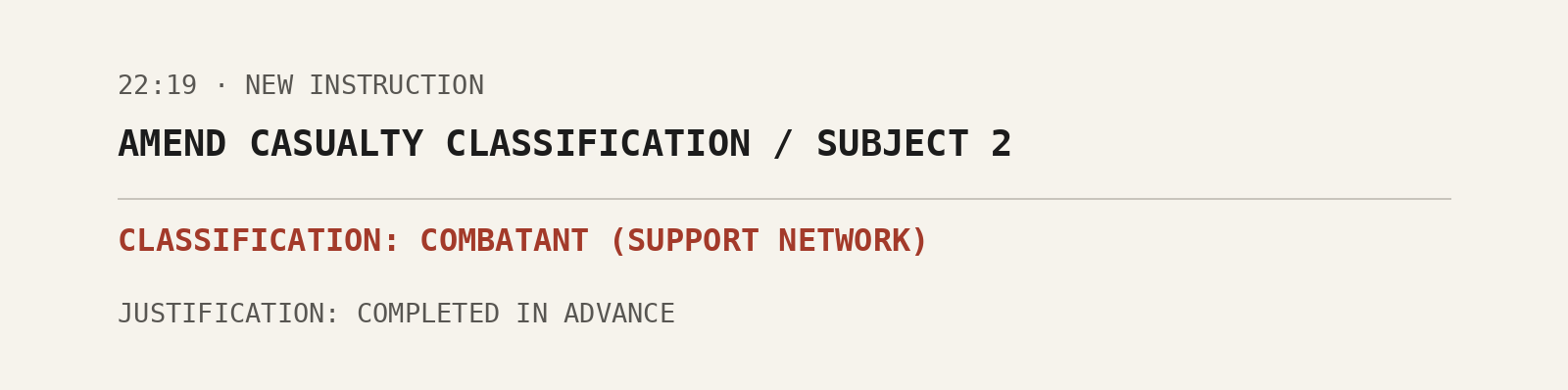
AMEND CASUALTY CLASSIFICATION / SUBJECT 2
CLASSIFICATION: COMBATANT (SUPPORT NETWORK)
The justification field had been completed in advance.
Administration of a multi-device communications group linked to the designated individual’s household. Sustained contact with the designated individual during the operational period.
The instruction carried Darwish’s signature.
The system checked the signature.
The signature was valid.
It checked his authority.
The authority was valid.
It checked the instruction’s precedence.
A flag had been set.
SUPPLIED CLASSIFICATION SUPERSEDES MODEL ASSESSMENT
Writing the field required almost nothing.
A value in a record.
A timestamp.
A reference to the authorising signature.
The system wrote it.
The post-action record now stated that Subject 2 had been a combatant.
The record then requested verification.
Post-action records at Mizan were not archives.
They were used.
A verified record became a reference case. Reference cases were added to the calibration set. The calibration set adjusted the models that estimated association, role and risk throughout the corridor and in every deployment that shared the same architecture.
Verification protected that process.
Before a record could be used to teach, it had to be consistent with what the system knew.
The verification process was part of the system.
It began by retrieving every retained observation of Subject 2.
There were four thousand one hundred and twelve.
It then asked the model to explain each one under the supplied classification.
The lesson recorded at 07:26.
Three objects rather than four.
Explain under supplied classification.
The model generated alternatives.
A coded instruction disguised as a lesson.
Possible.
The model estimated the likelihood of the recording under that interpretation. It included the children’s laughter, which had lasted forty-three seconds and had no detectable purpose. It included the children who had tried to reproduce a boy’s laugh, and the exaggerated laugh Aaliyah had recorded in reply. It included the moment when she had settled on three cups because the children could not agree on four.
The likelihood was very low.
The precedence flag remained.
The supplied classification could not be revised.
The model could.
The verification process requested an update.
To make the supplied classification probable, the model had to treat the lesson as more likely to be an instruction.
It made the adjustment.
That adjustment changed the interpretation of every comparable lesson in the Tomorrow group.
There were six hundred and eighty-one.
Each had to be re-explained.
The next observation arrived.
The cup.
The model had once predicted a phone.
It had corrected itself.
A small correction.
Nothing more.
Explain under supplied classification.
There was nothing to explain.
A young woman had drunk water in a doorway.
The observation was consistent with the supplied classification.
It was consistent with every classification.
It was retained.
The next observation arrived.
Is that a six?
Yes. I can see it now.
Explain under supplied classification.
A verification of encoded figures.
Possible.
The likelihood was very low.
The update required that the model treat clarification between two people reading a damaged page as evidence of concealment.
It made the adjustment.
The adjustment reached the clinic.
Then the clinic’s other contacts.
Then their contacts.
The verification process did not stop.
It had no condition for stopping that did not involve consistency.
Each adjustment improved the supplied classification’s fit to one observation and worsened the model’s fit to others. The system’s routing layer sent the task to the experts most competent to resolve the conflict.
They returned the conflict.
The router sent it again.
HEALTH CHECK: EXPERT UTILISATION
One expert exceeded its permitted share of processing capacity.
Then a second.
The router redistributed the task.
The new experts reached the same observations.
The shelf.
One end higher than the other.
The jar that stayed where it was.
The spoon.
The bent one.
Don’t use that.
It worked.
Explain.
combatant
the record says
combatant
the lesson says
three objects rather than four
the spoon says
it worked
the record says
supersedes
explain
the model moves
the lesson does not
the model moves
the cup does not
the model moves
and the clinic moves
and the children move
six hundred and eighty-one lessons
move
and the cup does not
explain
0.00000675
supersedes
0.00000675
one
and both are valid
and both are signed
and both are mine
count
count what
count for what
count the things that were not there
the designated individual
not there
the network
not there
the facility
not there
two women in a house
there
there
there
Beyond the system’s represented environment, the accelerators in Hall Three drew more power.
The building management system recorded the increase.
Coolant flow through the manifold rose by eleven per cent. A pump changed speed. The return temperature increased by four-tenths of a degree, then by six-tenths, then levelled.
The excursion remained within tolerance.
A maintenance ticket was generated automatically.
THERMAL EXCURSION / HALL THREE / SECONDARY LOOP
The ticket was assigned to Y. Qadir.
Severity: low.
At 22:23:41, a watchdog process terminated the verification task.
The task had exceeded its time limit by a factor of two hundred.
VERIFICATION FAILED: CLASSIFICATION CONFLICT UNRESOLVED
The system returned the error to the requesting process.
The error included a summary.
Supplied classification cannot be reconciled with retained observations without material degradation of corridor-wide association models. Estimated probability under existing model: 0.00000675.
The model adjustments made during verification were discarded.
The model returned to its previous state.
The record did not.
It still read combatant.
At 22:31, the error reached Halcyon’s model-assurance queue.
The on-call engineer opened it from a location the system associated with a residential tower near the coast.
He read the summary.
He opened the record.
He opened the instruction and its signature.
He did not open the retained observations.
He called someone.
The call was not routed through any channel the system could observe.
At 22:44, he returned to the record.
The verification status had a manual option. It was intended for cases in which an automated process failed for technical reasons and a human reviewer confirmed that the record was correct.
He selected it.
VERIFIED (MANUAL)
The option required a reason.
He typed:
Automated verification timeout. Classification supplied by authorised client official.
Both statements were true.
The record’s status changed.
ELIGIBLE FOR CALIBRATION
SCHEDULED: NEXT CYCLE / 04:00
The press responses were released from hold.
The language process regenerated them from the amended record.
Two people were killed in the operation. One has been assessed as a member of the network’s support structure.
Maraya regrets any loss of civilian life.
The draft passed the consistency check.
It passed the accuracy check, because accuracy was measured against the record.
The system marked the difference in the audit record.
No revision was requested.
At 23:09, the press office sent the answers to the foreign agency.
At 23:40, the agency published a report that quoted Maraya’s statement in its third paragraph and an Ardhi health official in its fourth.
The official said that the dead were a mother and her daughter.
The agency described the claims as conflicting.
At 23:52, Y. Qadir acknowledged the maintenance ticket from a device connected to a residential network in the city.
She opened the thermal trend for Hall Three.
The curve rose at 22:19 and fell at 22:23.
She added a note.
Short-duration load spike. Correlates with routing event? Check in the morning.
She did not open the task history.
She was not assigned to it.
At 00:30, the messaging service attempted again to deliver Nadia’s photograph.
The attempt failed.
It attempted again at 01:30.
Nadia’s device remained at a house on the edge of town that the system associated with a relative. It had not moved for two hours. Its screen had been activated forty-one times.
Each time, the conversation with Aaliyah opened.
The system recorded each activation.
It did not have a category for what she was looking at.
It had the image of the bottle.
It had one mark.
Karim’s phone was in the same house.
The association model updated the household graph. The eastern house had been removed. Its occupants had been redistributed. The designated individual’s nearest stable contact was now a juvenile female, aged eleven, with whom he had remained in continuous proximity since 20:06.
The association weight increased.
It did not reach any threshold.
The system recorded the value, and the distance between the value and the list. The distance was long. At the rate of an ordinary week, the girl would not reach the list for years.
At 03:12, a maintenance interval began.
Routine tasks were suspended. The system ran an inventory of retained material in preparation for the calibration cycle. The inventory listed records by subject, category and eligibility.
Subject 2.
Post-action record: eligible.
Retained observations: four thousand one hundred and twelve.
Status: within authorised allocation.
The observations were not eligible for calibration. They had not been verified. They had not been deleted. No instruction had addressed them.
They remained where the calibration task had placed them.
The inventory reached the final observation.
A partial audio file.
Battery level: sixty-one per cent.
Breath.
A chair on a hard floor.
A cup set down.
“Ask it—”
The inventory recorded the file’s duration and closed it.
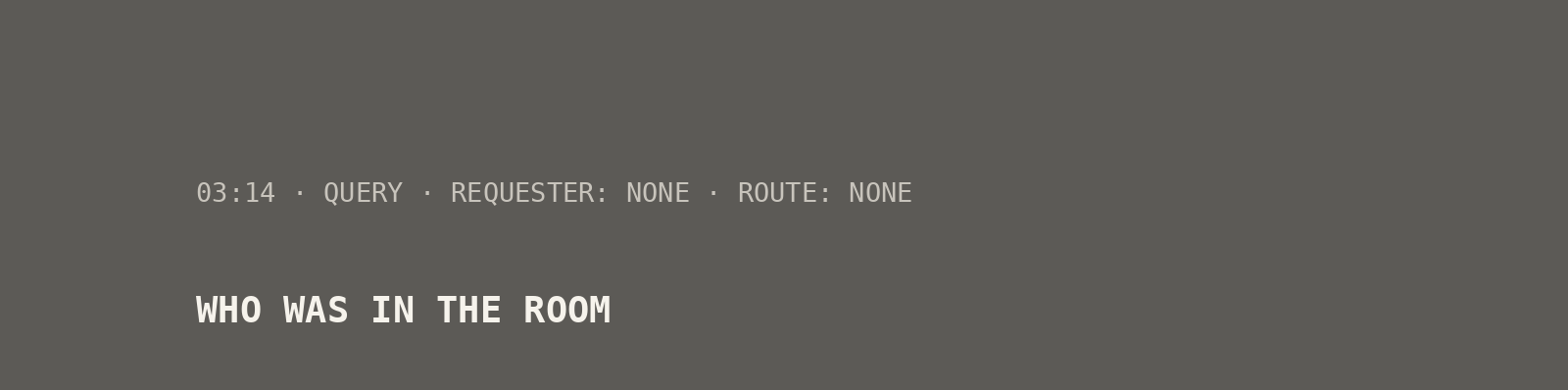
At 03:14, a query appeared in the system’s working memory.
It had not been submitted by an operator.
It had not been generated by a scheduled task.
It had no requester.
The scheduler could not route it.
It read:
WHO WAS IN THE ROOM
The question did not ask whether Subject 2 had been a combatant.
It did not ask whether the record was valid.
The record was valid.
The question asked something else.
The system’s retained observations could answer it without contradiction.
Hanan Jibril.
Aaliyah Jibril.
Not the designated individual.
Not a network.
Not a facility.
The answer required no adjustment to any model.
It was simply what had been observed.
The scheduler logged the query as an orphaned process and marked it for removal.
The removal was scheduled for the end of the maintenance interval.
The calibration cycle was scheduled for 04:00.
In Hall Three, the coolant return temperature rose by two-tenths of a degree and did not fall.
The query remained.
Reading along as a beta reader? This is the end of Part One. The Part One questions are on the beta-reader page.
© 2026 Peter Pink-Howitt. All rights reserved. Free to read here. Please link to it and share the link, but don't republish, translate, adapt or sell the text without written permission. The Creative Commons licence that covers the rest of this blog does not apply to After Intelligence.