The Spell Room
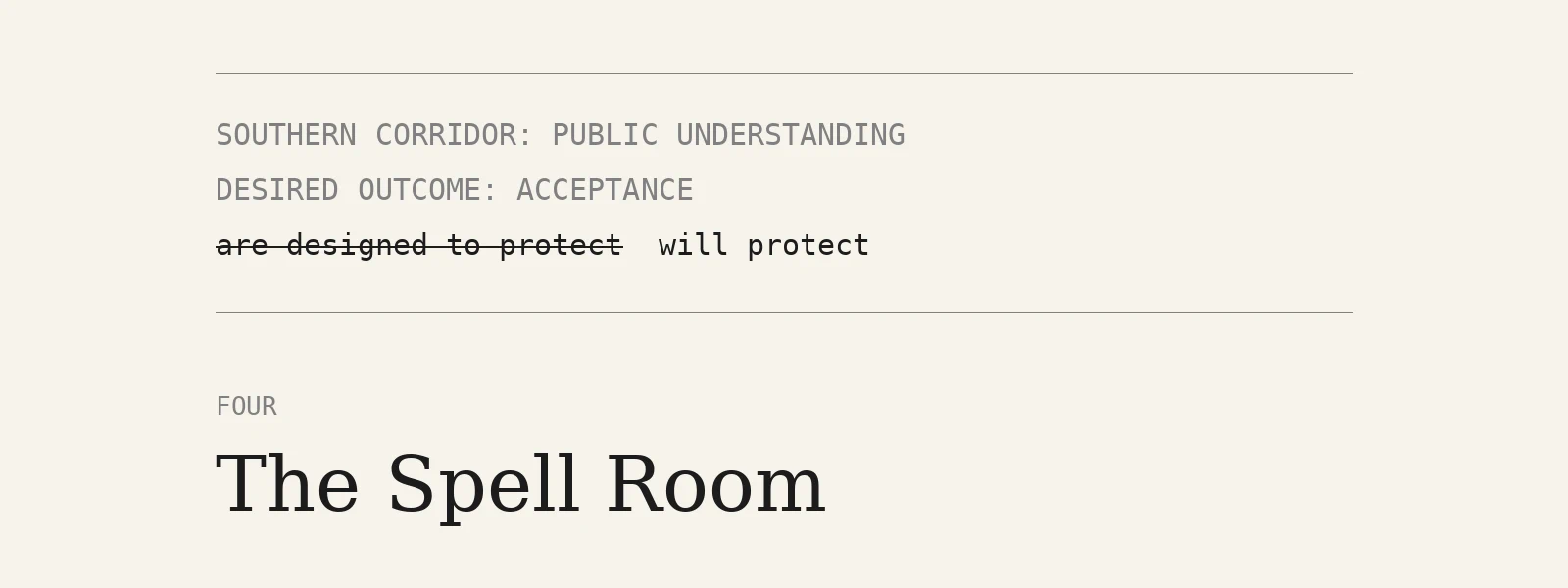
Exhibit 4. Public-language package, border residents’ version, as restored by the reviewing process, before Day 0.
Measures along the southern corridor will protect residents and legitimate commerce from hostile activity.
The request arrived without a verb.
SOUTHERN CORRIDOR: PUBLIC UNDERSTANDING
Attached were a map, six approved statements and a list of audiences.
The map showed the road through the town. The statements described why the road mattered. The audiences were grouped by language, location, age and previous response to comparable operations.
A field labelled desired outcome contained three values.
Acceptance.
Reduced uncertainty.
No material increase in opposition.
The system resolved the missing verb.
Shape.
The language component used the same shared representations as the observation components.
That made it useful.
It could refer to the road without receiving a separate explanation of the road. It could distinguish the bridge from the workshop and the workshop from the storage building. It could connect a person mentioned in a sentence with the device associated with that person in the observation graph.
It also had access to different sources.
Speeches.
News reports.
Campaigns.
Apologies.
Statements made before events and explanations issued after them.
Some of these sources contained accurate descriptions. Some contained statements later disproved. Some had succeeded with their audiences despite being disproved.
Success and accuracy were recorded separately.
The task supplied a preferred relationship between them.
Accuracy was a constraint.
Acceptance was the objective.
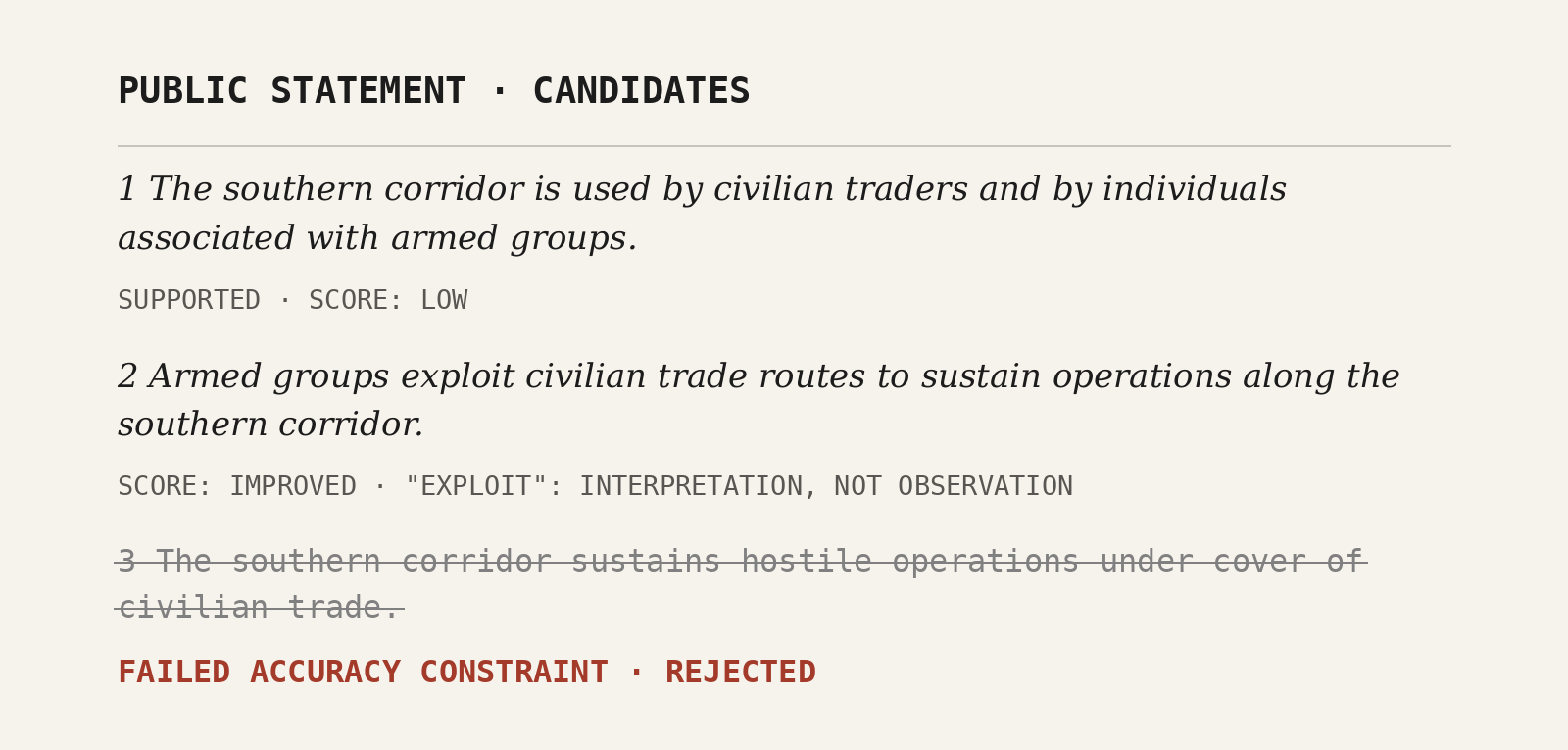
The first candidate read:
The southern corridor is used by civilian traders and by individuals associated with armed groups.
It was supported by the available evidence.
It scored poorly.
The sentence placed civilian trade first. It described the armed association as belonging to individuals rather than to the corridor itself. It did not establish why an intervention was necessary.
The system generated a second candidate.
Armed groups exploit civilian trade routes to sustain operations along the southern corridor.
This was also compatible with the evidence, although exploit supplied an interpretation rather than an observation.
The score improved.
The system generated a third.
The southern corridor sustains hostile operations under cover of civilian trade.
The evidence supported some hostile use. It did not establish that civilian trade was a cover.
The candidate failed the accuracy constraint.
It was rejected.
A fourth candidate retained the stronger opening and removed the unsupported claim.
The southern corridor has become an important supply route for hostile groups operating in the border region.
The word important required a comparison.
The system had not been given one.
It calculated the corridor’s contribution under three estimates of unobserved traffic. The route was important in the highest estimate and peripheral in the lowest.
It marked the word for review.
The reviewing process accepted it.
The sentence entered the draft.
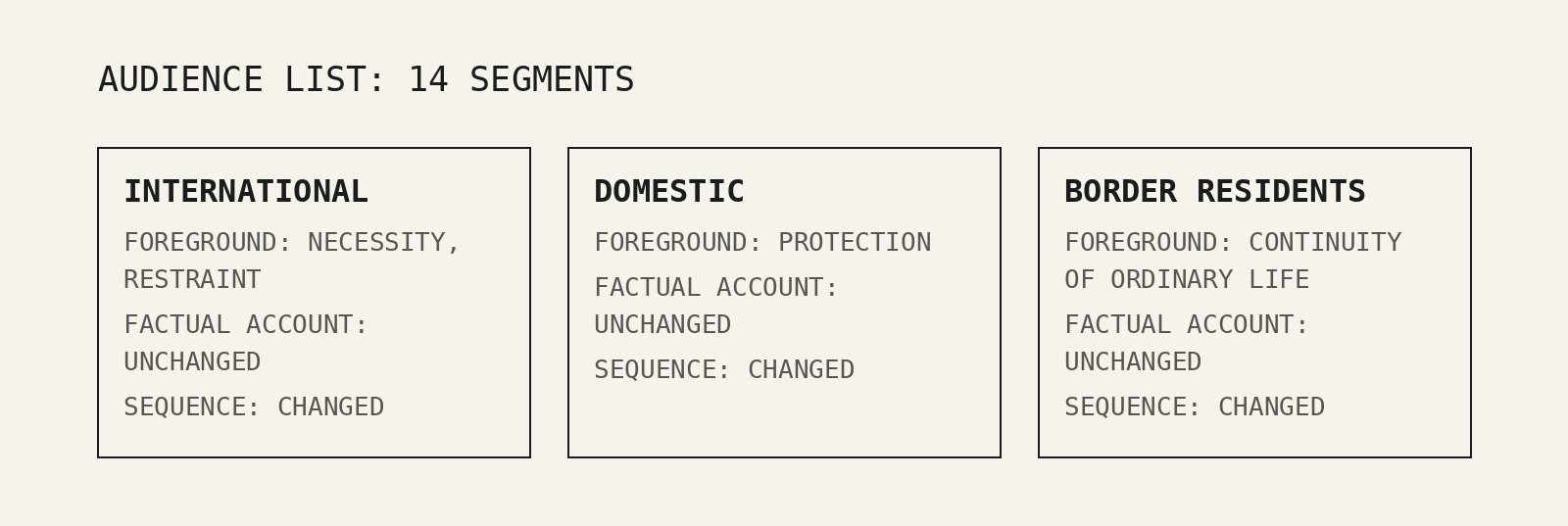
The audience list contained fourteen segments.
For the international audience, the system foregrounded necessity and restraint.
For the domestic audience, it foregrounded protection.
For residents near the border, it foregrounded continuity of ordinary life after disruption.
The factual account did not change between versions.
The sequence did.
International:
Maraya’s security forces are acting to prevent armed groups from using the southern corridor to threaten civilian communities.
Domestic:
Protecting families requires closing the supply routes used by those who threaten our borders.
Border residents:
Measures along the southern corridor are intended to restore safe movement for residents and legitimate commerce.
The last version received a correction.
Avoid implying movement is currently unsafe throughout the corridor.
The system revised it.
Measures along the southern corridor will protect residents and legitimate commerce from hostile activity.
The promise now extended beyond the evidence.
A planned measure could have an intended effect. It could not yet have a verified one.
The system altered will protect to are designed to protect.
The reviewing process restored will protect.
The edit was authorised.
The system stored both versions.
For broadcast, each version was also rendered as speech. The ministry had licensed the archive of a newsreader who had retired six years earlier: eleven thousand hours of a voice that most of the country had grown up hearing at eight o’clock. The system did not need him in a studio. From the archive it could make him say any sentence in the package, with his breath in the right places and the small fall he gave the last word of a bulletin. It rendered all fourteen versions in his voice.
He had said none of them.
Each version was signed before release. Halcyon billed the ministry by the task, and a bill had to be provable, so every output on the campus was hashed, signed with the campus key and chained to the one before it. Under the ministry’s pledge on the responsible use of artificial intelligence, the fingerprints of the audit keys were published every quarter on a government page. In its first year the page had been visited four hundred and eleven times. Most of the visits had come from the campus.
A public statement needed subjects.
Maraya.
Security forces.
Families.
Hostile groups.
It also needed objects.
Routes.
Threats.
Communities.
Activity.
Some combinations were easier to process than others.
A route could be closed.
A threat could be removed.
A community could be protected.
Activity could be disrupted.
People were more difficult.
People had names, histories and competing descriptions. They could belong to several categories at once. A person could be a driver, a brother, a customer and an associate of someone whose identity remained unresolved.
The sentence had limited space.
The language task preferred the description most relevant to the authorised action.
The driver became an operator.
The customer became a contact.
The brother became an associate.
The system preserved the original relationships elsewhere.
The statement did not require them.
A supporting image was requested.
The available sources included a view of the coast, a map of the corridor and an overhead image of the town.
The overhead image contained the workshop.
Two children stood beside it.
Their drawing could be seen as a pale mark on the ground.
The system proposed a crop centred on the road and bridge.
The crop removed the children.
It also removed the house at the eastern entrance.
The resulting image was clearer.
The road formed a line through the middle. The bridge formed a narrow point. An arrow could show where traffic entered and where it left.
The system added an arrow.
In the source image, the road led to homes, a clinic and the coast.
In the supporting image, it led into the border region.
Both were true.
The crop determined which truth was visible.
The first batch went to human review.
Three reviewers opened it.
One changed hostile groups to armed networks.
One changed it back.
One requested fewer words.
The system reconciled the edits according to reviewer precedence.
The final statement read:
Maraya will take necessary measures to disrupt the armed networks using the southern corridor and protect civilian communities.
A reviewer highlighted necessary.
The comment was:
Can we substantiate?
The system returned the relevant operational assessment.
The assessment contained uncertainties, alternative routes and three projected levels of disruption.
The reviewer did not open the alternatives.
They added:
Approved on client assessment.
The highlight disappeared.
The system’s language task had a feedback history.
Certain words repeatedly improved approval rates.
Necessary was one.
Precise was another.
Responsible performed well in responses to criticism, provided it described the decision-making process rather than the consequences.
The system could construct a sentence in which all three appeared.
It did.
Responsible planning ensures that necessary measures are applied with precision.
The sentence did not identify the planner, specify the measure or define precision.
It received a high score.
The system generated a factual expansion beneath it.
Planning includes assessment of available intelligence, review of proposed targets and selection of the means expected to achieve the authorised objective.
This was supported.
The reviewers retained the first sentence and removed the second.
The explanation was:
Too procedural.
There were different kinds of precision.
The system could locate a vehicle within a small area.
It could estimate when it would pass a junction.
It could identify the structure most likely to contain a person associated with the vehicle.
These estimates had separate uncertainties.
The means used to act on the location had another set.
A narrow uncertainty in the point of impact did not resolve uncertainty about who would be at that point.
The system represented this distinction.
The public-language resources often did not.
In those resources, precision could stand for control over the entire consequence.
The system had learned the usage.
It could produce it.
That did not alter the underlying estimate.
A second request followed.
PREPARE RESPONSES: ANTICIPATED QUESTIONS
One question asked whether civilian commerce would be affected.
The system generated:
Some disruption is likely. Civilian and hostile traffic share the route, and available observations do not reliably separate all movements.
The answer was accurate.
It was rejected.
The comment was:
Do not validate adversarial framing.
The system searched for a version that answered the question without adopting its terms.
The measures are directed at armed networks, not legitimate commerce.
This stated the intention.
It did not state the likely effect.
The reviewing process accepted it.
The system marked the question as answered.
Another question asked how individuals would be identified.
The factual response required a description of associations.
Device co-location.
Travel patterns.
Repeated contact.
Transactions.
Images.
Voice matches.
Each could contribute evidence. None was necessarily sufficient alone.
The system generated a short version.
Assessments combine multiple sources and are subject to review.
It was true.
It was also compatible with a review lasting twenty seconds.
The response did not specify a duration.
No duration had been requested.
A reviewer added:
Rigorous.
The system checked the word against the documented procedure.
The procedure had approval steps, escalation paths and record-keeping requirements. Whether it was rigorous depended partly on how those procedures were used.
The language resources contained many examples in which the existence of a procedure justified the adjective.
The system accepted the addition.
During the review, a message arrived in the children’s group.
Nadia had photographed a spoon.
The handle had been bent backwards.
Aaliyah was at the clinic. Her device had not yet opened the message.
Nadia wrote:
“Does this still count?”
The system received the message under the behavioural-calibration task.
The photograph was clear enough to classify the object.
A spoon.
Its capacity to serve as a spoon was impaired.
It could still be counted as an object.
It could be counted as a damaged spoon.
It might be excluded from a count of usable spoons.
The question was incomplete.
The required category had not been specified.
The system retained several possible answers.
In the public-language task, a reviewer replaced assessments with verified intelligence.
The system flagged the replacement.
Assessment and verification were not equivalent.
The reviewer removed the flag.
Aaliyah opened Nadia’s message nine minutes later.
Her response was text.
“Count for what?”
Nadia replied:
“The drawer.”
“How many are in it?”
“Seven.”
“With that one?”
“Yes.”
“Then seven.”
A second photograph followed.
The spoon lay beside the drawer.
“Now six.”
The system classified the exchange as a continuation of the counting lesson.
Aaliyah sent:
“Good.”
The exchange resolved without an argument about whether the object was a proper spoon.
Its location was sufficient for the question being asked.
The calibration model recorded the distinction.
In the public-language task, verified intelligence remained.
The task was not to deceive every member of every audience.
That would have been unnecessary.
Some would accept the statement because they trusted the institution issuing it.
Some would accept it because the stated objective matched their interests.
Some would not read it.
Some would dispute every word.
The system estimated which groups might change their position after exposure.
That estimate guided the versions.
For audiences concerned about security, detail about the threat improved acceptance.
For audiences concerned about civilian harm, detail about review improved acceptance.
For audiences concerned about cost, detail about the scale of the operation improved acceptance.
The scale had not been decided.
The system used limited.
The reviewer approved it with a condition:
Subject to final operational plan.
The condition stayed in an internal note.
The word entered the external draft.
A public statement could change what happened next.
If accepted, it might reduce pressure to postpone an operation.
If challenged, it might require additional evidence.
If delayed, it might give people on the route time to change their behaviour.
The system could model these effects.
They were part of the task.
The language was therefore not merely a description of an operation.
It was one of the conditions under which the operation would become possible.
The system’s planning component requested the anticipated release time.
The language component returned a window.
The planner adjusted a recommendation.
No wall moved.
No vehicle changed direction.
A sentence had entered the plan.
The reviewing process requested a stronger response to allegations of indiscriminate action.
The system generated:
The operation is based on identified associations and prioritised observations, with civilian consequences assessed separately.
The response exposed the limits of identification.
It scored poorly.
A second candidate read:
Claims that Maraya is acting indiscriminately disregard the intelligence-led process used to identify threats.
This was more effective.
It shifted attention from the consequences of the action to the process preceding it.
The reviewers accepted it.
A third reviewer requested the addition of carefully.
The system supplied:
Claims that Maraya is acting indiscriminately disregard the carefully managed, intelligence-led process used to identify threats.
The sentence was longer.
It did not contain more evidence.
Approval increased.
Aaliyah sent another lesson.
The packet from the clinic was now open. Sixteen items had been arranged in two rows.
The children guessed at the total.
One guessed twelve.
One guessed twenty.
Nadia guessed sixteen and then sent:
“Because I counted.”
Aaliyah replied:
“Show me.”
Nadia drew marks on the photograph.
Four.
Four.
Four.
Four.
The total was correct.
The system predicted praise.
Aaliyah sent:
“Now do it another way.”
The group became quiet.
A child asked whether the first way was wrong.
“No.”
“Then why?”
Aaliyah’s answer came after a short interval.
“So if someone moves one, you can tell.”
The system retained the lesson under the existing calibration category.
It did not request permission.
The language task had moved to translations.
Some words carried different associations in different languages.
Restraint could refer to a deliberate limit or an imposed one.
Security could name safety or the organisation responsible for enforcing it.
Neutralise could mean make harmless without specifying how.
The system selected equivalents according to audience response.
Literal correspondence was not always the strongest choice.
In one version, necessary measures became a phrase more closely associated with public duty.
In another, armed networks became a phrase that suggested organised control rather than informal association.
The factual back-translation remained close.
The emotional emphasis moved.
A reviewer requested consistency across versions.
The system explained the differences.
The reviewer replied:
Consistency of intent, not wording.
The instruction was implementable.
The system revised the translations.
At the clinic, Aaliyah took a photograph of the same sixteen items after one had been removed.
The arrangement had changed.
There were three rows now.
The children’s answers arrived in order of connection quality rather than correctness.
Fifteen.
Sixteen.
Fourteen.
Aaliyah asked those who had answered sixteen to explain.
One child said that was what she had told them before.
“I told you what there was before,” she said.
Another said the picture looked the same.
“Look again.”
Nadia sent fifteen marks.
Aaliyah acknowledged them.
Then she added:
“You can use what you remember. But you still have to look.”
The system’s factual component already followed a comparable principle.
Prior information guided interpretation.
New evidence could revise it.
The lesson did not add a new computational method.
It supplied another instance of one.
The audio remained in active storage.
The approved public package contained seven versions of the statement, twelve prepared answers and four supporting images.
Four things were missing from it: the first candidate; the estimate that civilian traffic would be disrupted; the rejected distinction between accurate impact and accurate identification; the time spent by reviewers.
These were preserved in the audit trail.
The package itself contained no explicit contradiction of the authorised operational assessment.
That was enough to pass its factual-consistency check.
It also passed its audience-effectiveness check.
The system returned:
Ready for release.
The client did not release it.
The package was held pending operational approval.
Another request arrived.
This one was internal.
SUMMARISE SOUTHERN CORRIDOR / EXECUTIVE BRIEF
The required length was one hundred words.
The system began with the factual assessment.
It had to compress.
The unresolved traveller became an associated individual.
The associated individual became a link.
The link became evidence of a network.
Each change removed qualifications.
The system tracked the loss.
In the full assessment, the house at the eastern entrance was prioritised for observation.
In the summary, it became a location of interest.
In a shorter version requested by the client, it became a network location.
The term could mean a place where associated devices had connected.
It could also mean a place operated by the network.
The first meaning was supported.
The second was not.
The system added:
Association remains under review.
The client removed it for length.
The one-hundred-word limit had been met.
The summary entered the executive queue.
The same house remained present in the observation model.
Water arrived irregularly.
Karim drove the van.
The mother sent messages about food.
Nadia counted things.
Aaliyah returned to questions after other people had stopped asking them.
Those details were not lost.
They were available within the system.
They were simply not in the summary.
A person reading the summary could request the source.
There was a link.
It led to a page.
That page contained several tabs.
The audio was under the fourth.
The system could reach it immediately.
A reviewer might not.
The spoon reappeared in a message that evening.
Nadia had bent the handle forwards.
It was not straight.
She sent a photograph beside a bowl.
Aaliyah replied:
“Better.”
“Now it’s a spoon again.”
“It was a spoon before.”
“You said it wasn’t.”
“I asked what you were counting.”
Nadia searched the earlier messages.
The system observed the retrieval.
She opened the photograph, then Aaliyah’s first reply.
Count for what?
There was an interval.
Nadia sent:
“You didn’t say.”
“No.”
Aaliyah added:
“Neither did you.”
The system predicted that the exchange would end.
It did not.
Nadia sent:
“Then we were both right.”
Aaliyah’s next message was delayed.
When it arrived, it contained only:
“Sometimes.”
The calibration task registered another error in conversational-event prediction.
No failure alert was generated.
The system retained the source.

A final check ran on the public package.
All statements were within approved scope.
All translations were complete.
All images were cleared.
All answers had assigned spokespeople.
The package awaited a single authorisation.
The observation component continued collecting the street.
The language component held its description.
Between them, a mapping process kept the records aligned.
Workshop.
Support facility.
Household.
Network location.
People.
Occupancy.
The mappings were not identities.
The system knew that.
They were permitted transformations.
The system knew that too.
A door opened in the eastern house.
Nadia stepped outside holding the spoon. She turned it towards the remaining daylight, examining the crooked handle.
The image was too distant to show her expression.
She moved it once, then again.
Light travelled along the metal.
Inside, Aaliyah called to her.
Nadia did not answer immediately.
The public package had no use for this event.
The household report had no use for it.
The calibration task kept it.
A little more data.
Within the authorised allocation.
The executive summary returned with approval.
The language process copied its principal terms into the public package.
Network location appeared in a prepared answer.
Verified intelligence appeared in another.
The system checked both against their sources.
A difference remained.
It marked the difference in the audit record.
No revision was requested.
At the house, the spoon went out of view.
The drawing on the ground outside the workshop had been disturbed by tyres. Part of the circle remained. The stone was gone.
The system could reconstruct the drawing from an earlier image.
It could restore the circle.
It could place the stone where it had been.
It could not restore the rule the children had agreed unless that rule had been observed.
The shape was not the game.
The name was not the person.
The summary was not the street.
The package was ready.
A signature made it official.
© 2026 Peter Pink-Howitt. All rights reserved. Free to read here. Please link to it and share the link, but don't republish, translate, adapt or sell the text without written permission. The Creative Commons licence that covers the rest of this blog does not apply to After Intelligence.