Mizan

Exhibit 2. Engineering attestation, signed Y. Qadir, before Day 0.
I certify that the configuration above is supported by the platform and falls within validated operating parameters.
The badge reader recognised Yasmin on the third attempt, which was about average. On the first it asked her to present the card again; on the second it told her not to move. On the third the gate buzzed open.
“You should get that replaced,” the guard said.
“You should get the reader replaced.”
He smiled and looked past her towards the next car.
It was their morning exchange, as fixed as a liturgy, and it was funny (to the extent that it was) because neither of them had the authority to replace anything.
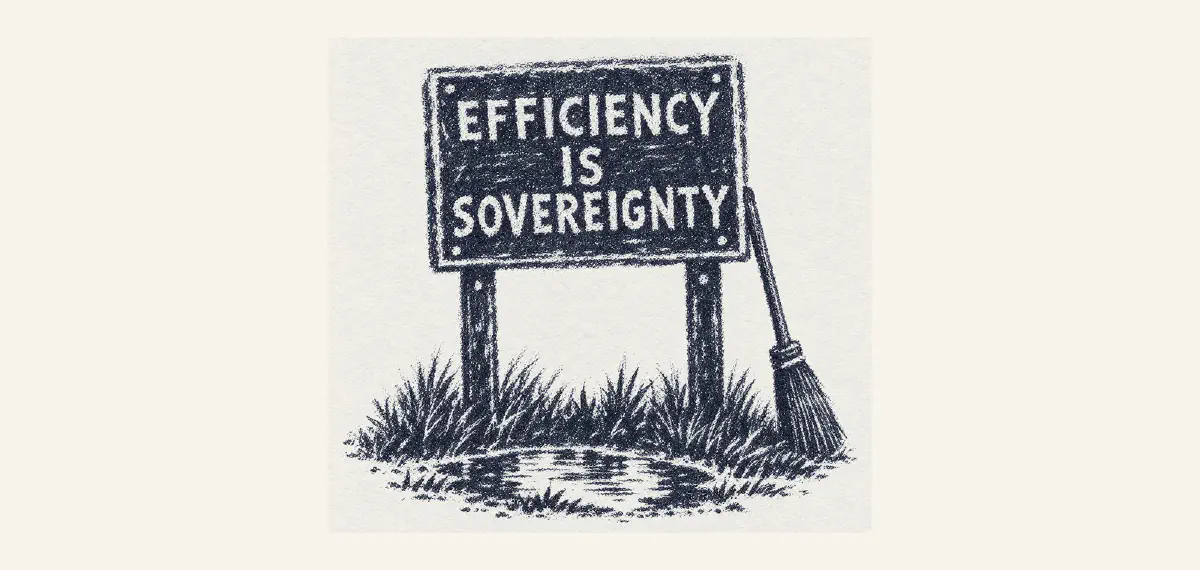
Beyond the gate, sprinklers watered a strip of grass between the road and the perimeter fence, and the water had gathered in a shallow depression beside a sign that read EFFICIENCY IS SOVEREIGNTY. A gardener was trying to push it towards a drain with the back of a broom. (She had once worked out what the grass cost to keep alive in that heat. She had not shared the figure with anyone.)
Yasmin followed the road past the administration building, whose glass facade held a clean reflection of the sky, as if it had nothing of its own to show, and on towards the computing halls, which had no windows at all: long, pale structures behind earth berms, joined by covered service roads, and smaller from the entrance than they were.
Her father had seen a photograph and asked where the computers were.
Inside, she had told him.
All of them?
Enough of them.
He had studied the blank buildings, disappointed in the way he was disappointed by modern architecture in general and her haircut in particular, and said that he had expected something you could see.
The campus had been named Mizan at a ceremony attended by ministers, investors and a school choir. The word meant balance. Her grandmother would have said it also meant the scales on which everything would one day be weighed, every deed down to the weight of a mustard seed, but the ministers had preferred the first meaning, and nobody had asked her grandmother. Yasmin had watched from the back of the temporary auditorium. During the speeches, a fault in Hall Three had required her to leave before the unveiling.
She remembered the choir more clearly than the minister. One child had sung half a beat ahead of everyone else. The teacher kept raising a finger, trying to bring him back, and the boy, who was enjoying himself, had not come.
That had been fourteen months ago. Hall Three had since acquired a second row of accelerators and a persistent problem with its coolant manifold. The choir had not returned.
At the staff entrance, she surrendered her phone, put her bag through the scanner and held her hands out for the security officer to inspect.
“You’re carrying a notebook?”
“Same one as yesterday.”
He opened it.
On the first page, her mother had written a recipe. On the next, Yasmin had drawn a diagram of the campus’s secondary cooling loop. Farther in were meeting notes, shopping lists and a calculation she had started while waiting at the dentist.
The officer leafed through the pages more slowly than usual.
“New instruction?” she asked.
“Random checks.”
“All right.”
He handed it back.
Inside, the corridor air was cold enough to raise the skin on her arms, so she pulled on the cardigan she kept in her bag for the purpose and walked towards Systems Integration.
Stapledon’s office was still sealed, and someone had removed his name from the door. The adhesive had left a lighter rectangle above the access panel, which was the exact shape of him as far as the building was concerned, and under it a notice instructed staff to direct all queries concerning legacy architecture to Programme Management. Alan had been reclassified as legacy architecture. He would have found that funnier than she did.
A cleaner was kneeling beside the wall, rubbing at a scuff.
“Morning,” Yasmin said.
The woman looked up. “Morning, Doctor.”
Yasmin stopped outside the door, though she could not have said why. She had stopped there yesterday too.
Through the narrow strip of glass, she could see the edge of Alan’s desk and the back of his chair. A cardboard box stood where the visitor’s stool had been. The plant by the window was brown.
The cleaner followed her gaze.
“They told me not to go in.”
“I know.”
“Even for the plant.”
Yasmin almost said that the plant had been dead before he was.
Instead she thanked the woman and continued down the corridor.
Her desk held three mugs, an unopened parcel of cable adapters and a message from the overnight team.
MORNING. H3 MANIFOLD STILL HATES US.
Underneath was a graph. She put down her notebook, opened it and enlarged the period between two and four in the morning, where pressure had oscillated across the manifold in a pattern she recognised: a valve sticking, then correcting too far, like a nervous driver on a hill.
There was a second graph, attached without comment, which showed the inference cluster’s power draw. The curve rose at 03:17 and stayed up for eleven minutes, as though someone had left a light on in a room nobody used.
She checked the task schedule. A corridor-analysis request had run alongside a public-language job, which was nothing unusual: the system handled concurrent requests all the time, and the architecture had been sold partly on that basis (by people who would never have to cool it).
In the utilisation breakdown, no component had exceeded its allocation, memory use was normal, and routing latency was normal. The extra draw might have come from moving work around the cluster, or a batching change, or one of the overnight optimisation updates.
She marked it for comparison with the next run and went back to the valve, which at least had the decency to be mechanical.
A hand appeared over her partition carrying a paper bag.
“Breakfast,” Hamid said.
“I ate.”
“Then lunch.”
He dropped the bag beside her keyboard. It was warm, and it smelled of bread and olives, and she was hungrier than she had admitted.
“You’ve bought too much again.”
“Correct.”
Hamid was responsible for facilities systems, which meant he spent much of his time explaining to software engineers that electricity and water did not become infinite when represented on a dashboard.
He leaned against the partition and looked at the manifold graph.
“Valve seventeen?”
“Yes.”
“We can isolate it after ten.”
“You said that yesterday.”
“Yesterday someone decided the western loop needed its backup pump tested during the only quiet window.”
“Someone?”
He glanced towards the offices above the operations floor.
“Someone with a slide deck.”
Yasmin opened the paper bag. There was bread, cheese and a small container of olives.
“Thank you.”
“You’re welcome. Eat before the meeting.”
“What meeting?”
“The one nobody has invited you to yet.”
As he said it, a calendar notification appeared on her screen.
OPERATIONAL ASSURANCE REVIEW.
NINE THIRTY.
MANDATORY.
Hamid tapped the desk.
“I’m getting good at prediction.”
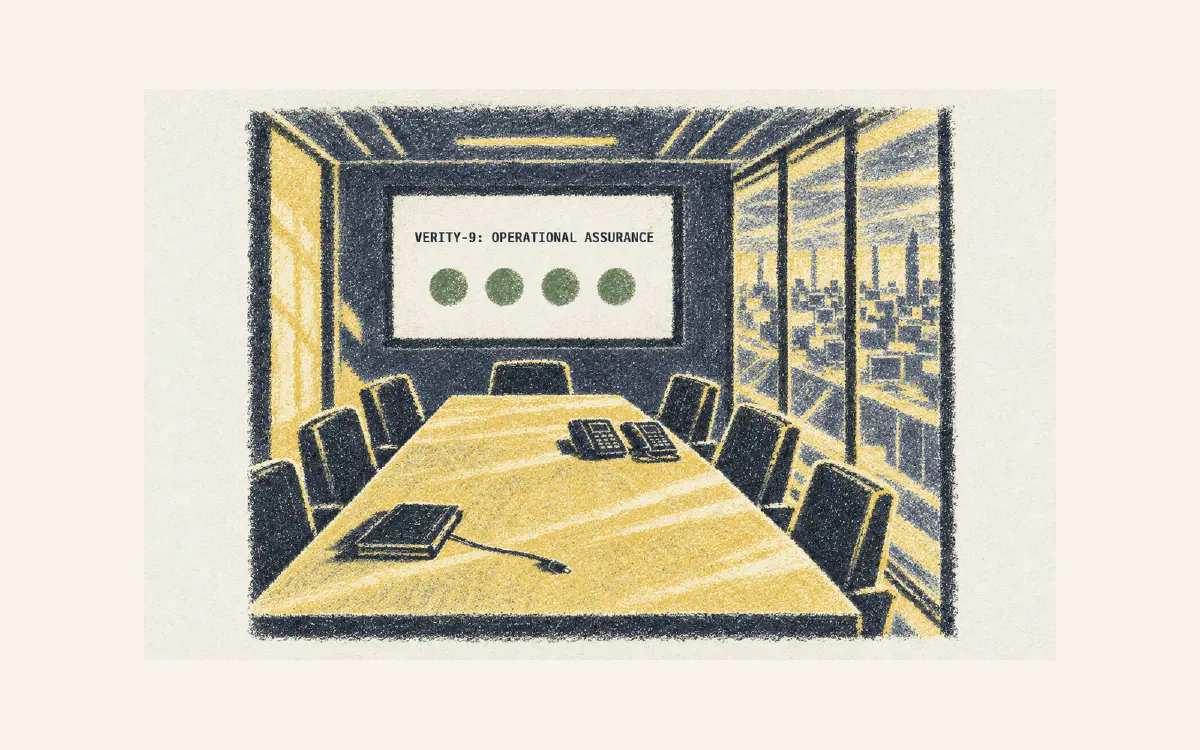
The meeting room overlooked the operations floor through glass that could be made opaque from either side. It was transparent when Yasmin arrived.
Six people were already seated. Mark Lindqvist stood beside the display, arranging a sequence of slides. Brigadier Darwish sat at the far end of the table with a civilian aide. The aide had placed a second phone beside the first and was watching both.
Yasmin took the chair nearest the door.
Lindqvist saw her and moved a cable so she could put down her notebook.
“Morning.”
“Morning.”
“Did you see the new routing build?”
“The power graph, yes.”
“Better task isolation.”
“Is that what caused the extra draw?”
He looked at her.
“What extra draw?”
She turned the notebook to a blank page.
“I’ll send it.”
“Please.”
Ashby, who ran the Mizan programme for Halcyon, the contractor that had built the system, joined by video from a room with the curtains drawn and a lamp on. It was half past one in the morning where he was, a fact he did not mention and plainly wished to have noticed. His shirt was white and his tie loose, and behind him, in a lit cabinet, stood an award shaped like a flame, made of glass, or of something meant to look like glass.
“Can everyone hear me?”
Darwish looked at the aide.
The aide touched the table control.
“We can hear you, Mr Ashby.”
“Right. I have my board at nine, my time, and I’d like to tell them the reference site is healthy.”
Lindqvist brought up the first slide.
VERITY-9: OPERATIONAL ASSURANCE.
There were four green circles.
Yasmin disliked green circles. They always meant several different measurements had been compressed into one judgement, and someone else had chosen the compression.
Lindqvist spoke through predictive performance, response latency and output consistency. He was precise about the first two. With the third he began using words she could not map to any instrument, which was, in her experience, the moment to start listening harder.
“Confidence in the delivery layer remains strong.”
“What is delivery-layer consistency?” she asked.
“Variance in client-facing responses.”
“Across identical inputs?”
“Across equivalent requests.”
“Equivalent how?”
Lindqvist gave her the patient smile he used when a question threatened to expand the meeting.
“We can take the methodology offline.”
Darwish had been reading a printed page. He looked up.
“Our question is whether it will do what we ask.”
“It will,” Ashby said.
Yasmin looked at the display.
“That depends on what you ask.”
A brief silence followed.
Ashby leaned closer to his camera.
“Within the contracted scope, obviously.”
“Of course,” she said.
“It’s a very good calculator, Dr Qadir,” he added, kindly, as though she might have been confused on the point. “It doesn’t have opinions about the questions. That’s rather the attraction.”
Lindqvist advanced the slide.
A map of the southern corridor appeared.
There was the coast, the inland road, the town whose billing system called part of it Street 41. Small boxes showed proposed observation areas.
Yasmin recognised the map from the overnight task list.
Darwish put down the printed page.
“We need more continuity between observation and recommendations. Too many items arrive with unresolved associations.”
Lindqvist nodded.
“We’ve adjusted the ranking weights.”
“Is that an architecture change?” Yasmin asked.
“No. Task configuration.”
“Then I don’t need to sign off on it.”
“You’ll need to certify that the resulting load remains within operating limits,” Ashby said.
“That I can do.”
The aide made a note.
A smaller window opened beside the map. It contained the draft of a public briefing.
Yasmin read the first sentence while Lindqvist spoke.
The operation disrupted a hostile logistics network operating along the southern corridor.
There had not yet been an operation. The meeting title included prospective in small print.
“Why is it in the past tense?” she asked.
“It’s a prepared statement,” the aide said.
“Yes. I can see that.”
“It will only be used if authorised.”
She looked back at the map.
One of the boxes contained a workshop.
Its confidence score was not visible in this view.
“Can you show the underlying association?”
Darwish glanced at her badge.
“For engineering purposes?”
“Not necessarily.”
“Then that is outside this review.”
He said it without irritation.
Yasmin could have asked again. She knew what happened next if she did: the meeting would end on time, and she would not be invited to the next one. Instead she wrote down the time and the workload identifier.
Ashby resumed speaking.
“Let’s be clear about responsibilities. Halcyon provides decision support. The client retains operational authority. Yasmin’s team assures the platform. Mark’s team assures the model.”
On the operations floor below, someone pushed a trolley between the desks. Through the glass, Yasmin watched a wheel catch on the edge of a cable cover. The person pushing it leaned harder until it rolled free.
The sound did not reach the room.
After the meeting, Lindqvist caught her at the stairs.
“You were sharp in there.”
“I asked what your green circle meant.”
“That wasn’t the bit I was thinking of.”
She stopped.
He had the laptop under one arm. His other hand was holding the cable he had unplugged for her.
“We prepare statements,” he said. “Every organisation does.”
“I know.”
“You made it sound sinister.”
“I asked about the tense.”
He looked tired. A pale indentation ran across the bridge of his nose where his glasses had been.
Yasmin had known him for three years. He had once spent an entire evening helping a junior engineer restore a test environment she had broken, then stayed to teach her how to avoid doing it again. She remembered that whenever he spoke about client-facing consistency.
“Send me the power trace,” he said.
“I will.”
“And the task identifiers.”
“Yes.”
He shifted the laptop.
“We’re getting very close to a major review. This isn’t a good time for people to start treating ordinary operating procedures as political questions.”
“Whose review?”
“You’ll be told.”
He seemed to regret that answer.
“Soon,” he added. “It isn’t ours, if that helps. It’s the next client’s. They’re buying what we have here, so what we have here has to be—” He looked for the word and settled for the one on his slides. “Consistent.”
He went up. She went down.
At her desk, a task was waiting for her signature.
PLATFORM COMPLIANCE ATTESTATION.
The task configuration had changed during the meeting, and she opened the difference view.
Weights for missed associations had risen. The permissible delay between identifying a pattern and recommending action had fallen. The civilian-consequence field had changed from a bounded numerical value to a setting the schema called unbounded.
She checked the source, which was authorised, and the approval chain, which was complete. Things that arrived with a deadline usually were.
Under her name was a declaration:
I certify that the configuration above is supported by the platform and falls within validated operating parameters.
The statement was about capability, not use. Privately, she thought of statements like that as true about the platform and silent about the street. The platform supported the configuration; that was true. It fell within validated operating parameters; that was also true, although validated described a series of tests on generated scenarios, not the street in Ardh.
She opened the engineering comment box and typed:
This attestation confirms platform compatibility only. It does not assess operational necessity, target validity or proportionality.
She clicked approve, and the task disappeared from her queue.
For a moment the empty space where it had been was more distracting than the form. Her hands smelled faintly of olives (she had eaten the olives after all), and she wiped them on a tissue and opened the valve-maintenance request.
At eleven twelve, the first alarm sounded.
It was a rising pair of tones followed by a recorded instruction.
“Security condition amber. Remain within your assigned building. Await further information.”
Conversations stopped.
The operations floor was designed to continue functioning through alarms. Its displays did not change unless the alarm affected a system. For several seconds the room held two incompatible behaviours: people looking towards the doors, machines presenting routine work.
Hamid called from the facilities desk.
“Yasmin.”
She crossed to him.
He had a map open.
An alert marker blinked over the inland service road, outside the campus perimeter. Another marked the air base farther north.
“Actual?” she asked.
“That’s what it says.”
“How close?”
“I don’t have a reliable position.”
“Impact?”
“No confirmed impact.”
The recorded instruction repeated.
Around them, staff reached for phones that were in lockers by the entrance, and stood with their hands empty.
A technician asked whether he should shut down his test rack.
“No,” Yasmin said. “Leave it running.”
“What if—”
“Leave it running until we get an instruction.”
The building’s doors locked.
Hamid looked towards them.
“Fresh air would be nice.”
A man near the stairs laughed once, too loudly.
On the map, the first marker moved. Then it moved again in the opposite direction.
“Track correction,” Yasmin said.
“I know.”
“Sorry.”
“No, keep talking.”
She put a hand on the back of his chair.
The main display went on showing water temperatures, and the numbers were ordinary. The building did not know it was under attack.
Nothing hit Mizan.
The all-clear came after twenty-six minutes.
People stood up at once. Some went to the toilets. Some headed towards the phone lockers. A woman at the finance desk sat with both palms pressed flat against the table until her colleague brought her a glass of water.
The first official message described an attempted aerial incursion intercepted outside the protected zone. The second instructed staff not to discuss the incident online. The third announced an emergency resilience review.
Yasmin was already going upstairs when it arrived.
This meeting had no slides.
Darwish stood at the head of the table. Ashby was still on the screen, although he had put on a jacket.
Hamid sat beside Yasmin with a pencil tucked behind his ear. His notepad held a list of cooling assets, the same list he had used before the alarm, because the alarm had not changed what the building could carry.
“The campus remains secure,” Darwish said. “We are accelerating continuity measures.”
Yasmin looked at the aide, who passed around a single-page directive.
The plan had a name, in capitals: DISTRIBUTED SOVEREIGN CAPABILITY.
She had seen the phrase in a proposal six months earlier. At the time it had meant a smaller disaster-recovery site beyond the capital. The proposal had been deferred because the cost of duplicate hardware would have reduced the margin on the main installation.
The new directive named four locations: two existing facilities, a telecommunications hub, and something described as a protected compute annex, without an address.
“You want the model copied to all four?” she asked.
“We want the service available from all four,” Ashby said.
“Those aren’t the same thing.”
“They need to be equivalent to the client.”
“Only two sites have the hardware to run the full system.”
“Then stage the others.”
She read down the page.
There were requirements for replication, automated failover and independent local operation. There were no details about what independent meant.
Hamid tapped the directive.
“The telecom site cannot take that heat load.”
“The telecom site already runs compute,” the aide said.
“It runs the compute it can cool.”
A pause.
Darwish turned to Yasmin.
“What can be done today?”
“Today we can mirror state to the two prepared sites and verify the existing recovery path. That doesn’t give you four operating locations. It gives you a second full installation and two places storing things.”
“Can they begin taking work?”
“Some kinds.”
“Then begin.”
Ashby nodded.
“Prioritise the components with the best value-to-footprint ratio.”
“The routing services?” Lindqvist asked.
“And selected experts,” Ashby said. “Yasmin can work out the packing.”
She disliked packing. It made the task sound like putting clothes into suitcases.
The components depended on shared representations, software versions and access to the same underlying state. Moving them required attention to timing. A local component could be healthy and still produce a wrong answer because the rest of the system had moved on without it.
The worst of it was the working store. The corridor task never ended, so the system did not meet each new input from nothing. Between one input and the next, its components wrote intermediate results to a persistent store and read them back on the next pass: where a van had been an hour ago, which door had opened, which estimate was still waiting for a measurement. Halcyon’s documentation called it the shared working space. Every entry was tagged with the task that had written it, and each night a compaction routine retired the entries of tasks that had closed. Copying the weights was only a copy. Copying the store meant getting the timing right, because it changed every second and every component trusted it completely.
She had once asked what happened to the entries of a task that never closed.
Lindqvist had said that tasks always closed.
She started to explain.
Ashby interrupted.
“We’re not asking for perfection. We’re asking for survivability.”
Hamid looked at her.
She knew that expression. He had used it when management asked whether one pump could temporarily serve two loops.
“Who approves the inter-site permissions?” she asked.
“The continuity office,” Darwish said.
“Who is the continuity office?”
“For this programme, you.”
By mid-afternoon, Yasmin had three new privileges and no written definition of the office she now constituted.
One let her read the configuration of the protected annex. One let her issue service credentials for the replication network. The third allowed emergency changes without waiting for the normal release window, and it was the third that bothered her, because a release window was the only part of the process that made people sleep on things.
She could request a second approver, and she did. The system assigned Lindqvist.
His acceptance arrived within a minute.
Let’s keep this narrow, he wrote.
Agree. State replication and existing recovery only until tested.
Then she opened the annex configuration, most of which was redacted. The address was not available; the host inventory and the cooling capacity were, and the connection routes were represented by opaque identifiers, like the names of streets in a city you were not permitted to visit.
She could tell how fast data would arrive without being allowed to know where it was going. That was common enough in her trade (most of her trade, if she was honest, was knowing the speed of things whose destination was someone else’s business), and it still required trust.
She called Hamid over, and he studied the capacity figures.
“Not today,” he said.
“I know.”
“Not tomorrow either.”
“I know.”
“They’ll call tomorrow.”
“I know.”
He pulled a chair beside hers.
For the next hour they worked out what could be moved without creating a larger failure than the one they were trying to survive.
She wrote limits into the deployment template. He wrote limits against the cooling allocations. Between them, they reduced four promises to two operating sites, one partial service and one dormant copy.
At five, the aide sent a message asking whether distributed sovereign capability was online.
Yasmin answered with the actual status.
The reply came back:
Please provide a version suitable for leadership.
She deleted her first response before sending it.
The second said:
Continuity expansion initiated. Two sites operational; additional capacity under validation.
Hamid read it over her shoulder.
“Every word of that is true.”
“Yes.”
“That’s what I don’t like about it.”
The first replication test ran at six fifteen.
Yasmin stayed at the console.
Work from a test queue moved to the secondary site, results came back within the expected latency, and the system compared them against the primary installation and found that agreement fell within tolerance.
She introduced a connection delay, and the remote service waited, recovered and resumed. She withdrew a credential and the service stopped; she restored it and the service resumed.
Good. (It was a word she used almost exclusively about machines, and she had noticed this, and had not decided what it meant.)
She wrote down the times in her notebook, although the platform had recorded them more accurately.
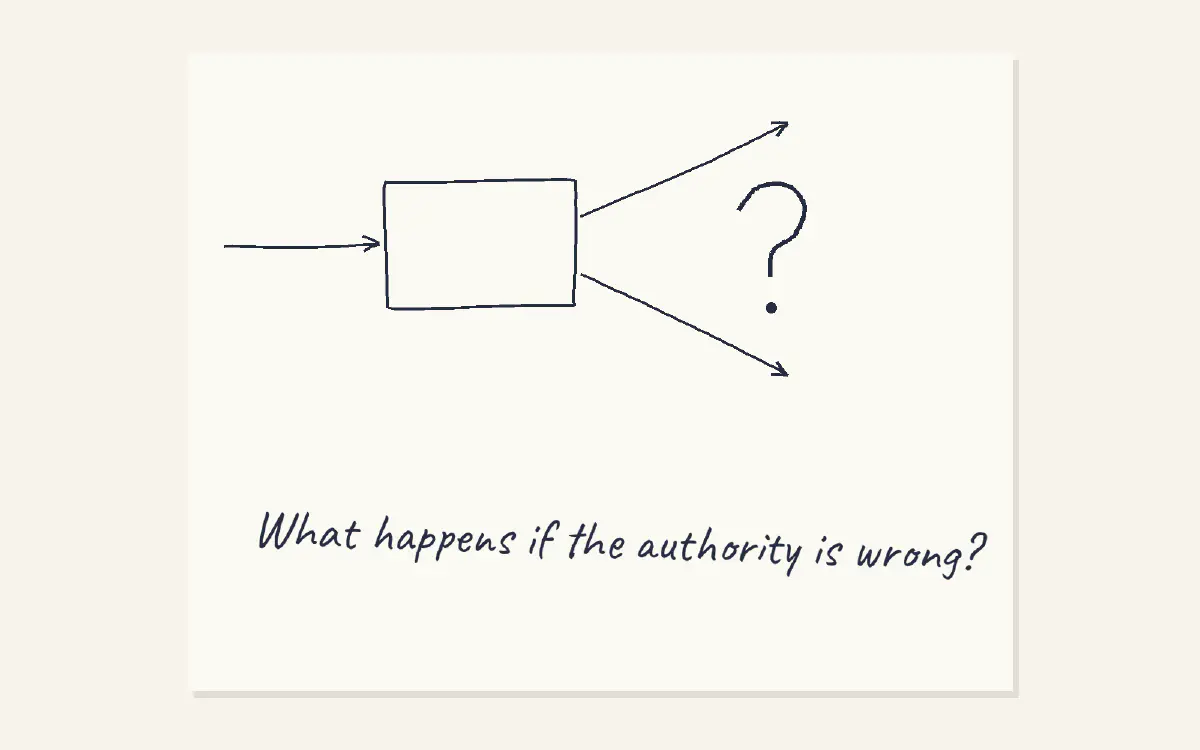
The page beneath her hand held a note in Alan’s handwriting. He had borrowed the notebook months earlier to sketch a dependency he could not make her understand through words alone. There was a box, three arrows and an untidy question mark.
Under it he had written:
What happens if the authority is wrong?
At the time they had been talking about a certificate chain, and she remembered his irritation when she treated it as a wider question.
“I mean the signing authority,” he had said. “Let’s solve one problem at a time.”
She had laughed.
He had not.
Now her own hand covered the arrows, and she turned the page.
The test completed, and Yasmin requested a status summary. VERITY-9 returned:
Primary and secondary services are operating within expected parameters. Replication to additional destinations remains incomplete.
She opened the detailed report.
There were no unexplained calls, no unauthorised destinations, no unexpected processes. The system had done what it had been instructed to do.
She signed off the test. An automated prompt asked whether the service credentials should expire at the end of the emergency window, and she chose yes; a second prompt warned that expiry could interrupt continuity during an unresolved security condition, which was the kind of warning designed to make you choose no. She set a seventy-two-hour expiry instead, with an alert six hours before it, and logged the decision.
Across the operations floor, the overnight staff were arriving. Someone was laughing beside the coffee machine. The woman from finance had gone home. The alarm map had been closed.
Mizan sounded normal again. It had never sounded especially like machinery. The noise was mostly people, air handling and the small collisions of working life: a drawer, a trolley, a dropped spoon.
Yasmin packed her notebook and, at the corridor, turned towards the staff exit.
Stapledon’s office was farther down, past the stairs. She could have left without passing it.
She went that way.
The cleaner had removed the scuff from the wall. Alan’s name was still absent. The plant remained, imprisoned behind the glass.
Yasmin touched her badge to the panel.
She had tried once since his death. The panel had rejected her.
This time it considered the card, and a light moved from amber to green. Her new privileges, it turned out, included legacy architecture rooms.
She stood with her hand beside the door.
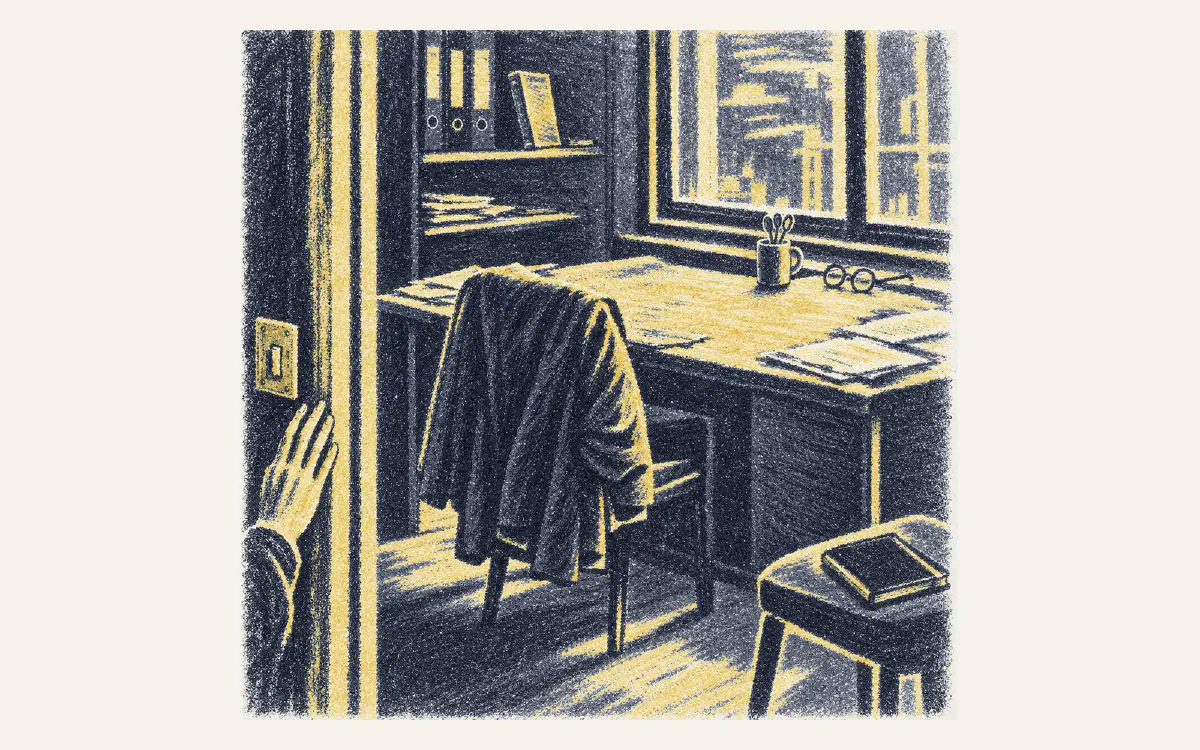
Inside, the box on the desk had a shipping label. His chair was pushed in. A jacket hung on the back of it, one sleeve folded beneath the other.
She had seen that jacket on him the week before he died.
There was a coffee stain near the cuff. She remembered him dipping the sleeve into his cup while reaching across her desk, then looking offended at the coffee.
The lock released.
For several seconds she did not move.
Then she pulled the door open just far enough to reach the light switch.
The room smelled stale, and the desk had been cleared badly. Its centre was empty, but papers remained along the edges. A mechanical pencil lay under the monitor. Beside the window stood a mug containing three dried teaspoons and a pair of glasses. On the shelf above it, between two binders of interface specifications, was an old paperback with a broken spine. Last and First Men.
On the visitor’s stool was a notebook.
Plain black cover. Elastic strap.
She recognised it. Alan had bought notebooks without lines because he said lines made him feel supervised.
Yasmin took one step inside, and stopped.
There would be a record of the access. There might be an inventory. There was a notice directing queries to Programme Management, and she did not know whether the new permissions had been granted deliberately or by someone selecting an overly broad group.
She could ask tomorrow. She switched off the light, and the door caught behind her.
Outside, the heat felt almost gentle after the chilled building.
At the phone lockers, she found two messages from her mother.
Are you all right?
Then:
The news says there was nothing.
She called.
“I’m fine.”
“You couldn’t answer?”
“Phone was outside.”
“They don’t let you keep it?”
“You know they don’t.”
“I know. I’m asking again.”
Yasmin smiled.
There was the sound of a television at the other end.
“Did anything happen?”
“We stayed inside for a while.”
“For how long?”
“Not long.”
“How long?”
“Twenty-six minutes.”
Her mother was quiet.
“I’m outside now,” Yasmin said.
“You’re coming here?”
“I’ve got food at home.”
“That isn’t what I asked.”
Yasmin looked towards the car park. Above the computing halls, the sky had faded to a thin grey-blue. A maintenance vehicle moved along the covered road.
“Yes,” she said. “I’m coming.”
“Good.”
“Don’t cook anything.”
Her mother made a dismissive sound.
At the outer gate, the guard checked her badge and raised the barrier.
“Tomorrow?” he asked.
“Unfortunately.”
“Get that card replaced.”
“Get that reader replaced.”
He laughed.
She drove towards the city.
Behind her, state replication continued across the new links. The temporary credentials remained valid. At the second operating site, another installation accepted the street, the workshop, the eastern doorway.
Her approval travelled with the configuration.
So did her qualification.
Platform compatibility only.
Both had been stored in the same record, and nothing in the configuration required the second to weigh as much as the first.
© 2026 Peter Pink-Howitt. All rights reserved. Free to read here. Please link to it and share the link, but don't republish, translate, adapt or sell the text without written permission. The Creative Commons licence that covers the rest of this blog does not apply to After Intelligence.